Across the Atlantic
They crossed an ocean for a future they would never fully see.
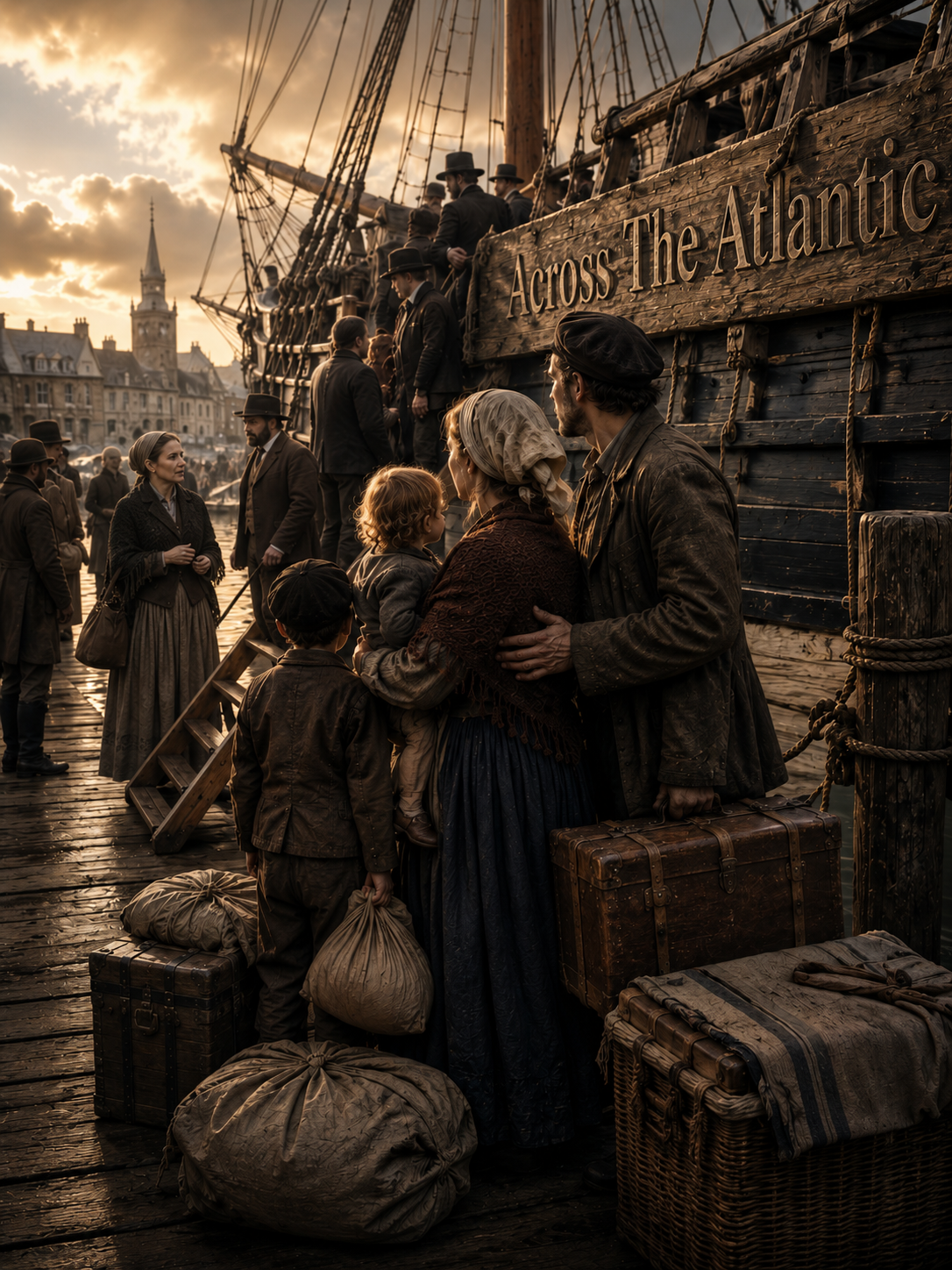
The Final Decision
There comes a moment when uncertainty becomes a decision.
For many families, that moment must have been almost unbearable. Should they stay where life was known but limited, or leave for a future no one could promise? The choice was not made with comfort, certainty, or romance. It was made under pressure, in fear, in prayer, in argument, in silence, and in hope.
To stay meant remaining inside the world they understood: familiar roads, familiar faces, familiar graves, familiar customs, and familiar limits. To leave meant stepping away from all of it. If they stayed, they might wonder what life could have been. If they left, they might lose everything and never return.
Selling One Life To Chase Another
To leave meant reducing one life in order to reach for another.
Possessions were narrowed down to what could be carried. Homes were left behind. Tools, blankets, clothing, family objects, and small reminders of the old life had to be chosen carefully. Some things were sold. Some were given away. Some were abandoned because there was simply no room.
That kind of leaving reaches deeper than travel. People were not merely packing for a journey. They were deciding what parts of their former life could survive the crossing. A cooking pot might represent a mother's care. A tool might represent a father's labor. A Bible, prayer book, letter, or family token might carry memory itself.
They were not just bringing supplies.
They were carrying proof that they had belonged somewhere before they stepped into the unknown.
The Walk To The Harbor
The walk to the harbor must have felt like walking between two lives.
Behind them was everything known. Ahead of them was water, distance, danger, and possibility. Crowded docks, creaking wagons, crying children, shouted instructions, whispered prayers, final embraces, and long silences filled the air. Everyone standing there was caught between terror and hope.
A harbor is usually full of motion, but for families leaving forever, every sound would have carried weight: the slap of water against wood, the smell of tar and rope, the groan of ships, the calls of sailors, the press of strangers, and the sight of the open sea.
What had once been discussed around a table or whispered beside a fire now stood before them in wood, sail, water, and distance.
The Last Look Back
Before stepping aboard, many must have looked back.
That last look may have held an entire lifetime: a street walked since childhood, a church bell heard for years, a parent too old to travel, a friend standing on shore, a grave that would never be visited again, a village, a field, a shop, a doorway, a corner of the world that had shaped them.
Modern people can underestimate the pain of that moment because distance has become easier for us. We can cross oceans quickly. We can send messages instantly. We can see faces across the world. They could not.
For many of them, leaving meant true separation. The ocean did not feel like an inconvenience.
It felt like a wall.
When the shoreline disappeared, part of their former life disappeared with it.
Stepping Onto The Ships
Then came the moment of no return.
Feet stepped onto wooden decks. Hands held children close. Families found their places among strangers. Voices from shore began to fade. The shoreline slowly pulled away. What had been a debate inside the heart became reality before their eyes.
The ships were not symbols to them. They were cramped, uncertain, dangerous vessels carrying human fear and human hope. The deck beneath their feet did not guarantee a future. It only carried them away from the past.
Once the ship moved, the decision could no longer be undone.
The old world was behind them.
The new one was still only an idea somewhere beyond the horizon.
Why They Still Went
They went because hope can be stronger than fear.
They believed opportunity might exist beyond what they had known. They believed freedom was worth risking everything for. They believed their children might inherit something better than what had been handed to them.
They did not go because they were fearless.
They went because hope refused to die.
Courage is not the absence of fear. Courage often exists because fear is present. These people understood enough of the cost to tremble. They knew the ocean could take them. They knew sickness could spread. They knew hunger, storms, and death were possible.
And still they went, because the future behind them felt too small, and the future ahead still held a chance.
Human Courage Often Looks Ordinary
History is not always moved forward by famous names. Often it is moved by ordinary mothers and fathers, ordinary workers, ordinary believers, and ordinary people making extraordinary choices.
Their courage did not always look dramatic. Sometimes it looked like carrying a child, holding a spouse's hand, standing quietly in line, lifting a trunk, wiping away tears, or stepping onto a ship while the heart was breaking.
That kind of courage deserves remembrance because it built the human foundation beneath the larger story. Before there were colonies, declarations, battles, constitutions, presidents, or monuments, there were people willing to cross water for a future they would never fully see.
Some would not survive. Some would suffer. Some would be disappointed by what they found.
But their willingness to move toward possibility helped open the path later generations would inherit.
Sacrifice becomes easier to honor when we understand it emotionally.
Many freedoms were purchased through uncertainty, loss, and risk. Civilization moves forward because some people are willing to step into the unknown for the sake of those who come after them.
After the decision came the crossing. The Atlantic would test the body, the mind, and the spirit. Storms, sickness, fear, endurance, and hope would all become part of the story.
But before the voyage became an ordeal, it was first an act of human courage.
They had already left the ground of one life behind.
Now the sea would decide how much more the journey would demand.