Building a New Life
Civilization is built slowly by ordinary people willing to work, sacrifice, and build something better for the generations that follow.
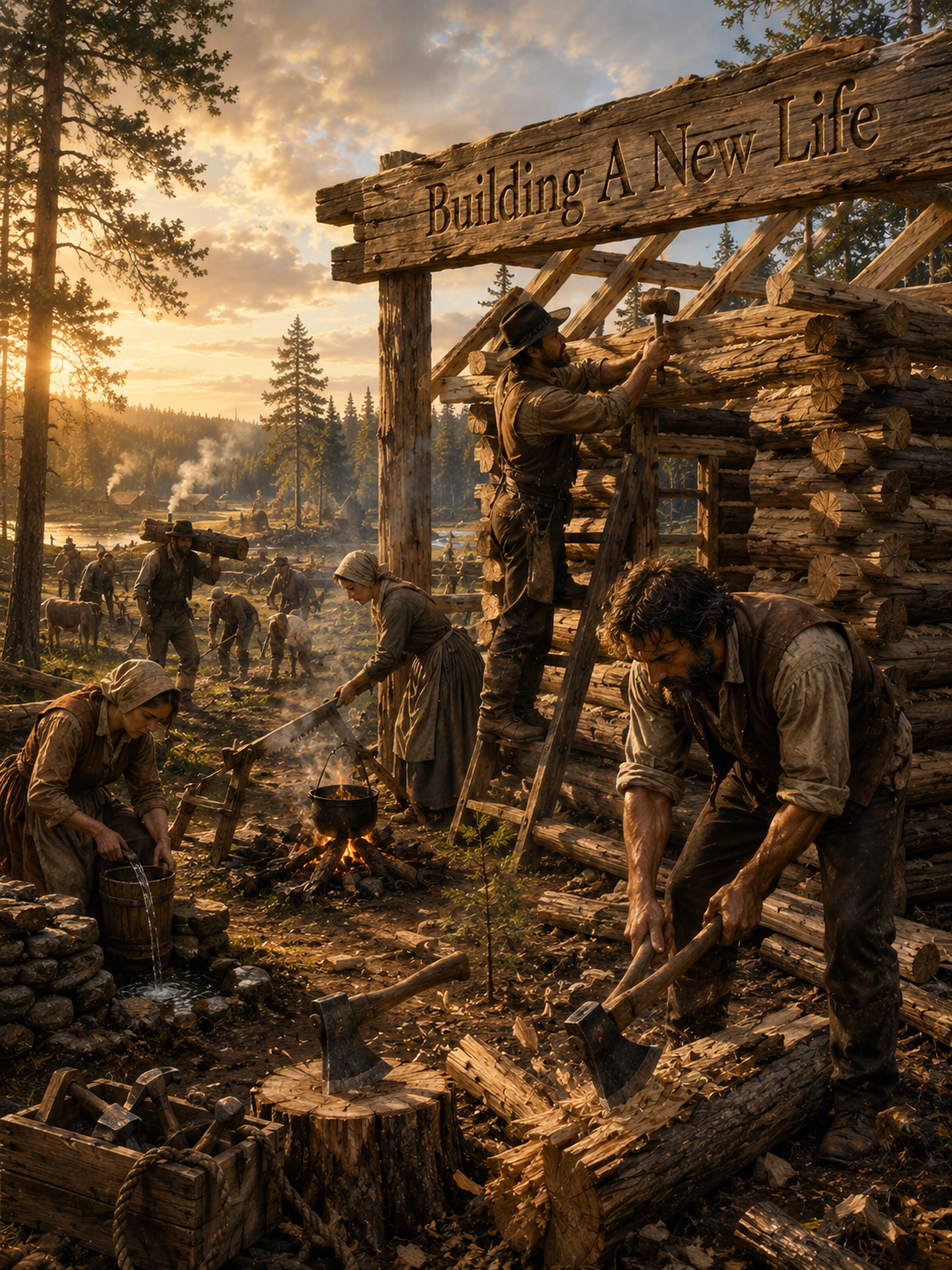
Survival Became Daily Work
After arrival, the dream of a new life quickly became the work of staying alive.
The people who reached the New World could not simply rest in the relief of landfall. Shelter had to be built. Timber had to be cut. Food had to be found, grown, hunted, stored, or protected. Fresh water had to be secured. Fires had to be kept. Tools had to be repaired. Clothing had to be mended. Every day demanded labor.
Survival was not an idea.
It was a schedule.
It was waking early, working through exhaustion, watching the sky, preparing for weather, guarding against hunger, and doing again tomorrow what had barely been finished today. The New World offered possibility, but possibility did not clear land, raise walls, dig wells, or feed families.
Human hands had to do that.
Hope had brought them across the ocean, but work would decide whether hope could become a life.
Nothing Was Easy
Nothing about the beginning was easy.
Tools were primitive. Comfort was limited. Isolation could be frightening. Weather could change plans quickly. Disease could move through a settlement before people understood how to stop it. Food supplies could run low. A hard winter, a failed crop, a poor decision, or a moment of carelessness could carry serious consequences.
It is easy to forget how much daily life once depended on practical judgment.
A weak roof could mean misery. Poorly stored food could mean hunger. Unsafe water could mean sickness. A broken tool could slow the work of an entire family. A bad harvest could threaten a community.
There were no large systems waiting nearby to solve every problem.
Survival depended on preparation, effort, skill, humility, and the willingness to learn quickly from failure.
That kind of life shaped people. It forced them to pay attention. It taught them that freedom was not the same as ease. Freedom gave them room to build, but it also placed responsibility directly into their hands.
Families Became The Foundation
Families became the first foundation of survival.
Parents taught children what had to be known: how to gather, carry, mend, plant, cook, watch, listen, and help. Responsibility began early because life required it. Children learned not only through words, but by watching adults work. They saw fatigue. They saw sacrifice. They saw fear hidden behind courage. They saw that everyone had a part to play.
A family was more than a private household.
It was a working unit.
Labor was shared because survival demanded shared effort. One person alone could do very little. Together, families could build shelter, prepare food, tend animals, clear ground, care for the sick, and protect one another against uncertainty.
The lessons children learned were not abstract. They were lessons of necessity: work matters, preparation matters, patience matters, and people depend on one another.
This is part of the inheritance modern readers should remember. Many freedoms later generations enjoy were built inside homes where people carried heavy responsibilities without expecting applause. The future was being shaped in small daily acts that rarely entered official history.
Communities Began Forming
As families worked to survive, communities began to form.
Neighbors helped neighbors because isolation was dangerous. A barn could not easily be raised alone. A well could not always be dug alone. A harvest could fail if hands were too few. Tools, knowledge, labor, food, and protection were often shared because cooperation was not merely generous. It was practical.
Churches and gathering places became more than buildings.
They became centers of memory, worship, teaching, decision-making, comfort, and connection. In a hard world, people needed places where they could gather, pray, speak, mourn, plan, and remember that they were not alone.
Community did not remove hardship, but it made hardship more bearable.
Civilization began to appear slowly. A path became a road. A cabin became a home. A clearing became a farm. A meeting place became a church. A few families became a settlement.
The work was not glamorous, but it was sacred in its own quiet way.
Human beings were taking uncertainty and shaping it into belonging.
Freedom Required Responsibility
Freedom in the New World carried responsibility with it.
There was no distant system coming to rescue every family from poor preparation, bad judgment, or unavoidable hardship. Survival depended on effort, adaptability, cooperation, and discipline. Independence and responsibility grew together because they had to.
That is one of the great lessons of this period.
Opportunity was real, but it came with hardship attached. A person could begin again, but beginning again required sacrifice. A family might have more room than it had known in the Old World, but room alone did not guarantee success.
Land had to be worked.
Shelter had to be built.
Communities had to be defended, organized, repaired, and sustained.
Freedom without responsibility becomes fragile. Responsibility without hope becomes burden. The early builders of life in the New World lived between the two.
They were not perfect people, and their story was not simple, but they understood something modern comfort can hide: a future worth having must be built and protected by those who inherit the chance to build it.
Ordinary People Built Extraordinary Things
The land changed people.
Hardship increased resilience. Practical knowledge became essential. Patience and endurance became daily virtues. Gratitude deepened when survival was not guaranteed. People learned the value of a warm fire, a sturdy wall, a good neighbor, a healthy child, a successful harvest, and one more day of life.
Ordinary people built extraordinary things, though they may not have thought of them that way.
They built roads, homes, farms, wells, towns, schools, churches, families, habits, and futures. They built the early foundations of civilization from timber, stone, soil, sweat, prayer, cooperation, grief, and hope.
Much of what they built began small, but small things can carry the future when they are repeated faithfully over time.
The beginning of America was not only in famous documents or famous names. It was also in hands hardened by work, in families learning to survive, in neighbors showing up for one another, and in communities forming where wilderness and uncertainty had stood before.
Later generations often inherit systems they did not personally build.
Roads, towns, homes, farms, churches, schools, laws, markets, and communities can feel permanent when we are born into them. But they are not permanent by accident. They survive because people build, repair, protect, and contribute.
Appreciating the effort behind civilization creates gratitude.
Gratitude creates responsibility.
Strong communities require participation, not only consumption. A society weakens when people inherit comfort but forget the labor, sacrifice, cooperation, and self-discipline that made comfort possible.
As settlements took shape, different regions began developing different identities, economies, habits, and cultures. Northern and southern communities would not grow in exactly the same way. Geography, climate, labor, trade, belief, and local necessity would begin shaping different worlds inside one future.
Next, the story follows those differences as the roots of future American culture slowly emerge.