Different Worlds, One Future
Different beginnings slowly shaped a shared future.
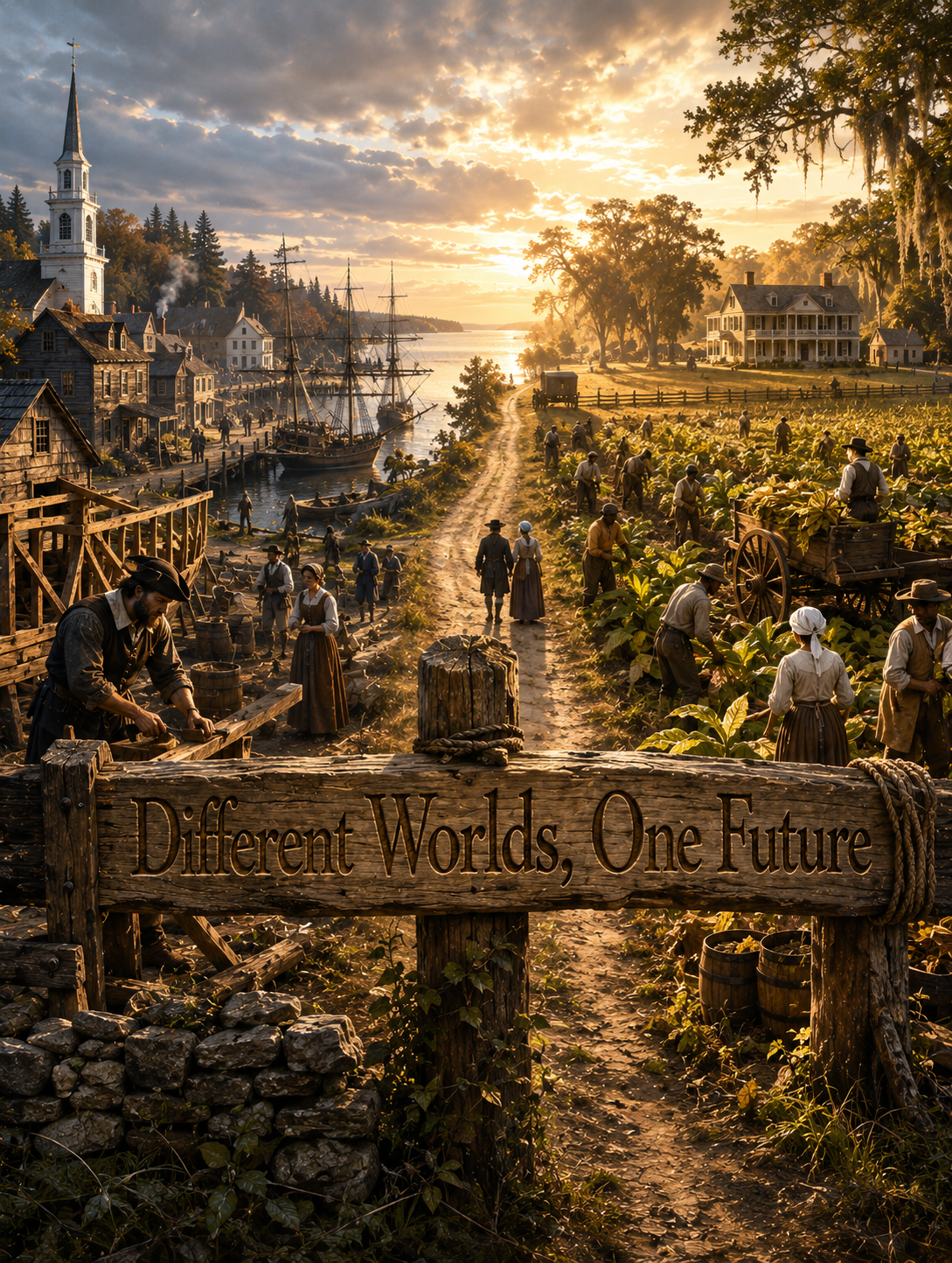
The Colonies Begin To Grow
As the first settlements became more stable, survival slowly began turning into community.
What had once been rough shelters, uncertain food supplies, scattered families, and fragile beginnings started becoming something more permanent. Farms expanded. Ports grew busier. Small towns took shape. Trade developed. Roads, churches, meetinghouses, docks, mills, and markets began connecting people to one another in new ways.
This did not happen quickly or easily.
Every improvement required labor. Every cleared field, raised wall, planted crop, repaired boat, dug well, and shared tool represented human effort. But over time, people began to imagine futures beyond mere survival. Families could think about children, land, trade, worship, inheritance, education, and community life.
The colonies were still small and vulnerable, but roots were beginning to hold.
The Northern Colonies
The northern colonies developed under difficult conditions.
Harsh winters, rocky soil, shorter growing seasons, and coastal geography shaped the way people lived. Large-scale farming was harder in many places, so smaller farms, fishing, shipbuilding, trade, and town life became important. People learned to adapt to the land in practical ways.
Religious belief also strongly shaped many northern communities.
Churches and meetinghouses were not only places of worship. They were centers of order, teaching, discipline, and local identity. Life could be strict, demanding, and deeply communal. Neighbors watched one another because survival and social order were tied together.
The northern colonies grew resilient because they had to.
Cold weather, limited soil, dangerous seas, and hard work shaped a culture that often valued discipline, education, craftsmanship, trade, and local cooperation. Their world was not easy, but it was becoming distinct.
The Southern Colonies
The southern colonies developed differently.
Warmer weather, longer growing seasons, wider stretches of land, and fertile soil encouraged agricultural economies. Tobacco and other cash crops became central to life in many areas. Land, labor, export, and plantation growth began shaping a society unlike the smaller town-centered patterns of much of the North.
That difference carried serious consequences.
Southern prosperity became tied to labor systems, including indentured servitude and, increasingly, the forced labor of enslaved Africans. To tell the story honestly, we cannot treat agricultural growth only as opportunity. It also contained the beginnings of deep moral contradiction and human suffering that would shape America for generations.
The South’s climate and economy produced different lifestyles, priorities, and social structures.
Wealth, land ownership, labor, and crop production became powerful forces. Some families pursued opportunity and independence, while others were trapped inside systems of exploitation and bondage. From the beginning, the American story carried both hope and contradiction.
Different Lives, Different Priorities
Geography shaped culture. Climate shaped work. Religion shaped laws and communities. Economic survival shaped identity.
People adapting to the same continent did not all live the same way, think the same way, worship the same way, or build the same kind of communities.
The northern merchant, the southern planter, the small farmer, the fisherman, the craftsman, the minister, the laborer, the servant, the enslaved person, the mother raising children on the edge of uncertainty, and the neighbor helping raise a roof were all part of the larger story.
Their lives were not equal in power or freedom, and their experiences were not the same. But together, they reveal the complexity of early America.
This matters because the colonies were not born as a finished nation with one clear identity.
They were different worlds growing side by side. Some differences were practical. Some were religious. Some were economic. Some were moral. Some would later create strength. Others would create conflict.
The Importance Of Community
Even with their differences, the colonies shared one powerful need: community.
Survival still required cooperation. Families needed neighbors. Farmers needed tools, labor, and markets. Sailors needed ports. Churches needed congregations. Children needed instruction. Towns needed meeting places. People needed somewhere to gather, worship, trade, settle disagreements, mourn losses, and make decisions.
Community did not mean life was peaceful or fair for everyone.
Human beings brought pride, fear, ambition, prejudice, generosity, faith, courage, selfishness, and hope with them. But communities gave people structure. They created habits of responsibility. They taught people to participate in local life.
They helped ordinary people understand that the future depended not only on individual effort, but on shared duty.
The colonies were slowly becoming places where local decisions mattered. Distance from Europe made daily self-reliance necessary. People could still be loyal to distant authorities, but they were also learning to solve problems close to home.
The Beginning Of An American Identity
In the beginning, many colonists still thought of themselves as English, Dutch, French, German, Scottish, Irish, African, or members of particular religious and cultural communities.
Their loyalties, memories, languages, customs, and identities did not disappear when they crossed the ocean.
But distance changes people.
Hardship changes people.
Responsibility changes people.
Over time, life in the colonies began creating something new. People who lived an ocean away from Europe had to adapt to different land, different dangers, different opportunities, and different local needs. They still carried the Old World within them, but they were no longer living fully inside it.
An American identity did not appear all at once.
It grew slowly through work, conflict, worship, trade, family life, local government, hardship, and shared experience. It grew as people began to understand that their lives were being shaped by this place, this land, these communities, and these responsibilities.
America has always contained different viewpoints, cultures, regions, priorities, hopes, and wounds.
That began early.
The colonies were not identical, and they were not simple. Unity did not require sameness then, and it does not require sameness now. Strong societies are built when people remember shared purpose while still telling the truth about difference, conflict, and human failure.
Future generations inherit both the strengths and the mistakes of those who came before them.
We inherit courage and contradiction, faith and blindness, sacrifice and injustice, community and division. Remembering honestly helps us become wiser stewards of what was handed forward.
As the colonies grew, tension with the British Crown would slowly begin to emerge. Questions of freedom, taxation, authority, distance, loyalty, and self-governance would not arrive all at once. They would grow quietly beneath daily life, until citizens began asking whether they were merely distant subjects of an empire or something new beginning to form across the Atlantic.