Information Is Not Wisdom
A generation raised before screens still remembers the sound of silence.
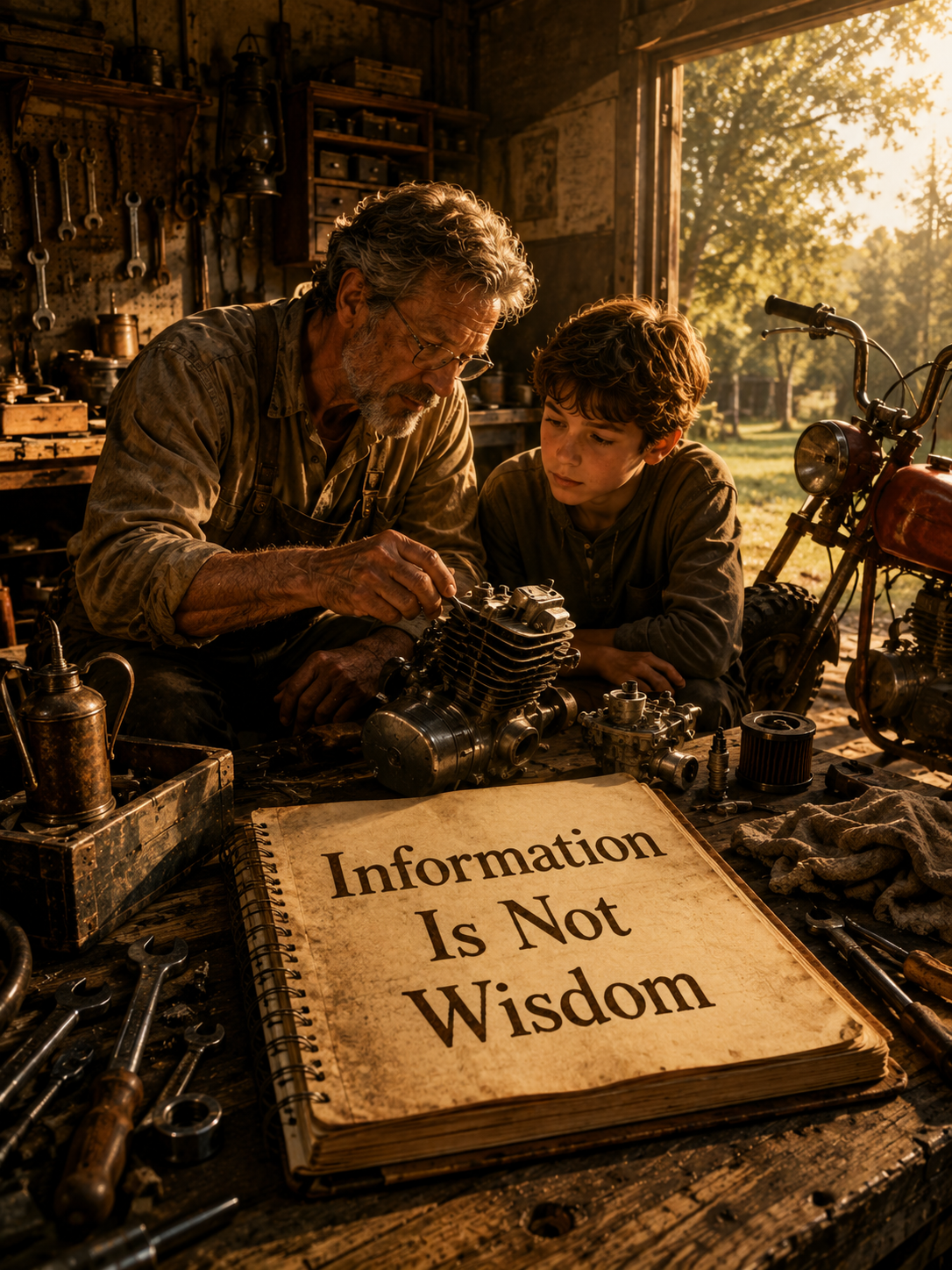
A generation raised before screens still remembers the sound of silence.
The Sound Of Silence
I grew up in a world where silence was not empty. It was where you thought. It was where you learned to listen. It was where you figured things out because there was not always someone standing over you, explaining every step, warning you about every mistake, or rescuing you from every consequence.
When I was young, freedom came early, and so did responsibility.
We rode minibikes. We stayed outside until the streetlights came on. We learned where the limits were because we found them ourselves. We learned that choices had consequences because life had a way of teaching directly. Nobody had to explain every lesson in advance. Some lessons came from scraped knees, broken parts, lost tools, hard work, and the quiet understanding that you would have to do better next time.
That kind of learning stays with a person because it is not only stored in the mind. It becomes part of how you see the world.
There was value in that slower world. Not because it was perfect, and not because every part of it should return, but because it gave people room to become capable. You had time to wonder. You had time to be bored. You had time to make a mistake and think about it. You had time to watch how older people handled problems before you were expected to handle your own.
Silence gave lessons space to settle.
Before Everything Had An Answer
Before technology took over so much of daily life, people had to remember things.
Phone numbers lived in your head. Directions were learned by landmarks. If you were going somewhere unfamiliar, you paid attention. You remembered the gas station on the corner, the bend in the road, the church steeple, the old oak tree, or the house with the white fence. The world asked more of your memory because there was no screen waiting to do all the remembering for you.
Conversations happened face to face. If something broke, you tried to fix it. If you did not know how, you watched somebody who did. A father, a neighbor, an uncle, a grandparent, or a friend down the street could teach more in an afternoon than a set of instructions ever could.
Knowledge moved from person to person, hand to hand, story to story. You learned by watching. You learned by trying. You learned by failing and being told to try again. That was not just information. That was wisdom.
Wisdom often came wrapped in ordinary moments. It came while holding a flashlight for someone repairing an engine. It came while listening to adults talk around a kitchen table. It came while watching someone keep their word, apologize after being wrong, help a neighbor without being asked, or finish a job even when nobody was watching.
No one always stopped to announce the lesson. You absorbed it because you were close enough to see it lived.
The Difference Between Knowing And Understanding
Information can tell you the answer. Wisdom helps you understand what the answer means.
Information can be found in seconds, but wisdom usually takes years. Information can tell you how something works. Wisdom teaches you when to speak, when to wait, when to help, when to stand firm, and when to admit you were wrong.
That is one of the great differences between knowing and understanding.
The modern world gives us more answers than any generation before us could have imagined, but answers alone do not make people wise. A person can know a thousand facts and still not understand patience, sacrifice, responsibility, gratitude, or courage. A person can search history in seconds and still never feel connected to the people who lived it.
History used to help connect those things. It connected children to parents and grandparents. It connected families to the sacrifices that came before them. It reminded people that they were not alone in time. They were part of a long human chain, stretching backward through struggle and forward into responsibility.
When that connection weakens, we risk losing more than old stories. We risk losing self-reliance, patience, community, responsibility, and the ability to understand our own place in the story.
That is why this chapter matters near the beginning of the journey.
Before we walk into the old world, the ocean crossing, the colonies, the Revolution, the Civil War, and the generations that followed, we have to understand the difference between collecting facts and receiving meaning. The facts will matter. The dates will matter. The events will matter. But if we never feel the human meaning underneath them, then history stays flat on the page.
What The Modern World Cannot Replace
This journey is not about wishing everything could go back to the way it was.
Every generation has its blessings and its burdens. The past was not perfect, and the present is not hopeless. Technology has given us tools, speed, convenience, and access to knowledge that earlier generations could hardly have imagined.
But there are still things no machine can hand us fully formed.
People still need courage. People still need patience. People still need responsibility. People still need each other. Every generation still needs to understand that the world it inherits was built by people who came before.
That understanding does not come from information alone. It comes from memory, experience, stories, hardship, gratitude, and the willingness to listen to those who have already walked part of the road.
If younger generations are going to understand where they belong, they need more than facts on a screen. They need to know they are part of something older, deeper, and more meaningful than the moment they are living in. They need to know that people before them struggled, built, failed, repaired, endured, and passed something forward.
They need to know their lives are not disconnected fragments floating in the present.
A person who does not know where they came from can be made to feel rootless very easily. A people who forget their story can be pushed around by every loud voice of the moment. But when memory is alive, it gives people a place to stand. It does not make them perfect. It does not give them every answer. But it reminds them that they belong to something larger than themselves, and that they are responsible for more than their own comfort.
Passing Wisdom Forward
That is why information is not enough.
We need memory. We need experience. We need stories. We need wisdom. Not because the past was perfect, but because the past contains human lessons that can help us live with more humility, gratitude, responsibility, and courage.
The REMEMBRANCE Journey is built on that belief: not merely gathering historical facts, but recovering the meaning inside them. It is a way of slowing down long enough to see the people behind the events, the cost behind the comfort, and the responsibility behind the inheritance.
If we remember that truth, then maybe we can still pass along something worth carrying. Not just information. Not just opinions. Not just quick answers. Something deeper. Something earned. Something human enough to help the next generation understand where they came from, what was handed to them, and why it still matters.
And that is where this journey must continue.
Because when information replaces wisdom, people do not merely forget details. They begin to forget meaning. They begin to forget sacrifice. They begin to forget the human chain that carried them here. And when a people forget long enough, they can lose more than memory. They can lose themselves.