Preparing for a Future No One Wanted
They prayed for peace while quietly preparing for sacrifice.
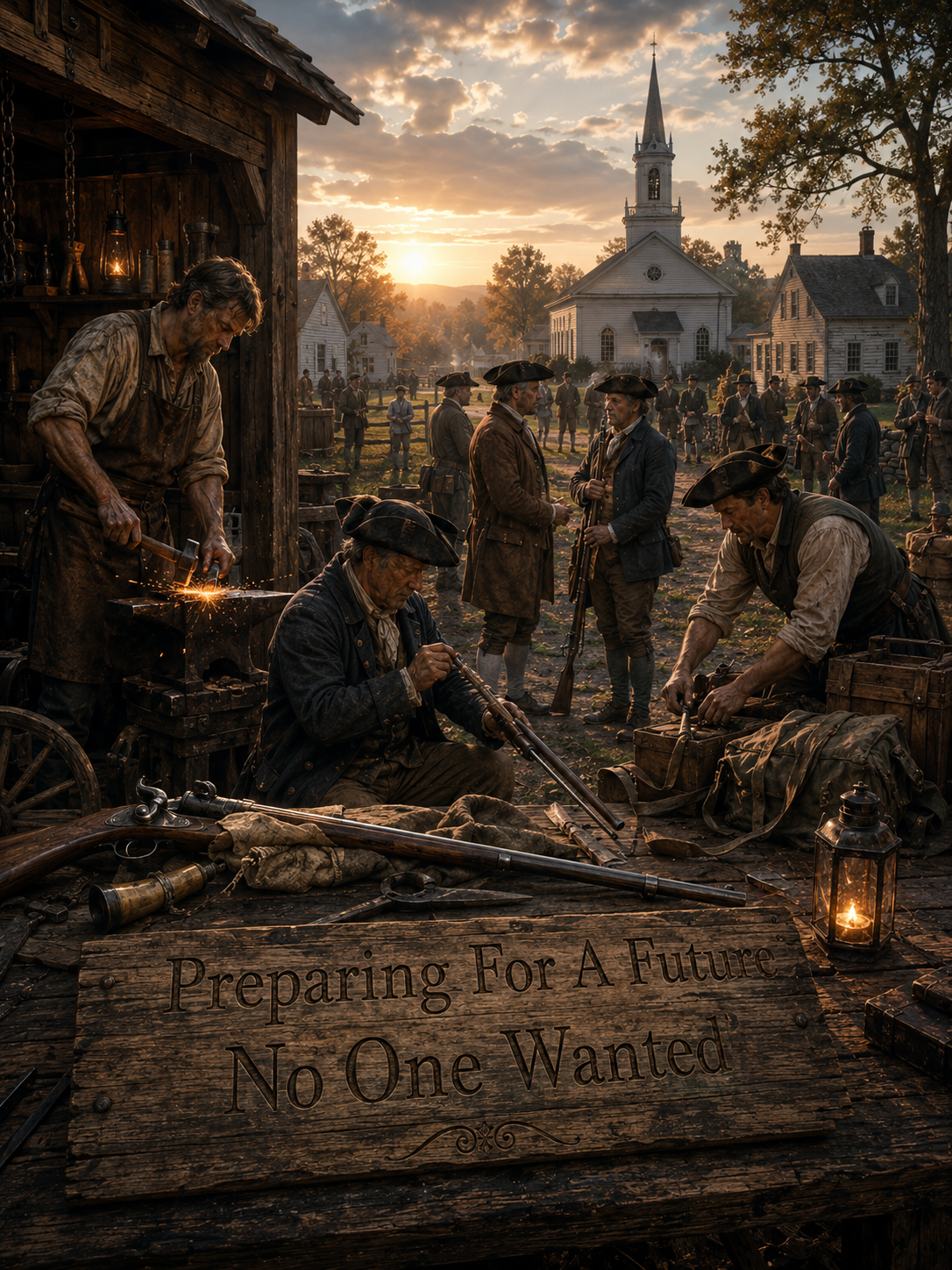
The Colonies Began Preparing
Protecting the future sometimes begins long before the first battle is ever fought.
After the colonies found a stronger shared voice, preparation began spreading through towns and villages. Militias organized. Supplies were gathered. Weapons, ammunition, tools, food, horses, wagons, and communication became increasingly important. Training began among ordinary citizens who had never expected their lives to move toward war.
This was not the preparation of people eager for violence.
Many still hoped conflict could be avoided. But hope does not remove responsibility. Communities understood that if the crisis with Britain continued to worsen, they could not wait until the last moment to become ready.
Preparedness became a quiet form of duty.
It was an admission that peace was still desired, but no longer guaranteed.
The men who gathered were not professional soldiers in the usual sense. They were farmers, blacksmiths, laborers, merchants, fathers, sons, neighbors, and church members.
They were people with ordinary lives standing under extraordinary pressure.
History was asking more of them than most had ever imagined.
Everyday Life Continued
Even as preparation spread, everyday life continued.
Fields still needed tending. Shops still opened. Tools still broke and had to be repaired. Families still cooked meals, mended clothing, cut wood, cared for animals, and tried to hold ordinary routines together. Churches still gathered on Sundays. Neighbors still spoke in the road. Children still grew up inside homes where adults carried worry quietly.
That contrast matters.
History rarely stops ordinary life before changing it. More often, history moves underneath it. People continue doing what must be done while sensing that the world around them is becoming less certain.
A man might spend the morning working his field and the evening training with a militia. A blacksmith might repair a plow one hour and handle a musket the next. A mother might prepare food while listening to rumors about British movements.
Life outwardly appeared normal in many places, but beneath the surface, people could feel the pressure rising.
The colonies were entering a season where normal life and emergency preparation existed side by side.
That tension gave the moment its emotional weight.
Anxiety Lingered Everywhere
Anxiety filled conversations.
Rumors spread constantly. News moved from town to town, sometimes accurate, sometimes confused, always carrying fear with it. People wondered what Britain would do next. They wondered whether militias would be enough. They wondered whether leaders could still find a peaceful answer. They wondered what would happen to their families if the crisis became war.
Conflict with Britain was not a small thought.
Britain was powerful, wealthy, experienced, and feared. Its army and navy were not distant ideas. They were real forces capable of punishment, occupation, and destruction.
The possibility of open conflict must have felt almost impossible to many colonists, even as they prepared for it.
Fear did not mean weakness.
It meant people understood the cost. War could bring hunger, death, loss of property, broken families, divided communities, and futures no one could fully predict.
The courage forming in this moment was not the absence of fear.
It was the decision to prepare responsibly while fear remained present.
Citizen Soldiers Emerged
Citizen soldiers began emerging from ordinary life.
Blacksmiths, farmers, laborers, merchants, fathers, sons, and neighbors prepared to defend communities they loved. Their identity did not change all at once. They were still working men, family men, church men, village men, and household providers.
But they were also becoming something more.
That transformation is one of the most important human truths of this chapter. A citizen soldier is not only a person holding a weapon. He is a person standing between home and danger.
He carries the memory of his family, the labor of his community, the prayers of his church, the future of his children, and the fear that all of it could be lost if no one is willing to defend it.
Training required discipline. Supplies required planning. Ammunition required care. Communication required trust. Communities had to think ahead, coordinate quietly, and prepare for a future they still hoped would never arrive.
Ordinary people were beginning to carry history on their shoulders before they fully understood how heavy it would become.
Most Still Hoped For Peace
Most people still hoped for peace.
Many colonists did not yet seek independence. Some still believed reconciliation was possible. Others believed Britain might listen if colonial unity grew strong enough. War carried unimaginable risks, and no responsible person could treat it lightly.
That hope for peace is important.
It keeps the story honest.
The movement toward revolution was not one long celebration of defiance. It was filled with hesitation, prayer, debate, dread, and uncertainty. People wanted dignity and rights, but they also wanted their homes intact, their children safe, their communities whole, and their futures unbroken.
Human nature never changes as much as we think.
People prepare for danger long before they fully understand it. Courage often grows quietly. Uncertainty can strengthen communities when people choose responsibility over panic.
Ordinary individuals frequently carry history through everyday choices: showing up, training, storing supplies, sharing information, repairing tools, helping neighbors, and staying alert when others would rather look away.
The emotional atmosphere was heavy but changing.
Helplessness began giving way to determination. Communities became more connected because preparation required cooperation. Fear and resolve existed together. People increasingly sensed they were approaching a point of no return.
That does not mean they knew exactly what was coming.
They did not.
No one could see the full road ahead. They could not know how long a war might last, how many would suffer, or whether the colonies could endure. But they could feel that the old pattern of complaint, petition, punishment, and protest was becoming unstable.
This was the quiet before history broke open.
A village green, a blacksmith’s shop, a churchyard, a barn, a road, a storage room, or a family table could become part of the larger preparation. The future was no longer being shaped only by delegates and declarations.
It was being shaped by ordinary people preparing for a sacrifice they still prayed would not be required.
Preparedness reflects responsibility.
Strong communities are built before crisis arrives. A people cannot wait until danger is standing at the door to decide whether their homes, freedoms, and future are worth defending. The strength or weakness of a society is often formed quietly, in the habits it builds before the test comes.
Future generations inherit the strength or weakness of what people build together.
They inherit preparation or neglect, courage or avoidance, discipline or confusion, responsibility or complacency.
That is why this chapter matters. It shows that history is not only shaped in the moment of battle. It is shaped beforehand, when ordinary people decide whether they will be ready.
The story now moves toward the first armed confrontation.
Lexington and Concord wait just ahead. The shot heard around the world has not yet been fired, but the people who would hear it were already preparing.
Words had carried the colonies far.
Soon, words would no longer be enough.