The Cost of Being Ruled from Afar
The desire for self-government began long before the first shots of revolution were ever fired.
England Wanted Greater Control
As the colonies grew, they became more valuable to England.
What had once been fragile settlements scattered across a difficult continent were now producing trade, resources, labor, crops, ships, markets, and wealth. From England’s point of view, the colonies were part of a larger empire. They were expected to serve imperial interests, obey imperial rules, and remain loyal to authority across the Atlantic.
That view made sense to those who saw the world through the structure of empire.
The Crown and Parliament saw trade, taxation, resources, and obedience as natural parts of colonial life. Colonies were not meant to exist entirely for themselves. They were expected to strengthen the nation that claimed them.
But the people living in the colonies were not experiencing life as an idea on a map.
They were building homes, raising families, repairing roads, running shops, farming land, loading ships, burying loved ones, and solving problems with their own hands. England saw assets, trade, and authority. Colonists increasingly saw homes, labor, communities, and futures.
The Colonists Saw Life Differently
Many colonists had lived independently for generations.
They had crossed an ocean, endured hardship, built settlements, raised families, formed local governments, defended communities, and learned to survive through cooperation and responsibility. Their daily lives had trained them to think locally and practically. They knew the soil, the weather, the ports, the roads, the dangers, and the needs of their own communities.
That experience created a different mindset.
A law made in England could sound reasonable to men who had never walked colonial roads, faced colonial winters, loaded colonial ships, or tried to manage life in distant settlements. But to those living under those laws, distant control could feel blind to reality.
The question was not only whether England had power.
The question was whether power so far away could truly understand the lives it governed.
Self-reliance had become part of colonial identity. People who had spent generations handling local problems did not easily accept that every important decision should come from across the ocean.
They still had ties to England, but their daily experience was teaching them that responsibility and voice belonged together.
Taxes And Restrictions
New taxes and trade restrictions sharpened that tension.
Colonists saw money, goods, labor, and commerce affected by decisions made far from their towns and ports. Merchants felt it in trade. Farmers felt it in markets. Craftsmen felt it in costs. Families felt it in the price of daily life.
What might have looked like policy in London became personal in the colonies.
Taxes were not only about coins changing hands. They became symbols of authority. A tax carried a message: someone else has the power to reach into your labor and take from it.
That can be accepted when people believe the system is fair, when they believe they have a voice, and when they believe the burden serves a shared purpose. But when people feel unheard, even a smaller burden can begin to feel like a warning.
Trade rules carried the same weight.
Restrictions could limit where goods were sold, what could be imported, how business could be done, and whose interests were protected first. Colonists increasingly asked why their work, risk, and daily life should be governed by people who did not fully know their circumstances.
The Question Of Representation
The question of representation grew from that frustration.
Many colonists believed people should have a voice in laws affecting them. They were not merely arguing about money. They were asking a deeper question about dignity, consent, and self-government: how can distant rulers understand our daily lives if we are not truly heard?
That question has power because it reaches beyond one moment in history.
Human beings want a voice in their own future. They want to know that decisions affecting their homes, labor, children, communities, and rights are not made without them. When people are expected to obey but not participate, resentment grows. When they are asked to sacrifice but not be heard, trust begins to break.
For many colonists, representation became the line between lawful authority and distant control.
They were not all ready for independence, and many still considered themselves loyal subjects. But loyalty was becoming strained by the feeling that obedience was being demanded without proper voice.
Taverns, Churches, And Gathering Places
Political change often begins in ordinary places.
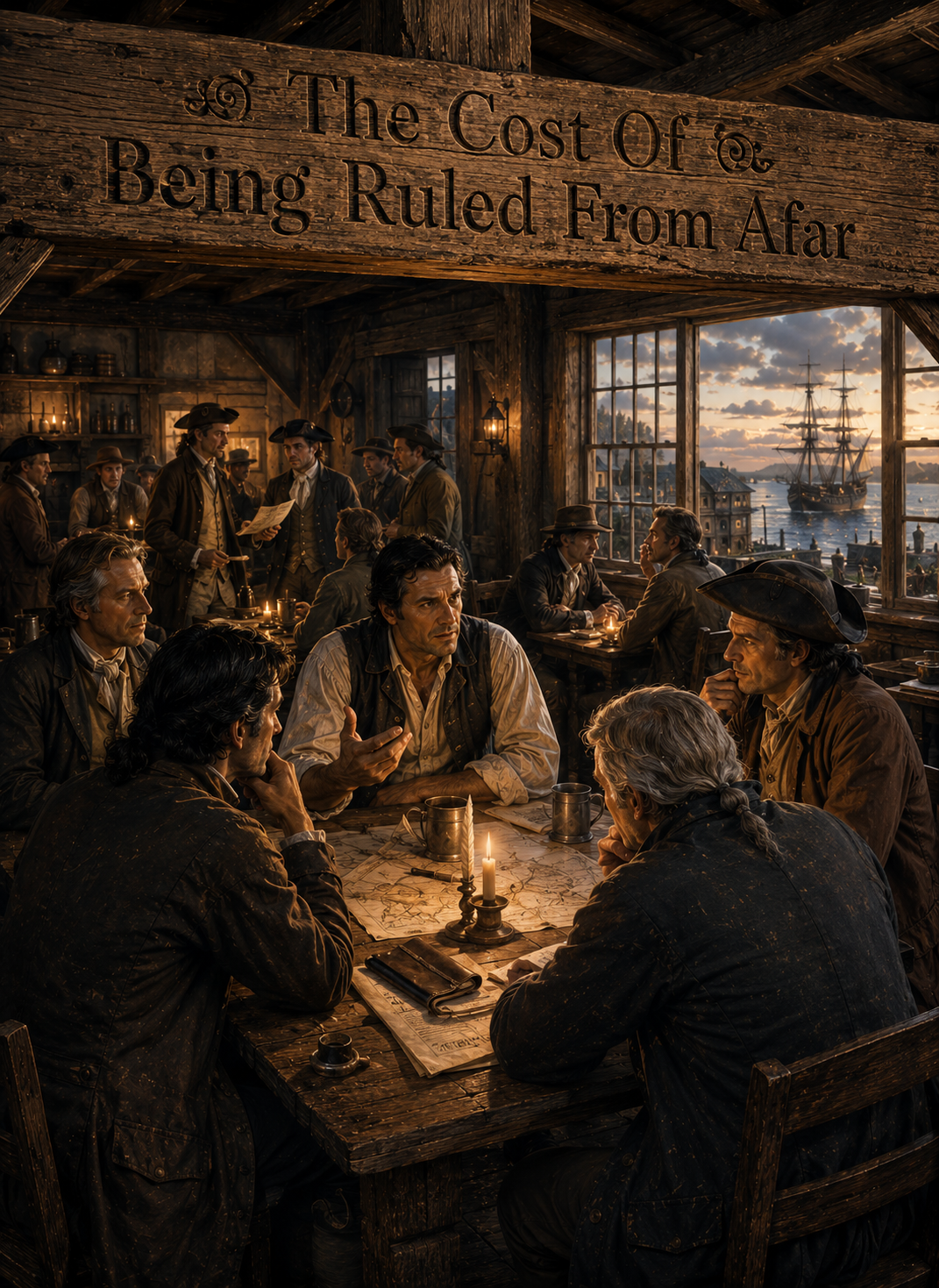
Taverns, churches, meetinghouses, workshops, homes, docks, and town squares became places where people talked, argued, listened, and questioned. Ideas moved through conversation. Newspapers and pamphlets spread information. Sermons, letters, and public meetings helped ordinary people connect local frustration to larger principles.
That is important because history is not only made in capitals and battlefields.
It is made when ordinary people begin talking differently about their lives. A merchant worried about trade. A farmer worried about taxes. A craftsman worried about cost. A minister spoke about conscience. A town meeting discussed rights. A neighbor repeated what he had read.
Slowly, scattered complaints became shared concern.
Public discussion became part of colonial culture. People learned to weigh arguments, question authority, defend local interests, and imagine themselves as participants in public life. The more they discussed the cost of distant rule, the more they began to understand that freedom required more than private independence.
It required public responsibility.
People want dignity. They want fairness. They want a voice in their future. They want their labor to matter. They want authority to be connected to responsibility. They want to believe that those who make decisions understand the people who must live under them.
Freedom and responsibility naturally grow together.
A community that wants liberty must also learn to participate. It must stay informed. It must discuss, debate, listen, serve, sacrifice, and care about consequences beyond the present moment. Self-government is not only a political structure. It is a habit of mind and character.
That is why major historical changes often begin with ordinary conversations.
Before a crowd gathers, before a protest forms, before a declaration is written, people talk. They ask whether what they are experiencing is right. They compare burdens. They remember older promises. They teach one another the language of rights, duty, consent, and responsibility.
Why This Matters Today
The cost of being ruled from afar still speaks to modern readers because freedom always depends on participation.
Self-government only survives when people stay informed, responsible, and engaged. A society weakens when people inherit liberty but no longer understand the work required to preserve it.
Strong societies require both liberty and responsibility.
Liberty without responsibility becomes selfishness. Responsibility without liberty becomes control. The American struggle would eventually force colonists to wrestle with both. They wanted freedom, but freedom would demand courage, sacrifice, wisdom, discipline, and a willingness to carry consequences.
Future generations inherit the results of what previous generations defend or ignore.
That is why remembering matters.
The colonists were not perfect, and their world contained deep contradictions. But the questions they wrestled with still matter: Who should have a voice? What makes authority legitimate? What does freedom require? What happens when people feel unheard by those who govern them?
The desire for self-government did not begin with gunfire.
It began with distance, frustration, debate, and the growing belief that people should have a voice in laws affecting their lives. The colonies were still tied to England, but the emotional bond was weakening.
The idea of being governed from across an ocean no longer felt natural to many people who had built lives through local effort and responsibility.
Soon resistance would become more visible. Protests, boycotts, pamphlets, public anger, and organized opposition would spread through the colonies. The road toward revolution would become harder to ignore.
But before resistance became action, it had to become conviction.
Ordinary people first had to believe that the cost of being ruled from afar was becoming too great for a free people to accept.