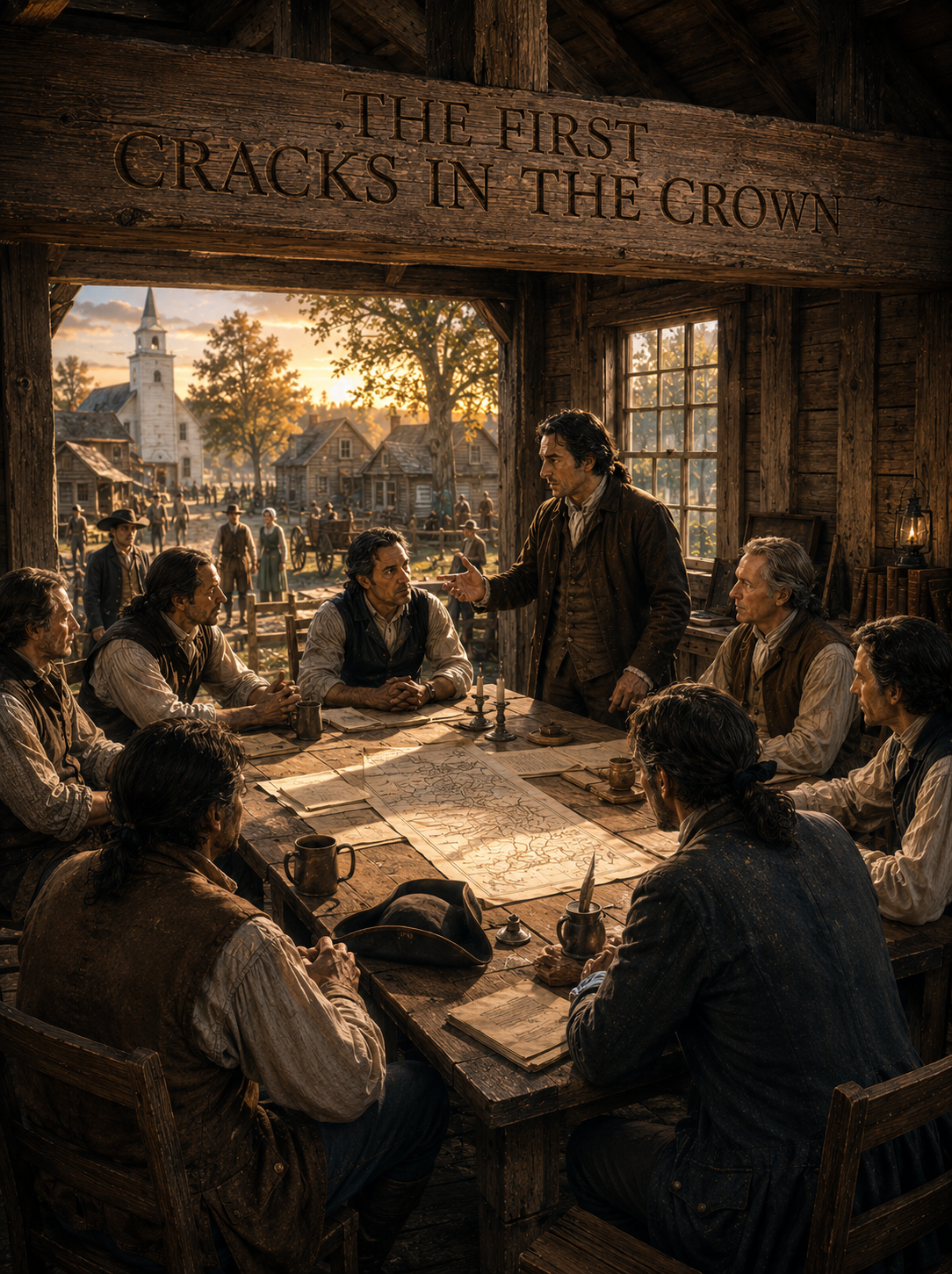
The First Cracks in the Crown
Long before revolution, the desire to govern one’s own future had already begun taking root.
Distance Changed Everything
The colonies were an ocean away from England, and that distance changed more than travel.
It changed daily life, habits, expectations, and eventually the way people thought about authority. Messages took weeks or months to cross the Atlantic. Decisions made in London could feel far removed from the realities of colonial life. Problems needing immediate attention could not always wait for distant instruction.
Because of that, colonists increasingly handled many matters themselves.
Communities learned to solve local problems, settle disputes, organize labor, defend their interests, and make practical decisions close to home. What began as necessity slowly became habit. And habit slowly became identity.
Long before revolution was openly discussed, self-reliance had already begun shaping the colonial mind.
Distance also created a quiet psychological change. A king could still rule from across the ocean, and Parliament could still pass laws, but daily survival was happening in fields, ports, workshops, churches, homes, and meetinghouses far from London.
The farther people lived from the center of power, the more they learned to depend on judgment formed by experience rather than commands sent from afar.
A Different Life Was Emerging
Life in the colonies was producing something different from the world many Europeans had known.
Colonists worked land, built local communities, governed town affairs, traded with neighbors, defended settlements, and relied on one another in practical ways. Survival rewarded initiative, adaptability, and personal responsibility. In many places, ordinary people experienced forms of local participation and independence that many people in Europe rarely knew.
That did not mean colonial life was easy or fair for everyone.
Hardship remained constant. Labor remained demanding. Many people still lived under deep inequality, and some were denied freedom altogether. But even with those contradictions, colonial life was shaping a population more accustomed to local effort and local decision-making than distant dependence.
A person living in a colonial town or settlement could see the connection between responsibility and outcome.
A road improved because local people worked on it. A church or meetinghouse stood because neighbors built and supported it. A dispute might be settled by men known in the community. A danger might be answered by those who lived close enough to understand it.
This did not create independence overnight, but it trained people to think in terms of local duty, local voice, and local consequence.
The Crown Still Expected Control
England still viewed the colonies as part of the empire.
From the Crown’s point of view, the colonies were not separate political experiments. They were extensions of British authority, British trade, and British interest. Laws, taxes, trade restrictions, and imperial expectations continued to come from far away.
But distance has a way of exposing tension.
Many colonists began questioning whether rulers across an ocean truly understood the realities of colonial life. How could men in England fully grasp the land, labor, danger, weather, trade conditions, and practical needs of people living in towns, ports, farms, and settlements so far away?
The more colonists handled life for themselves, the more natural it became to wonder whether outside control always deserved unquestioned obedience.
At first, these questions did not have to sound like rebellion. They could sound like frustration, confusion, or practical complaint. A tax might seem unfair. A trade rule might seem disconnected from reality. A decision made in England might ignore colonial hardship.
But beneath those complaints, a deeper question was beginning to form: who truly understood the life being governed, those who lived it or those who ruled it from a distance?
The Seeds Of Independence
The first steps toward independence often begin quietly.
They begin before slogans, before protests, before battle, and before famous declarations. In the colonies, those early steps appeared in local assemblies, community meetings, church discussions, town decisions, and the growing belief that people had a right to a voice in matters affecting their lives.
Communities discussed rights, representation, taxation, trade, and responsibility.
Ordinary people were not yet necessarily calling themselves revolutionaries, but they were beginning to think differently than many Europeans. They were learning that self-government was not only an idea. It was a lived habit.
When people solve problems locally for long enough, they begin to feel that participation belongs to them.
That feeling matters.
A people may remain outwardly loyal for a long time while inwardly changing. That is often how history moves. First the habits change. Then the expectations change. Then the questions become harder to silence.
The first cracks in the Crown did not appear because everyone suddenly wanted separation. They appeared because colonial life was slowly teaching people to expect a voice in their own future.
The Habit Of Self-Government
Self-government is not born only in grand halls or famous documents.
It grows in ordinary rooms where people gather to decide what must be done. It grows when neighbors argue, listen, vote, compromise, disagree, and still return to the same community the next morning. It grows when people realize that public life is not someone else’s responsibility.
In the colonies, these habits formed through practical necessity.
Local assemblies, town meetings, church gatherings, courts, and committees gave people experience in making decisions together. They learned to debate needs, weigh consequences, raise money, enforce rules, organize defense, support public works, and speak for local interests.
These actions may seem small compared with revolution, but they mattered deeply.
A society becomes different when ordinary people practice responsibility. They begin to understand that liberty requires more than desire. It requires judgment. It requires patience. It requires knowledge of local conditions. It requires citizens willing to participate instead of merely complain.
The colonies were still tied to Britain, but many colonists were already learning the muscles of self-government before they ever named the larger struggle.
Human Nature And Generational Responsibility
Human nature remains remarkably consistent across time.
People want a voice in their own future. They want fairness. They want their labor to matter. They want to protect their families, shape their communities, and participate in decisions that affect their lives.
Freedom and responsibility often grow together because one naturally calls for the other.
Communities become stronger when individuals participate. Self-government is not simply a right handed down from above. It is a responsibility practiced from below. It lives in the habit of showing up, thinking carefully, speaking honestly, listening, weighing consequences, and caring what becomes of the future.
Independence often begins quietly before it becomes history.
Every generation inherits both freedom and responsibility. The colonists were not creating their world from nothing. They were building on what previous generations had endured, crossed, planted, repaired, and established.
Many of the opportunities they enjoyed had been purchased by sacrifice they themselves did not make.
That truth remains important in every age.
Wisdom often comes through experience, hardship, and reflection. Older generations pass forward more than property or tradition. They pass perspective. They pass lessons about effort, danger, duty, gratitude, and the cost of neglect.
Strong societies endure when people remember that what they enjoy today was often built by those who would never live long enough to fully enjoy it themselves.
Freedom is never automatic.
Self-government requires informed, responsible, and participating citizens. Societies weaken when people become disconnected from history, responsibility, and gratitude. They strengthen when people remember how slowly liberty grows and how carefully it must be protected.
The first cracks in British authority did not begin with explosion.
They began with distance, local responsibility, lived experience, and the growing belief that ordinary people should have a say in their own future. The colonists were still connected to England, but they were no longer thinking exactly like people who lived under the shadow of nearby authority.
Their lives had changed.
Their expectations had changed.
Their sense of responsibility had changed.
Soon those quiet changes would move closer to the foreground. Taxes, protest, representation, and authority would no longer remain distant concerns. The road toward revolution was beginning to show itself, not yet as open war, but as a question forming in the hearts and minds of ordinary people:
Who has the right to decide the future of a people who have learned to govern much of life for themselves?