The Night the Harbor Changed History
On one cold night in Boston Harbor, ordinary people chose defiance over silence, and history would never move the same way again.
Frustration Reached A Breaking Point
By the time tea ships arrived in Boston Harbor, frustration had been building for years.
Taxes, trade restrictions, distant authority, military presence, public protests, and unanswered appeals had changed the emotional life of the colonies. Many colonists no longer believed their concerns were truly being heard. They had petitioned, argued, organized, boycotted, printed, debated, and warned.
Still, the pressure continued.
The issue was not only tea.
Tea became the object in front of them, but the deeper question was representation, consent, dignity, and self-government. Colonists were asking whether a distant power could continue making decisions that affected their homes, work, trade, and future without giving them a meaningful voice.
The more their concerns were dismissed, the more citizens began to believe that silence would only invite more control.
Anger spread through ports and cities because port towns felt the pressure directly. Ships carried goods, laws, taxes, authority, and conflict across the water.
Boston Harbor became more than a harbor.
It became a place where the struggle between empire and local liberty could be seen, touched, and smelled in the salt air.
The Tea Ships Arrived
When British tea entered Boston Harbor, tension escalated quickly.
The ships did not merely carry cargo. To many colonists, they carried a message: the Crown and Parliament still expected obedience. The tea became a symbol of whether colonists would accept taxation and control without the representation they believed free people deserved.
Meetings filled with debate and emotion.
People argued over what should be done. Some wanted the tea sent back. Some feared the consequences of defiance. Some still hoped for a peaceful resolution. Others believed that allowing the tea to be unloaded would signal surrender.
The city lived under uncertainty, and uncertainty has a way of making every decision feel heavier.
For ordinary people, this was not an abstract political argument. It reached into shops, homes, docks, meetinghouses, taverns, and family conversations. A crate of tea sitting in a ship’s hold could represent the future of colonial rights.
That is how symbols work in history.
A simple object can become the place where a people decide what they are willing to accept.
An Extraordinary Decision
The decision that followed was extraordinary because it moved beyond words.
Colonists gathered quietly. Identities were concealed. The night itself became part of the act. Darkness gave cover, but it also deepened the seriousness of what was happening. These were not people making a casual protest. They understood that openly defying the Crown could bring punishment.
Fear and determination existed side by side.
Courage is not always loud. Sometimes courage is quiet, organized, and disciplined. It is a person stepping forward while knowing that consequences may come. It is a community deciding that symbolic action is necessary because polite objection has failed.
The people involved were not acting as spectators to history.
They were becoming participants in it. They were ordinary human beings choosing to make their convictions visible. Some may have been angry. Some may have been afraid. Some may have been unsure what would follow.
But they understood that a message had to be sent in a form that could not be easily ignored.
The Boston Tea Party
The Boston Tea Party unfolded with remarkable discipline.
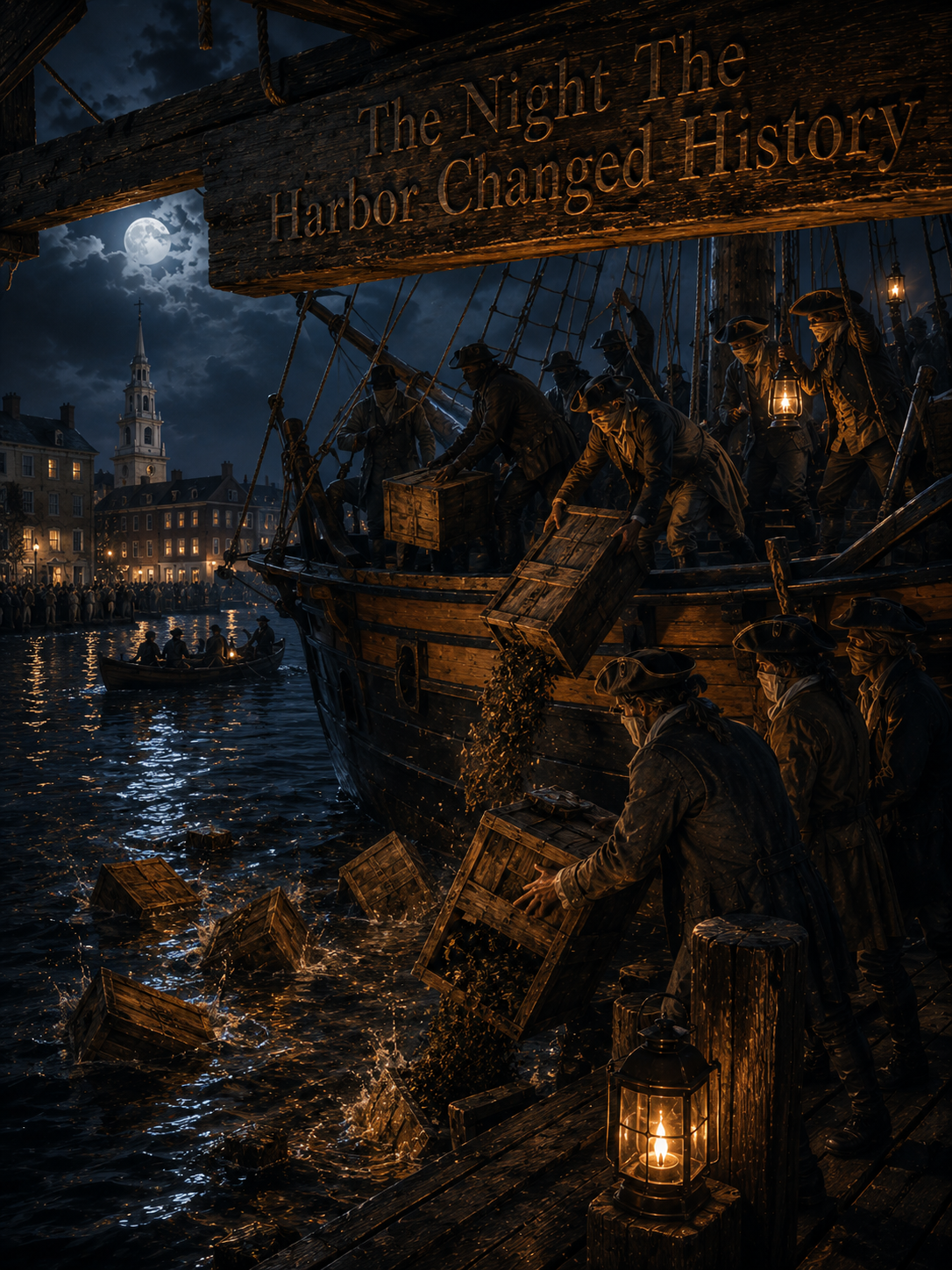
Crates of tea were thrown into the harbor. The destruction was intentional, symbolic, and focused. It was not random chaos. It was aimed at one powerful object of dispute. The tea was destroyed because it represented a system of authority many colonists believed had crossed a line.
That night shocked both Britain and the colonies.
To some colonists, it was a necessary act of defiance. To others, it was dangerous and reckless. To British authorities, it was not merely protest. It was destruction of property and a challenge to imperial power.
The meaning of the night depended on where a person stood, but no one could easily pretend it did not matter.
The harbor became a symbol of growing resistance.
Water swallowed the tea, but the message rose. Ordinary people had demonstrated that they were willing to act, not simply complain. They had shown that resistance could be organized, public, symbolic, and unforgettable.
More Than Tea
The event was about more than tea.
It was about representation. It was about dignity. It was about self-government. It was about whether free people deserved a voice in laws that affected their labor, property, trade, homes, and future.
The tea was the object, but the principle was larger.
Human nature never changes as much as we think. People eventually resist when they feel unheard. They may tolerate inconvenience. They may endure hardship. They may complain quietly for a time.
But when people believe their dignity is being ignored and their future is being decided without them, resistance can become a moral act in their own eyes.
Courage often begins collectively.
One person alone may hesitate, but a community can give courage to its members. When people stand together, fear does not disappear, but it becomes bearable.
That night in Boston Harbor showed how ordinary individuals, acting together with purpose, could alter history profoundly.
The Emotional Consequences
The emotional consequences spread quickly.
Some celebrated the protest as a bold defense of liberty. Others feared retaliation. Many sensed there was no easy path backward now. Once such an act had been committed, the relationship between Britain and the colonies could not simply return to what it had been.
The event deepened uncertainty across the colonies.
People who supported resistance may have felt encouraged. People who feared conflict may have felt dread. Loyalists saw danger. Patriots saw courage. Those caught in the middle saw a future becoming harder to predict.
The Boston Tea Party did not settle the conflict.
It intensified it.
This is why the night matters. It turned frustration into a public symbol that could travel from town to town and colony to colony. People heard about it, argued over it, defended it, condemned it, and measured their own convictions against it.
Symbolic acts can awaken entire generations because they give people an image of choice.
Action or silence.
Obedience or resistance.
Fear or participation.
Freedom and responsibility remained connected.
Defiance carried consequences. Strong societies require participation and courage, but courage must also accept the burden of what follows. The people who acted in Boston Harbor helped move history forward, but they also helped bring the colonies closer to punishment, pressure, and confrontation.
Future generations inherit the results of whether people choose action or silence.
That does not mean every act of defiance is wise, and it does not mean every protest is righteous. But it does mean that history often turns when ordinary people decide they can no longer remain passive.
The Boston Tea Party became one of those turning points.
Britain would respond harshly. Punishment and pressure would intensify. The colonies would move even closer toward revolution, and ordinary people would begin preparing for the possibility of war.
The night the harbor changed history was not the end of the struggle.
It was the moment when the road back became narrower and the road toward revolution became harder to deny.