The Voyage
Between the world they left and the world they hoped to reach, the ocean became their first great test.
Life Between Two Worlds
Once the shoreline disappeared, families entered a world unlike anything they had known. They were no longer part of the Old World, but they had not yet reached the New World. They were suspended between past and future, between memory and possibility, between everything familiar and everything unknown.
That middle place must have felt strange to the human heart. Behind them was a life they could no longer easily return to. Ahead of them was a future they could not yet see. Around them was water, wind, wood, rope, sky, and the constant motion of the sea. There was no road back, no village in sight, no familiar church bell, no known field, no doorway to return through.
The ocean became more than distance.
It became the space between who they had been and who they were trying to become.
Below Deck
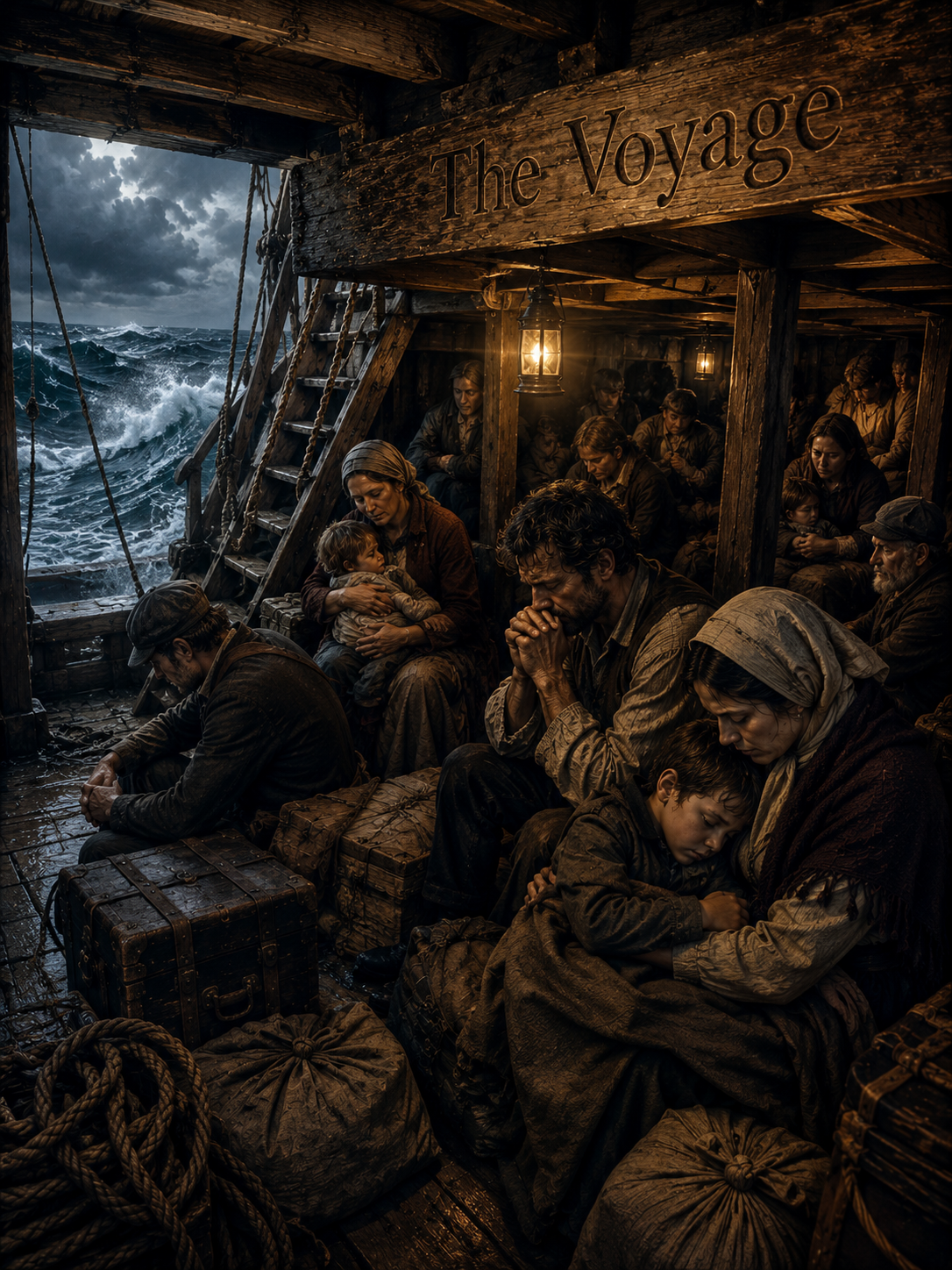
For many passengers, life below deck was crowded, dark, damp, and difficult. Wooden quarters were cramped. Fresh air was limited. Privacy was almost impossible. Sickness could spread quickly. The smell of saltwater, sweat, fear, illness, damp clothing, stored food, and humanity filled the space where families tried to sleep, pray, comfort one another, and survive.
The journey was not romantic. It was hard.
People who had already left behind nearly everything familiar now had to endure weeks of discomfort and fear. A ship could carry hope, but it could also become a place of exhaustion. The body had little room to rest. The mind had little room to escape. The sea moved beneath them even when they tried to sleep.
Families had to create some kind of order inside disorder. They guarded their small bundles, kept children close, watched the sick, saved what food they could, and tried to preserve dignity where comfort was scarce.
The smallest things mattered: a dry corner, a shared blanket, a cup of water, a quiet prayer, a familiar voice in the dark.
On land, people had known where they stood.
At sea, even the floor beneath them moved.
The Atlantic Ocean
The Atlantic reminded people how small human beings can be. Storms terrified passengers. Waves rose higher than anything many had ever seen. Violent winds shook everything that had seemed stable. For weeks, there could be no land in sight, only water, sky, and the awareness that nature could not be reasoned with.
The same ocean that carried their hope also held their fear.
In calm weather, the sea may have looked endless and almost beautiful, but even that beauty could feel lonely. In violent weather, it became a force beyond human control. The ship that had seemed large at the harbor could feel small against the Atlantic.
There is something humbling about open water. It strips away the illusion that human beings control everything.
People who had already surrendered home now had to surrender certainty. They could not command the wind, hurry the horizon closer, or make the waves obey. They could only endure the day in front of them, then the next day, then the next, while hope remained somewhere beyond sight.
Families Under Pressure
Families were tested in every way. Children were frightened. Parents were exhausted. Food and water had to be guarded carefully. The sick needed care. The weak needed help. People who had once been strangers became temporary communities because survival required more than individual strength.
Hardship forced people to lean on one another.
A mother might comfort a child while hiding her own fear. A father might pretend confidence he did not feel. A stranger might share water, lift a bundle, steady someone during rough seas, or sit beside the sick when there was little else to offer.
In such conditions, small acts became large.
Kindness could become courage. Patience could become strength. A hand held in darkness could remind someone that they were not alone.
History often remembers ships, dates, routes, and arrivals. But the real crossing happened inside ordinary people. It happened inside the parent trying to keep a child calm, the exhausted passenger helping someone weaker, and the frightened soul who kept praying when no answer seemed visible.
The voyage did not only test bodies.
It tested love, patience, faith, and the will to keep going.
Faith And Grief At Sea
For many, prayer became part of survival. People leaned on belief, family, and whoever stood beside them. Courage did not arrive all at once. It grew through hardship, one day at a time, one storm at a time, one act of care at a time.
Hope survived even when fear was stronger.
But not every story reached land. Disease, malnutrition, accidents, weakness, and the harshness of the crossing took lives along the way. Some families carried grief across the water. Some lost loved ones between the world they had left and the world they hoped to reach.
Grief traveled beside hope.
To remember the voyage honestly, we cannot make it only brave and beautiful. We must allow it to be painful, costly, and deeply human.
The Ocean Changed Them
The voyage changed those who survived it.
Suffering creates resilience. Hardship changes perspective. People learn what truly matters when comfort disappears. They learn the value of a shared crust of bread, a whispered prayer, a steady hand, a cup of water, a protected child, and a stranger who chooses compassion when everyone is afraid.
The people who reached the other side were not the same people who had stepped onto the ship. They had left one world, endured the ocean, and carried forward both hope and sorrow.
That lesson belongs to more than one generation.
Every life has crossings. Every family, every people, and every nation eventually faces a stretch where the past is gone and the future has not yet arrived. The voyage reminds us that the middle can be the hardest place to remain faithful.
It is where hope must survive without proof.
It is where courage must continue without applause.
Comfort can hide the strength previous generations needed simply to survive.
We remember not to glorify suffering, but to honor those who endured it.
Their voyage reminds us that civilization is not handed forward without cost. It is carried by people who suffer, adapt, help one another, and keep moving toward a hope they may not fully live to see.
After the voyage came landfall. Exhausted settlers would finally see the New World, but arrival did not mean safety. The land they had dreamed of would test them in new ways.
The ocean had carried them away from the world they knew.
Now the land ahead would ask whether their hope could become a life.