When Neighbors Began Choosing Sides
The Tension Could No Longer Be Ignored
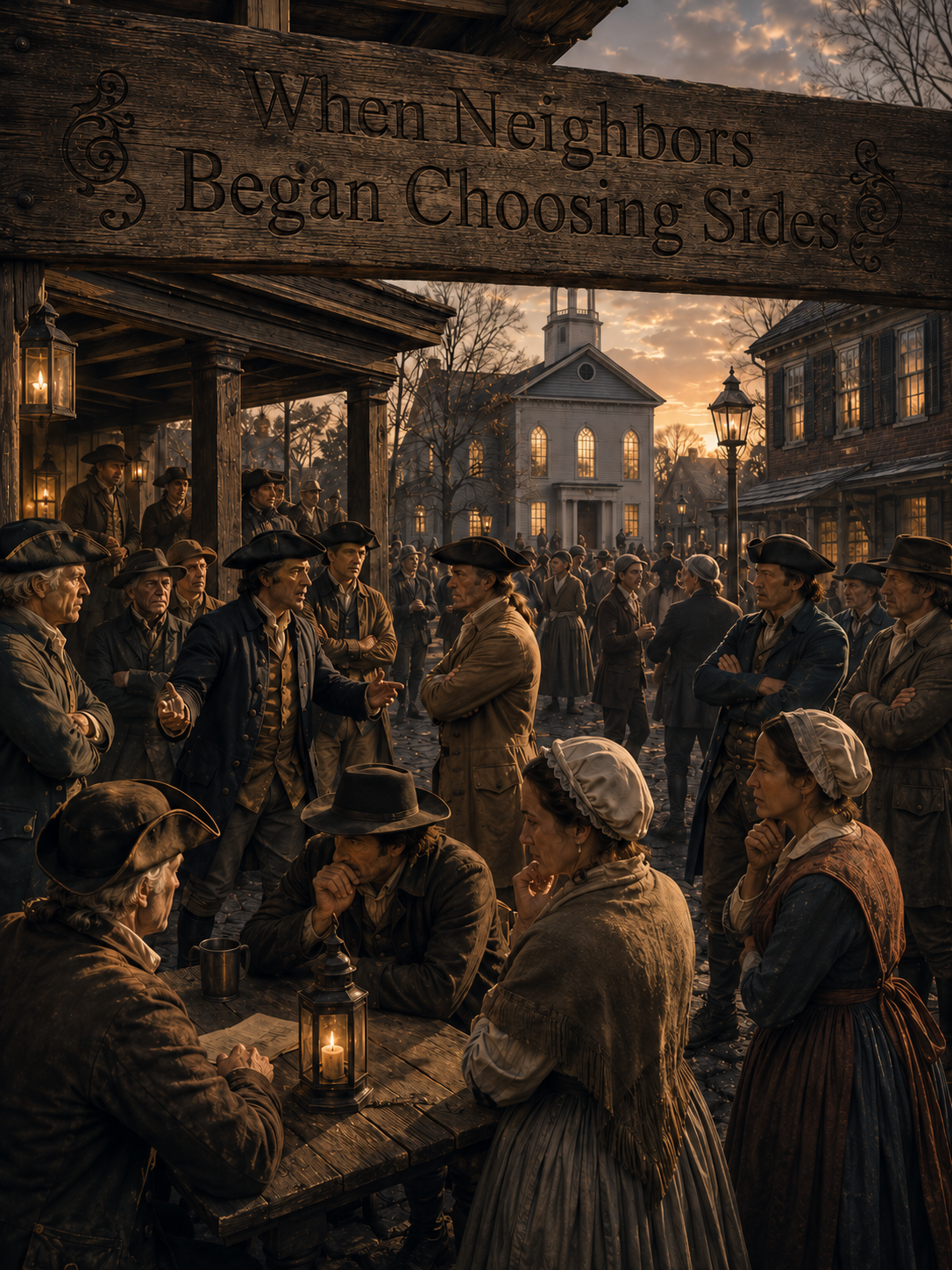
As resistance spread, the colonies entered a more dangerous emotional season.
Protests continued. Boycotts gained attention. Public meetings grew more serious. British authority tightened in response. What had once been frustration, argument, and local complaint began to feel like something larger moving beneath colonial life.
Many people sensed that the relationship between the colonies and Britain was changing in ways that could not easily be undone.
Anger grew, but so did fear. A person could oppose unfair taxation and still fear where resistance might lead. A family could resent distant control and still tremble at the thought of war. A community could speak of liberty in public and still wonder privately whether the cost would become too great.
That is what makes this moment so human.
History often looks clear after it has already happened. But for those living inside it, the future was uncertain. They did not know whether resistance would bring reform, punishment, reconciliation, or disaster. They only knew that the old relationship was cracking, and the sound of that cracking could now be heard in ordinary life.
Not Everyone Agreed
Not every colonist wanted the same future.
Some demanded greater independence and believed the colonies had already earned the right to govern themselves. Others remained loyal to the Crown and believed rebellion against Britain would bring ruin, dishonor, or chaos. Many stood somewhere in the middle, frustrated by British policy but frightened by the thought of open conflict.
That middle ground mattered.
Most people do not rush eagerly into historical crisis. They hesitate. They weigh consequences. They think of homes, shops, farms, children, debts, churches, neighbors, reputations, and survival. Choosing a side was not merely a political statement. It could affect friendships, business relationships, social standing, safety, and family peace.
The colonies were not divided between simple heroes and villains.
They were filled with human beings trying to make decisions without knowing the ending. Some were bold. Some were cautious. Some were angry. Some were afraid. Some believed loyalty was a duty. Others believed resistance had become a duty.
The closer the colonies moved toward confrontation, the harder it became to avoid the question.
Families And Friendships Strained
Political tension does not remain politely outside the door.
It enters homes. It sits at dinner tables. It follows people into churches, taverns, shops, meetinghouses, and fields. Neighbors who once helped one another might begin arguing openly. Friends might avoid certain subjects. Families could find themselves divided by loyalty, fear, principle, or temperament.
Some households likely tried to keep peace by silence.
Others could not.
A father might fear that resistance would destroy everything his family had built. A son might believe submission would dishonor the future. A merchant might worry that protest would ruin business. A minister might speak of conscience. A mother might wonder what any of it would mean for her children.
Ordinary relationships became political because the questions were no longer distant.
This is one of the painful truths of history. Major events are not only fought in public. They are carried inside private lives. Before armies form, people argue. Before declarations are signed, families worry.
Before nations divide, communities feel the strain of choosing.
The Fear Of War
War against Britain seemed almost unimaginable.
Britain was one of the most powerful empires in the world. Its navy, army, wealth, authority, and reach were known across the Atlantic world. The idea that scattered colonies could openly resist such power must have seemed reckless to many people.
Fear of war was not weakness.
It was realism.
War meant death, hunger, destruction, poverty, broken families, and uncertain futures. Parents had reason to worry. Merchants had reason to worry. Farmers had reason to worry. Churches and communities had reason to worry.
Once violence began, no one could fully control where it would lead.
That fear gives the story weight. The people moving toward resistance were not choosing between comfort and glory. They were choosing between different kinds of danger.
Submission carried a cost.
Resistance carried a cost.
Silence carried a cost.
Speech carried a cost.
Every path seemed to ask something from them.
The Weight Of Conscience
As the crisis deepened, many people wrestled privately with difficult questions.
When should loyalty end? What is worth risking everything for? What responsibilities do free people carry? Is peace always the highest good, or can peace become surrender when injustice is accepted too long?
Those questions do not belong only to the past.
Human nature remains consistent across time. Fear and courage often exist together. People long for peace even while conflict grows around them. Difficult times reveal character because they force people to decide what they truly believe, what they are willing to defend, and what they are willing to risk for those who will come after them.
The weight of conscience is often quiet.
It may not look dramatic from the outside. It may look like a person lying awake at night, listening to arguments in a tavern, reading a pamphlet twice, praying for wisdom, or looking at a child and wondering what kind of future silence will leave behind.
History is shaped by ordinary individuals making deeply personal choices before the world knows their names.
The Slow Birth Of An American Identity
As tension grew, colonists increasingly began seeing themselves as connected.
The colonies still differed in religion, economy, climate, region, and habit. They did not all think alike. They did not all want the same path. But shared hardship began creating shared purpose. Ideas of liberty, representation, rights, and responsibility moved from colony to colony.
An American identity did not appear suddenly.
It formed slowly through argument, cooperation, fear, sacrifice, and shared pressure. People who once thought mostly as Virginians, New Englanders, Pennsylvanians, merchants, farmers, church members, or local citizens began to sense that their struggles were linked.
What happened in one colony could matter to another.
What one town resisted could encourage another town to speak.
This identity was still young, uneven, and fragile. But it was forming. The colonies were beginning to understand that they might be something more than distant extensions of Britain.
They might be a people with a shared future, even if they had not yet fully named it.
Division is not new in human history.
Strong societies require both freedom and empathy. Disagreement does not erase shared humanity, but fear can make people forget that. When people face uncertain times, they need courage, but they also need wisdom. They need conviction, but they also need humility.
They need to remember that future generations will inherit the consequences of what they defend, ignore, or destroy.
This chapter matters because it reminds us that great historical choices are rarely easy for those who must make them.
The people of the colonies were not reading a finished story. They were living inside uncertainty. They had to choose under pressure, with incomplete knowledge, divided communities, and real fear of what might come next.
The journey now moves closer to physical confrontation.
British authority would continue to tighten. Colonial resistance would grow louder. The relationship between England and the colonies would approach a breaking point. History was nearing the edge of revolution, and ordinary people would soon discover that choosing sides was only the beginning.