When Ordinary People Begin to Resist
The desire for self-government began long before the first shots of revolution were ever fired.
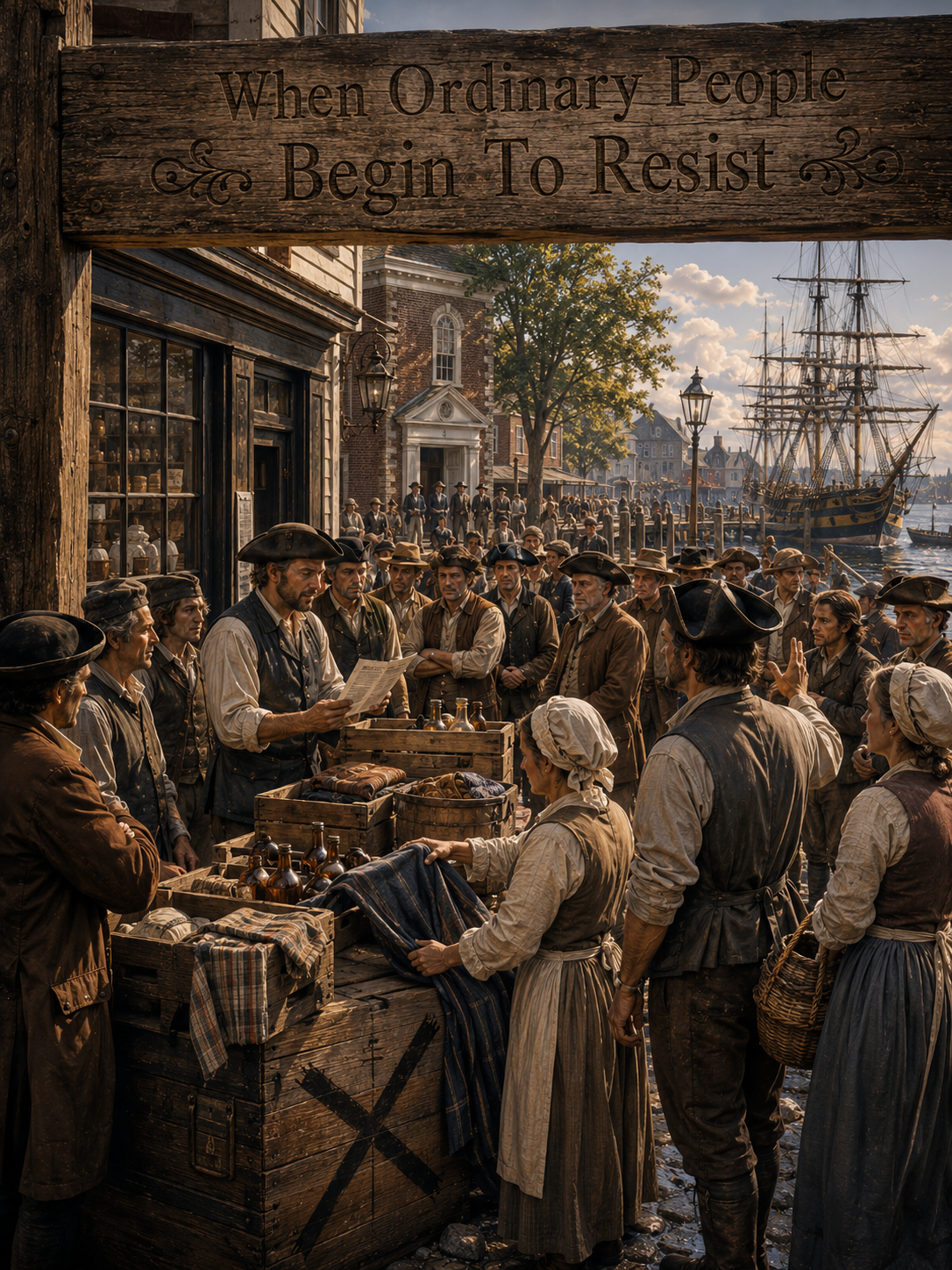
Frustration Became Public
Frustration did not remain hidden forever.
What had begun as private concern around tables, docks, shops, farms, and meeting places slowly became public. Anger spread through towns and ports as colonists discussed taxation, trade restrictions, representation, and the growing feeling that decisions made far away were reaching too deeply into their daily lives.
This was not only a matter for wealthy leaders or polished speakers.
Merchants felt pressure in trade. Dockworkers felt it in the flow of goods. Farmers felt it in markets and costs. Craftsmen felt it in materials and business. Families felt it in the price of ordinary life.
The cost of distant rule was becoming visible in practical ways, and practical hardship has a way of turning quiet concern into public conversation.
Resistance began moving from thought into action.
People who may once have complained privately began speaking more openly. Communities began asking what could be done. The feeling spread that accepting every burden without protest would only invite more control.
Ordinary people were beginning to understand that silence itself could become a kind of surrender.
Boycotts And Protest
Boycotts became one of the first powerful tools of colonial resistance.
By refusing certain British goods, colonists found a way to resist without immediately turning to violence. They could use buying, selling, trading, and refusing as a form of public speech. Economic resistance allowed people to participate in a struggle that was still taking shape.
This mattered because resistance became practical.
A merchant could refuse goods. A shopkeeper could make a choice. A family could do without certain items. A community could agree to support local alternatives. What people purchased, used, wore, drank, or refused became connected to larger questions of liberty and responsibility.
Boycotts also required sacrifice.
Refusing imported goods was not always convenient. It could be costly. It could create tension. It required discipline and trust. People had to believe that their private choices mattered because those choices were part of something larger.
Resistance was teaching the colonies that freedom was not only spoken about in public meetings.
It had to be practiced in daily life.
The Power Of Shared Ideas
Ideas spread quickly when people were ready to hear them.
Newspapers, pamphlets, letters, sermons, tavern conversations, and meetinghouse discussions helped connect separate frustrations into a shared understanding. A complaint in one town could become known in another. A printed argument could travel farther than a single voice. A story of resistance in one colony could encourage people elsewhere.
That was powerful.
Many people who felt frustrated may have first believed their concerns were local or isolated. But as information spread, colonists began realizing they were not alone. Others were asking the same questions. Others were feeling the same pressure. Others were wondering whether distant authority had gone too far.
Shared ideas helped create shared identity.
The colonies still differed in region, economy, religion, and habit, but printed words and public discussion helped build emotional connection. People who had never met could begin to recognize themselves in one another’s concerns.
Before unity becomes political, it often becomes emotional.
People begin to feel that someone else’s burden is connected to their own.
Ordinary Citizens Stepped Forward
History is often told through famous names, but history is not carried by famous names alone.
Ordinary citizens stepped forward in ways large and small. Blacksmiths, dockworkers, merchants, farmers, mothers, printers, ministers, shopkeepers, apprentices, sailors, and laborers all became part of the growing resistance. Some spoke publicly. Some organized. Some printed. Some refused goods. Some supported neighbors. Some taught their children what was happening.
That is one of the great truths of this chapter.
Resistance became real when ordinary people began participating.
They did not all participate in the same way. They did not all agree on everything. They did not all understand the future clearly. But more and more people began to feel that responsibility for the future was becoming personal.
A mother managing a household during a boycott was part of the story. A printer risking criticism by circulating arguments was part of the story. A merchant choosing principle over profit was part of the story. A worker listening in a tavern and carrying the conversation home was part of the story.
History was beginning to move through common hands.
Fear And Courage Existed Together
Even as resistance grew, fear remained.
Many colonists still feared conflict with England. That fear was reasonable. England was powerful. The empire had ships, soldiers, laws, money, and authority. Open resistance could bring punishment, financial loss, social division, or worse.
Not everyone wanted confrontation. Not everyone believed the same path should be taken.
Courage did not erase that uncertainty.
Courage often grows while uncertainty remains. Some colonists believed freedom required sacrifice, but they could not know how much sacrifice would eventually be demanded. Others hoped tensions could still be resolved. Families worried about consequences. Communities debated what was wise.
Hope and anxiety walked side by side.
That tension makes the story more human. These were not people moving through history with perfect knowledge. They did not know the ending. They had to choose while the future was unclear.
They had to decide whether small acts of resistance were worth the risk.
That is where courage often begins: not with certainty, but with the decision to act responsibly despite fear.
Unity Slowly Emerged
Unity did not appear all at once.
The colonies still differed in many ways. Northern ports, southern farms, frontier settlements, coastal towns, merchants, laborers, religious communities, and local governments did not all share the same daily life. Regional differences remained real, and local priorities still mattered.
But shared frustration began creating shared identity.
The more colonists talked, printed, protested, refused, and organized, the more they began seeing themselves as connected. A tax in one place, a restriction in another, a protest in one town, and a boycott in another began forming a larger pattern.
People began to understand that the problem was not only local inconvenience.
It was a question of authority, consent, responsibility, and future freedom.
A new sense of purpose was forming slowly. It was fragile, imperfect, and uneven, but it was real. Colonists were beginning to think not only as separate communities, but as people facing a shared question:
What should be done when a distant power demands obedience without truly listening?
Why This Matters Today
Human nature never changes as much as we imagine.
People desire dignity and fairness. Communities become stronger when individuals participate. Courage often begins with small actions. History changes when ordinary people stop believing they are powerless.
That truth still matters.
Freedom survives through participation. Strong societies depend on informed and engaged citizens. Ordinary people shape the future more than they realize, not only through dramatic moments, but through daily choices, conversations, sacrifices, responsibilities, and willingness to stand for what they believe is right.
Future generations inherit the courage or complacency of those who came before them.
That is a serious inheritance.
A people can receive freedom and still fail to understand what preserves it. They can enjoy comfort and forget the discipline that built it. They can speak of rights while neglecting responsibility.
Remembering ordinary resistance helps us understand that liberty is not maintained by spectators. It is preserved by people willing to participate.
When citizens began to resist, the relationship between England and the colonies changed.
Resistance gave frustration a public shape. Boycotts, pamphlets, meetings, sermons, conversations, and organized action helped turn scattered anger into shared purpose.
But public resistance also raised the stakes.
British authority would not simply disappear because colonists objected. As resistance grew louder, authority tightened. As authority tightened, colonial anger deepened. The relationship between England and the colonies began approaching a breaking point.
The road toward revolution was becoming harder to ignore.
What began as frustration over distant rule was becoming a test of courage, unity, discipline, and conviction. Ordinary people were stepping into history, not because they knew exactly what would happen, but because they were beginning to believe that the future required their participation.