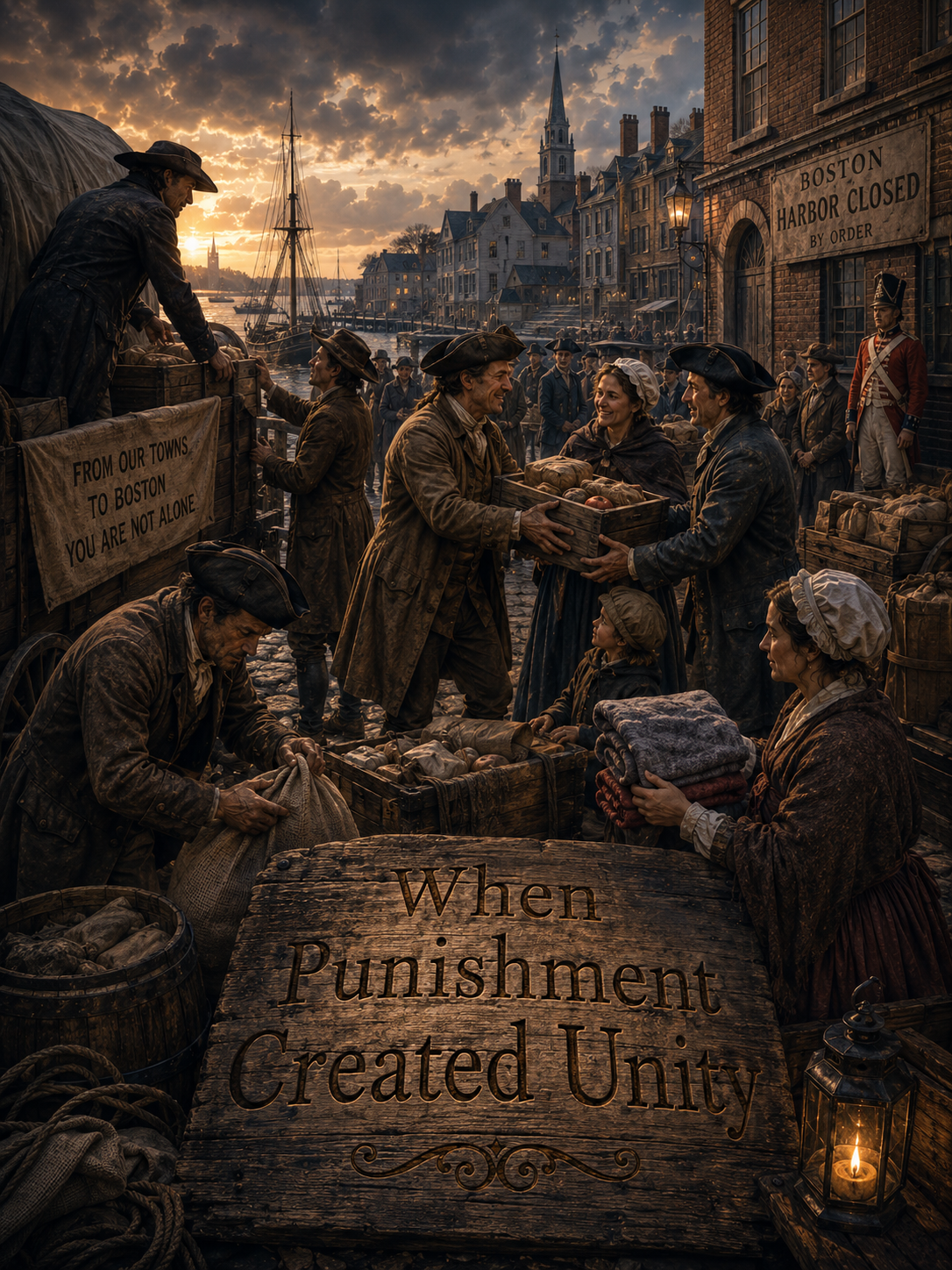
When Punishment Created Unity
The harder the Crown tightened its grip, the more the colonies began seeing themselves not as separate people, but as one.
Britain Responded Harshly
The Boston Tea Party shocked the British government.
To many in Britain, the destruction of the tea was not merely a protest. It was defiance, disorder, and a direct challenge to imperial authority. The Crown and Parliament believed punishment was necessary. They wanted to make an example of Boston, restore control, and remind the colonies that resistance carried consequences.
Punishment came quickly.
Laws tightened. Authority increased. Pressure intensified throughout Massachusetts. What had begun as a dispute over tea now became something much larger. Britain was no longer only answering one act of defiance. It was trying to reassert power over a people who were becoming harder to govern from afar.
For ordinary people, the response was not abstract.
It reached into work, trade, food, family security, and daily life. When governments punish, ordinary households often feel the weight first. Merchants worry. Laborers worry. Mothers worry. Fathers wonder how long supplies will last.
The punishment of Boston became a lesson the rest of the colonies could not ignore.
The Intolerable Acts
The laws that many colonists came to call the Intolerable Acts struck hard.
Boston Harbor was closed. Commerce slowed or stopped. Livelihoods suffered. Workers connected to shipping, trade, loading, repairing, selling, and supplying felt the pressure. A harbor is not only water. It is work, food, wages, news, movement, and survival.
Closing it affected more than merchants.
It threatened the life of a city.
Soldiers maintained stronger control, and many colonists viewed the new laws as collective punishment. To them, Britain was not simply punishing individuals responsible for the destruction of tea. It was punishing an entire community.
That mattered emotionally.
A people may tolerate disagreement with authority, but collective punishment can make authority feel less like law and more like force.
The message seemed clear: resist, and pressure will follow.
But harsh punishment can produce results rulers do not expect. It can frighten people into silence, but it can also cause them to look at one another differently. It can make separate communities ask whether their own safety depends on standing together.
Fear Spread Beyond Boston
Other colonies watched carefully.
What happened in Massachusetts did not feel distant for long. If Boston could be punished so severely, what would stop the same thing from happening elsewhere? If one port could be closed, could another? If one community could be placed under increased control, could others follow?
That question changed the emotional meaning of the crisis.
The issue no longer affected only Massachusetts. It became a warning to every colony.
People began asking, “If this can happen there, could it happen anywhere?”
That question has echoed through many moments in history because human beings understand danger differently when another person’s suffering begins to look like a possible version of their own future.
Fear spread, but fear did not move alone.
Concern spread with it. Sympathy spread with it. Responsibility spread with it. The colonies were still different in region, economy, religion, and habit, but punishment helped many people see a shared vulnerability.
The pressure on Boston became a mirror in which others could see their own possible fate.
Something Unexpected Happened
Britain may have expected punishment to isolate Boston.
Instead, support began growing.
Colonies sent supplies and assistance. Communities reached toward Massachusetts rather than turning away from it. Food, goods, encouragement, and practical help became signs that Boston was not alone.
That response mattered deeply.
Assistance is more than material support. It is a message: your suffering concerns us. Your struggle is connected to ours. Your punishment is not yours alone to carry.
In that sense, aid became an act of unity. It helped transform separate grievances into shared purpose.
Ordinary people felt this shift. A farmer sending food, a merchant contributing goods, a family giving what it could, a town gathering support, a minister speaking of common cause, or a neighbor choosing solidarity over fear all became part of the larger movement.
Unity did not appear suddenly as a finished national identity.
It formed through acts of concern repeated by people who were beginning to understand that their futures were tied together.
Ordinary People Became Part Of History
History was no longer only happening in royal offices, colonial assemblies, or printed arguments.
It was happening in households, churches, docks, farms, shops, and roads. Merchants, farmers, dockworkers, mothers, ministers, laborers, and families became part of the story. Many had never expected to shape history.
They were simply trying to do what responsibility required in a difficult moment.
That is one of the central truths of this journey.
Ordinary people often enter history before they realize history has entered them.
They may think they are sending supplies, attending a meeting, helping a neighbor, repeating news, feeding a family, or making a practical choice. Only later do people understand that those small acts were part of something larger.
Hardship can divide people, but it can also unite them.
Pressure reveals character. Some retreat into fear. Some think only of themselves. Others see suffering and recognize duty.
In the punishment of Boston, many colonists began to discover that shared struggle could create deeper connection than comfort ever had.
The Emotional Shift
A larger identity was slowly forming.
Colonists increasingly stopped thinking only as separate colonies facing separate problems. They began to see that the question of British authority touched all of them. The punishment of Massachusetts helped turn local anger into colonial concern.
Fear still existed.
No one could know where the crisis would lead. Britain remained powerful. The colonies remained divided in many ways. Loyalists still feared rebellion. Cautious people still hoped the conflict might be resolved. Families still worried about war, poverty, punishment, and the safety of their children.
But alongside fear, resolve was growing.
People began sensing history accelerating around them. The old language of separate colonies was no longer enough to describe what they were feeling.
Something wider was taking shape: not yet a nation, not yet independence, but a shared awareness that what happened to one colony could matter to all.
Unity often emerges during difficult times.
Freedom requires courage, but it also requires shared responsibility. Societies grow stronger when people recognize their common humanity and understand that another community’s suffering may one day become their own.
Future generations inherit whether people choose fear or solidarity.
That is why this chapter matters. The punishment meant to control Boston helped awaken a broader colonial conscience. It reminded ordinary people that silence in the face of another’s hardship can become its own kind of surrender.
The story now moves toward organized unity.
Representatives from the colonies would gather together. The First Continental Congress would convene. America was not yet independent, and revolution was not yet fully unavoidable, but scattered resistance was becoming something more coordinated.
The colonies were beginning to move from shared concern toward shared action.