When the Colonies Found One Voice
As the sun rose on divided colonies, a new identity quietly began rising with it—one people, bound together by shared struggle and a common future.
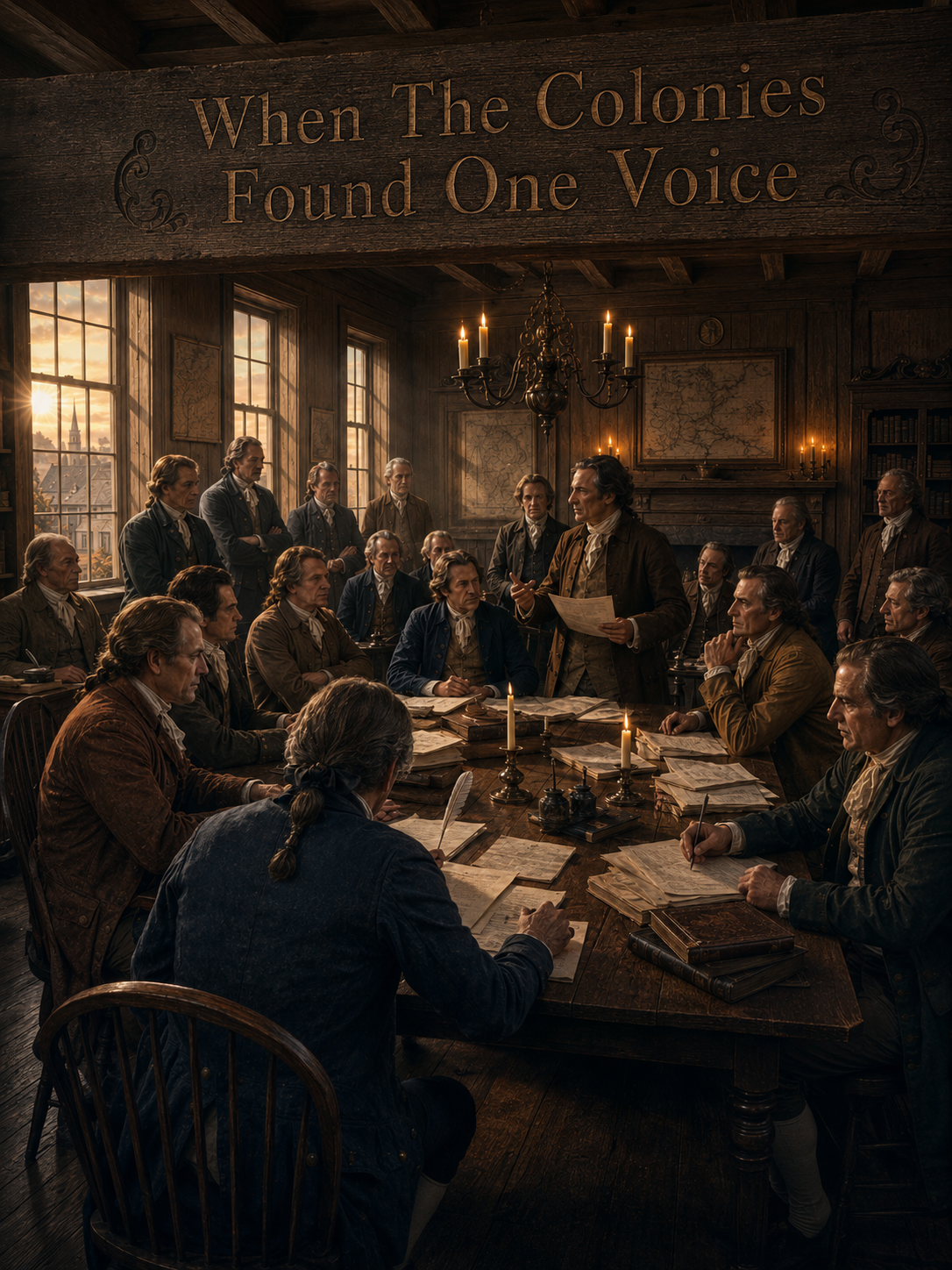
Representatives Gathered Together
After Britain’s punishment of Boston, the colonies faced a question that could no longer be avoided.
Were they separate communities dealing with separate troubles, or were they connected by a larger struggle?
The answer began taking shape when representatives from across the colonies gathered together.
They did not all come from the same background. They came from different regions, economies, churches, towns, farms, ports, and ways of life. Some were merchants. Some were lawyers. Some were farmers. Some were landowners. Some were deeply cautious. Others were more ready for resistance.
Many had never met before.
They carried local concerns, regional loyalties, personal fears, and different ideas about what should happen next.
That gathering mattered because unity does not begin with sameness.
It begins when people with real differences decide that something larger requires their attention. The colonies were still divided in many ways, but the pressure of the moment was teaching them that the future might demand more than local identity.
The First Continental Congress
The First Continental Congress met in an atmosphere of seriousness and uncertainty.
The delegates were not assembling after victory. They were gathering before the future was clear. Britain remained powerful. Punishment had already begun. Resistance was spreading. Fear, anger, loyalty, hope, caution, and courage all entered the room with them.
Debate filled the halls.
Some delegates hoped reconciliation was still possible. They did not want open conflict with Britain and believed the relationship might still be repaired. Others believed stronger action was necessary because petitions and peaceful appeals had not brought the change colonists needed.
The room did not contain one simple opinion.
It contained a people learning how difficult unity can be.
That is important. Unity is not the absence of disagreement. Real unity is often forged through disagreement handled with purpose. The delegates had to listen, argue, persuade, compromise, and consider consequences beyond themselves.
They had to speak for their colonies while also beginning to think about the colonies together.
Fear And Responsibility
The delegates understood the risks.
Britain was still the greatest military power in the world. Its navy, army, wealth, authority, and reach were not imaginary. To challenge imperial power, even through petitions and agreements, was no small act. Failure could cost reputations, property, safety, liberty, and perhaps lives.
But the greatest burden did not fall only on the men in the room.
Ordinary families would bear the consequences of whatever came next. Farmers, shopkeepers, dockworkers, sailors, printers, ministers, mothers, fathers, children, laborers, and neighbors would all be affected by decisions made in those meetings.
A resolution written on paper could eventually reach into homes, markets, churches, fields, and streets.
That awareness gave the moment weight. Responsible people do not treat history lightly when others may pay the price. The delegates had to think not only about rights, but about consequences. Not only about anger, but about wisdom.
Not only about what Britain had done, but about what kind of people the colonies were becoming in response.
A Shared Identity Began Emerging
As the colonies worked together, a shared identity slowly began emerging.
People were not yet united in every belief, and they were not yet one nation. But they were increasingly less willing to think only as separate colonies. Common struggle was creating common purpose.
Distance from Britain, punishment after the Tea Party, shared outrage, shared fear, and shared responsibility all pushed the colonies toward one another.
The word “Americans” was still taking shape emotionally before it would fully take shape politically.
People were beginning to see that what happened in Boston could matter in Virginia, Pennsylvania, Connecticut, South Carolina, and beyond. One colony’s danger could become every colony’s warning.
This was one of the quiet miracles of the period.
Different regions, economies, traditions, and priorities did not disappear. But something larger began rising above them. Unity became stronger than regional difference because the crisis forced people to recognize a shared future.
Words Became Powerful
Words became powerful in this season.
Declarations, petitions, agreements, letters, resolutions, and public statements carried weight because they gave shape to conviction. Words helped organize emotion. They turned anger into argument, fear into warning, concern into principle, and scattered frustration into shared purpose.
People realized that ideas themselves could shape history.
A written statement could travel farther than one voice. A petition could speak for many. An agreement could bind communities together. A public declaration could help ordinary people understand what was at stake and where their leaders stood.
This matters because revolutions are not born only from weapons.
They are born from language, memory, conscience, and shared meaning. Before people are willing to sacrifice, they must understand why sacrifice may be necessary. Before people act together, they must find words that name what they are defending.
The colonies were learning to speak together, and that shared language would become part of the foundation of American identity.
Uncertainty still filled the colonies.
Many feared war. Many still hoped peace could survive. Many did not know where the road would lead. There were loyalists, cautious moderates, determined patriots, frightened families, and people who simply wanted stability.
The future remained unsettled.
Human nature never changes as much as we think. Difficult moments often force people to choose between fear and courage, between self-protection and shared responsibility, between silence and participation.
Unity requires listening, sacrifice, patience, humility, and purpose.
People become stronger when they recognize their common humanity and remember that the future is not protected by one person alone.
The emotional atmosphere was heavy because history was moving toward something unavoidable. Not everyone welcomed that feeling. Some resisted it. Some feared it. Some sensed it before they could name it.
But more and more, the colonies understood that they were no longer merely reacting to isolated policies.
They were entering a larger struggle over voice, liberty, responsibility, and the future.
Strong societies require dialogue and participation.
Unity does not require sameness. People can disagree and still protect a shared future if they remember that something larger than personal opinion is at stake. That lesson belongs not only to the eighteenth century, but to every generation that inherits freedom and must decide what to do with it.
Future generations inherit whether people choose division or cooperation.
The First Continental Congress mattered because it showed scattered colonies beginning to act with greater purpose. They were not yet fully united, not yet independent, and not yet at war.
But they had begun to speak together, and that changed what was possible.
The story now moves toward preparation. Militias would organize. Supplies would be gathered. Communities would grow more alert. Ordinary citizens would begin preparing for the possibility that words might no longer be enough.
The colonies had found one voice, but soon that voice would have to decide how much it was willing to risk.