Why This Journey Matters
History only becomes wisdom when we remember the people who lived it.
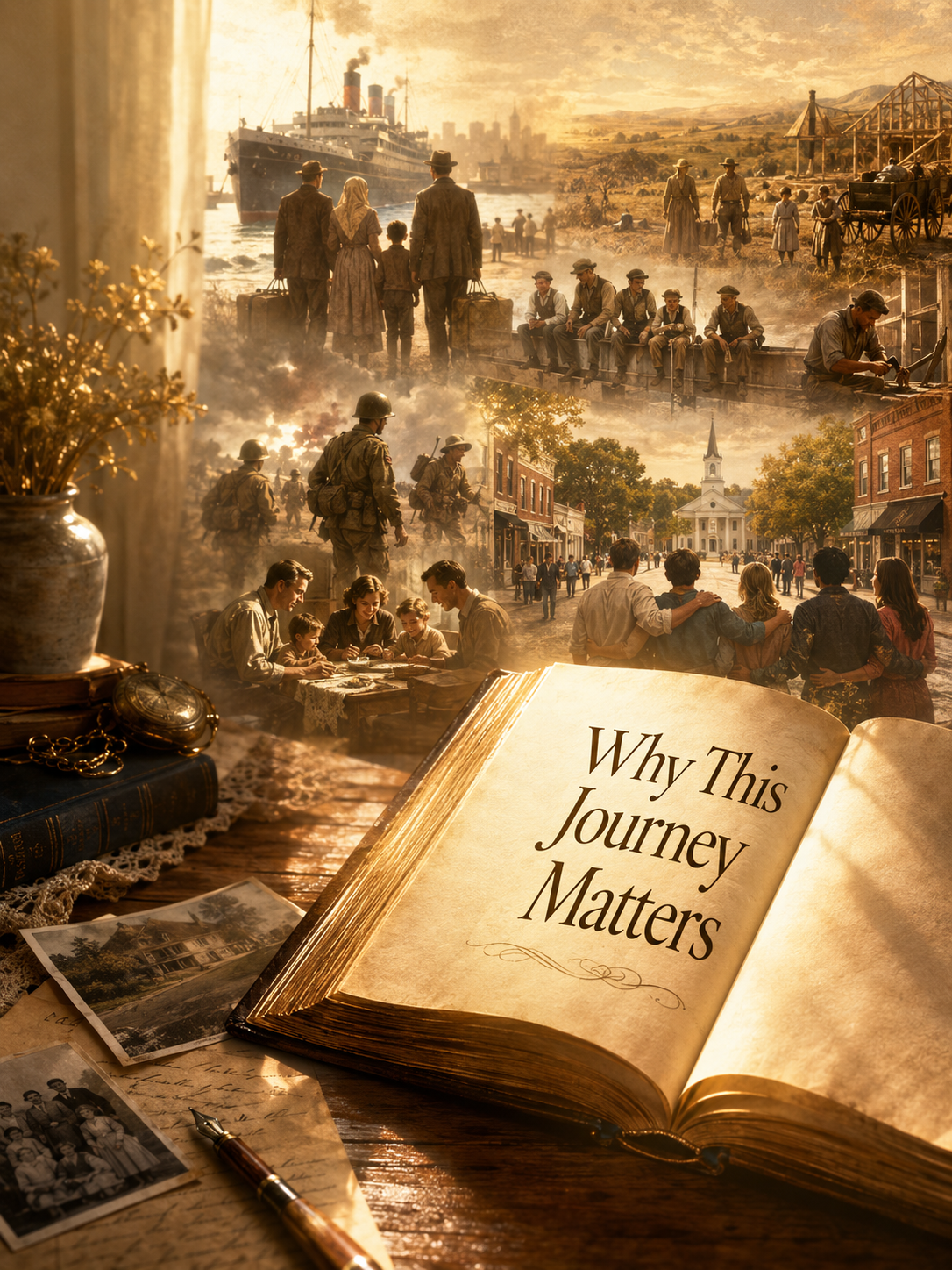
History only becomes wisdom when we remember the people who lived it.
A World Moving Faster Than Memory
We live in a world moving faster than any generation before us could have imagined. Information reaches us instantly. News changes by the hour. Answers appear on screens in seconds. We can look up almost any date, name, battle, law, invention, or event without ever opening a book. And yet, with all that information around us, many people feel more disconnected than ever — disconnected from the past, disconnected from each other, and disconnected from any clear understanding of how we got here.
That is one of the reasons this journey matters. Information can tell us what happened, but memory helps us understand why it mattered. Facts can be useful, but facts alone do not create wisdom. Wisdom comes when we begin to understand the human cost behind those facts — the fear, courage, sacrifice, responsibility, and hope carried by the people who came before us.
What We Were Not Handed
Many people today were never truly handed history in a way that reached their heart. They may have memorized dates, studied for tests, or heard familiar names like Washington, Jefferson, Lincoln, Edison, Roosevelt, King, or Kennedy. But too often, history was presented as something distant, flat, and already finished — old paper, old portraits, old wars, and old names.
But history was never only that. History was mothers and fathers making impossible decisions. It was families leaving everything familiar behind. It was people crossing oceans without knowing if they would survive. It was neighbors building homes, towns, farms, churches, schools, roads, workshops, and communities from almost nothing. It was ordinary people carrying responsibility through uncertainty.
When that part is missing, history becomes cold. And when history becomes cold, people stop feeling connected to it. They may know that something happened, but they do not feel why it mattered. They do not see the human beings inside the story. They do not recognize the inheritance that was handed forward.
The Cost Behind Comfort
One of the easiest things for modern people to forget is that comfort did not appear by accident. The world we inherited was built slowly by hands that worked harder than most of us can imagine. It was built by people who endured sickness, hunger, loss, danger, fear, war, failure, grief, and uncertainty. Many of them never lived long enough to enjoy the full fruit of what they helped build.
They worked for children they would never see grow old. They sacrificed for grandchildren they would never meet. They carried burdens so future generations might have a better chance.
That does not mean the past was perfect. It was not. Human beings have always been imperfect, and honest history must be willing to face both courage and failure. But imperfection does not erase sacrifice. Failure does not erase endurance. Hard truth does not erase the dignity of those who kept building anyway.
That is why gratitude matters.
Not blind gratitude. Not shallow gratitude. Not pretending everything was easy or everyone was treated fairly. I mean the kind of gratitude that comes from understanding cost. When we understand what people endured before us, it becomes harder to take our lives for granted. It becomes harder to see freedom as automatic. It becomes harder to enjoy comfort without remembering sacrifice.
History Is A Human Chain
History is not simply a record of the dead. It is a human chain. One generation struggles, builds, learns, fails, sacrifices, and carries something forward. The next generation receives it, whether they understand the cost or not. Then that generation must decide what it will do with what it has been given.
This is why history cannot belong only to scholars, teachers, museums, or textbooks. History belongs to the people who inherit its consequences. It belongs to families, communities, children, and nations. It belongs to anyone trying to understand where they came from, what was handed to them, and what they are responsible for carrying forward.
This journey is not about politics. It is not about anger. It is not about worshiping the past or pretending America has always lived up to its highest ideals. America has always been a human story, and human stories are complicated. There is courage in this story, and there is failure. There is sacrifice, and there is injustice. There is vision, and there is blindness.
To remember honestly is not to make the past simple.
It is to make the present wiser.
Why We Begin
Many people are hungry for connection and do not know where to find it. Beneath the noise of modern life, many are looking for something steady — something older than the moment, something that reminds them they are part of a larger human story.
That is what history can give us when it is told with honesty and heart. It reminds us that we are not the first people to face uncertainty, division, hardship, or fear about the future. Others walked through uncertainty before us. Others carried responsibility before us. Others sacrificed for a future they would never fully see.
In the chapters ahead, we will walk slowly through the American story together. We will begin before America had a name. We will look at the world people left behind, the ocean they crossed, the new life they tried to build, and the generations that followed. We will see hardship, courage, disagreement, sacrifice, expansion, conflict, invention, failure, rebuilding, and hope.
But the purpose is not simply to learn what happened. The purpose is to remember the people. The purpose is to see them not as statues, dates, or distant figures, but as human beings who carried fear, faith, exhaustion, love, responsibility, and hope through their own uncertain time.
If we remember them well, we may recover deeper gratitude, stronger responsibility, and a clearer sense of belonging.
That is why this journey matters.