Chapter 16
The First Sparks of Revolution
Tension Finally Turned Physical
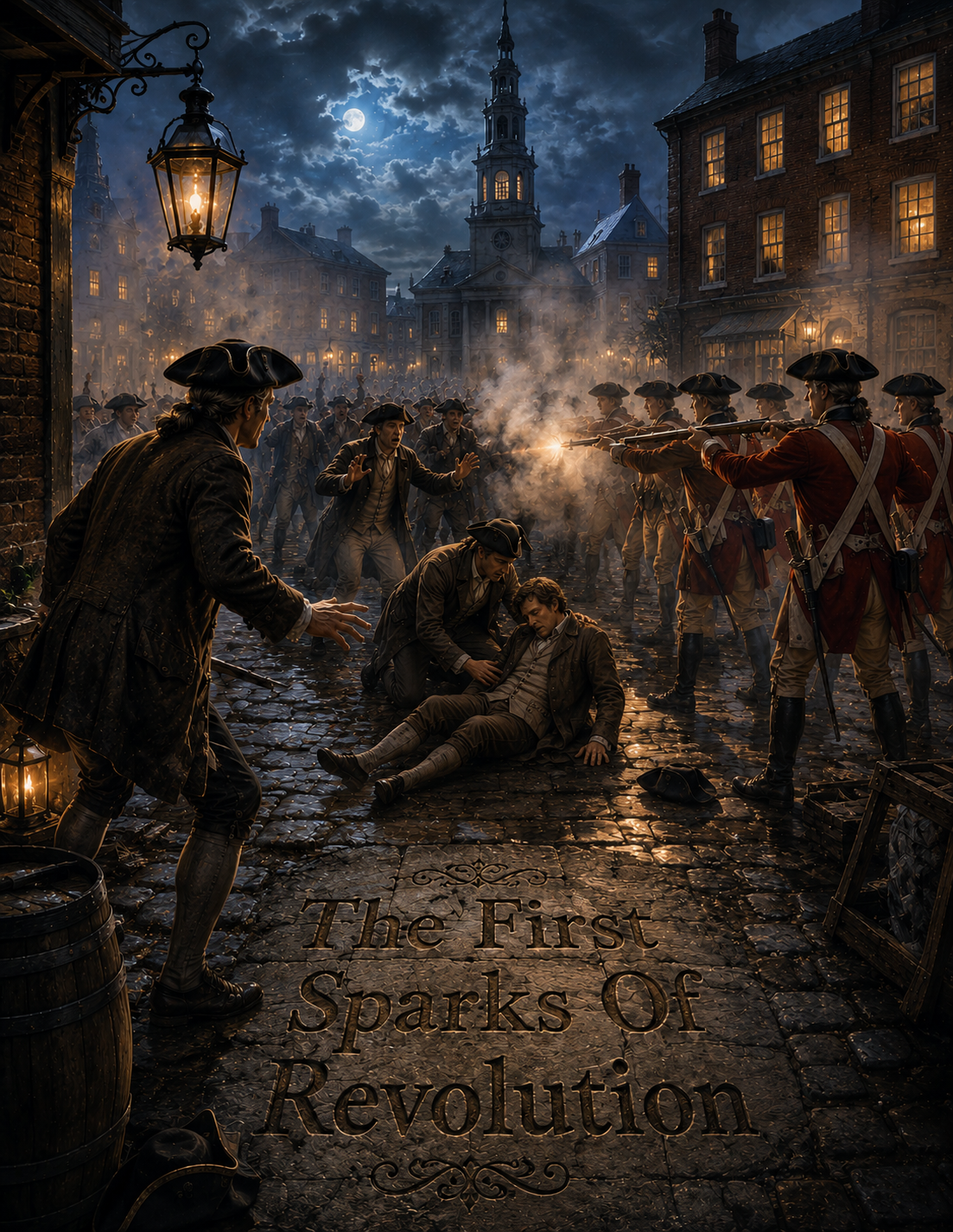
For years, frustration had been building across the colonies.
Taxes, trade restrictions, distant authority, public protest, boycotts, pamphlets, and arguments had changed the emotional atmosphere of colonial life. What had once been disagreement was becoming something more dangerous. Anger no longer stayed safely inside private conversation. Fear no longer belonged to only one side.
British soldiers and colonists increasingly confronted one another in cities and ports.
The presence of troops made some colonists feel watched, controlled, and threatened. The anger of crowds made some soldiers feel surrounded, hated, and endangered. Every look, word, shove, insult, or rumor could carry more weight than it once had.
Ordinary disagreements began carrying the possibility of violence.
That is how history often approaches its breaking points. Not all at once. Not always with one clear warning. Pressure builds slowly until a moment arrives when people are no longer only debating ideas.
They are standing close enough for fear to become action.
Boston Became A Flashpoint
Boston became one of the places where tension felt most visible.
British troops maintained a presence in the city, and many colonists viewed those soldiers as living symbols of control. To some, the red coats represented order and imperial authority. To others, they represented distant power pressing into local life.
Daily life became charged with suspicion.
Soldiers and civilians crossed paths in streets, shops, taverns, docks, and public spaces. Small conflicts could escalate quickly because people were no longer reacting only to the moment in front of them. They were reacting to years of resentment, anxiety, insult, and mistrust.
A city can become dangerous when people stop seeing one another clearly.
Colonists could look at soldiers and see oppression. Soldiers could look at colonists and see hostility. Each side carried fear, and fear changes what people think they see.
In that kind of atmosphere, even confusion can become deadly.
Fear Controlled Both Sides
Fear controlled both sides more than either side may have fully understood.
Colonists feared losing their freedoms, their voice, their local authority, and the future they believed they had earned through generations of work and sacrifice. They feared that if distant power could tax, command, and occupy without true consent, then more control would follow.
British soldiers had fears of their own.
Many were young men far from home, placed among people who resented their presence. They faced hostile crowds, insults, threats, and uncertainty. They could not know when anger would remain words and when it might turn physical.
A frightened soldier with a weapon is a dangerous thing.
A frightened crowd is dangerous too.
Rumors spread constantly. In tense times, rumor can move faster than truth. People begin reacting not only to what happened, but to what they heard, what they feared, and what they believed might happen next.
Uncertainty made every confrontation more dangerous because trust had already been weakened.
The Boston Massacre
Then came the moment remembered as the Boston Massacre.
Confusion, shouting, anger, and panic erupted in the street. A confrontation that might once have ended as another ugly exchange suddenly became something far worse. Shots were fired into the crowd. Ordinary citizens were killed.
Blood had now entered the story.
The event shocked the colonies. It was not the beginning of the American Revolution as a war, but it was one of the moments that made peaceful resolution feel less certain. What had been political argument now had bodies attached to it. What had been debate now had mourning. What had been anger now had grief.
In the aftermath, people were forced to ask what the tragedy meant.
Was it proof of tyranny? Was it the result of panic? Was it murder, confusion, provocation, fear, or some terrible mixture of all of them?
History rarely arrives in perfect simplicity.
But the emotional impact was undeniable.
A line had been crossed.
The Emotional Impact
Grief spread quickly.
Families mourned. Communities talked. Anger deepened. Trust between the colonies and Britain weakened dramatically. Many colonists who already felt uneasy now saw the presence of British troops as even more dangerous.
The idea that soldiers could fire on civilians became a powerful emotional wound.
Moments like this do not remain only events. They become memory. They become symbols. They become stories people tell one another when they are trying to understand what kind of future they are living inside.
The Boston Massacre became larger than the street where it happened because it touched fears already alive across the colonies.
For many, peaceful resolution began to feel less likely.
That does not mean everyone immediately wanted war. Many still feared war deeply. Many still hoped reconciliation might be possible. But after blood was spilled, the relationship between authority and trust changed.
It became harder to believe that the old bonds could simply be repaired.
The Power Of Story
News of the event spread rapidly through newspapers, engravings, speeches, letters, and public discussion.
The story traveled beyond Boston and into the wider colonial imagination. People who had not been there came to feel the event through words and images. In that way, the event became more than a local tragedy.
It became a shared colonial memory.
The power of story matters. How people understand an event can shape what they are willing to believe, defend, forgive, or resist. The Boston Massacre helped unify many colonists emotionally because it gave form to their fears.
It showed them an image of distant authority turned dangerous in the streets of colonial life.
Shared outrage accelerated the growth of American identity. Colonists in different places could look at Boston and feel that what happened there mattered to them too. The pain of one city became part of a larger colonial awakening.
The story helped people see themselves as connected, not only by complaint, but by common danger and shared grief.
Fear can escalate conflict quickly. Anger can narrow judgment. Rumor can harden suspicion. Ordinary people can become trapped inside larger historical forces before they fully understand what is happening around them.
Moments of panic can alter history forever.
One confrontation, one shouted word, one misunderstood movement, one frightened decision, one shot, one death — any of these can change the emotional direction of a people.
That is why strong societies require both liberty and restraint.
Freedom needs courage, but it also needs wisdom. Anger may be understandable, but it can become dangerous when empathy disappears.
The Boston Massacre reminds us that peace is fragile.
It is not preserved by accident. It requires trust, patience, self-control, honest leadership, and people willing to see one another as human even when tension is high.
When fear takes over, history can move with frightening speed.
This chapter matters because it shows the moment when political tension became physical consequence.
The colonies had not yet declared independence. Revolution had not yet fully arrived. But the emotional ground had changed. Blood had been spilled. Grief had entered the argument. Trust had weakened. The idea of peaceful resolution had become harder to hold.
The first sparks of revolution were not only in the shots themselves.
They were in the fear before them, the grief after them, and the story that spread from them. They were in the realization that the conflict between the colonies and Britain was no longer only about taxes, trade, or representation.
It was becoming about power, dignity, safety, memory, and the future.
From here, resistance would become increasingly organized. Acts of defiance would grow bolder. British authority would face colonial anger with tightening control, and colonial resistance would answer with greater resolve.
The road toward revolution was no longer hidden in the distance.
It had begun to glow at the edge of history.