Chapter 21
The Shot Heard Around the World
As the smoke rose over Lexington and Concord, ordinary people unknowingly stepped into a moment that would forever remind future generations that freedom is never inherited without sacrifice.
The British Began Marching
British troops moved toward Concord because weapons and supplies were believed to be hidden there.
For months, tension had been building across the colonies. Resistance had grown more organized. Militias had trained. Supplies had been gathered. Rumors had spread from town to town, and many people feared that armed conflict was no longer a distant possibility.
Still, knowing danger may come is different from watching it arrive.
The movement of British troops changed the atmosphere of the night. What had been anxiety now became urgency. Roads, homes, taverns, churches, farms, and village paths suddenly belonged to a larger story. Ordinary communities were being pulled toward a moment no one could fully control.
The people living through that night did not know they were standing at the beginning of a revolution.
They knew only that soldiers were marching, warnings had to be carried, and something terrible might happen before morning.
Riders Carried The Warning
Messages spread through the night.
Riders moved across dark roads carrying urgent warnings to towns and villages. Doors opened. Families woke suddenly. Men listened, dressed, gathered what they could, and prepared themselves for what might come. Church bells rang. Neighbors spoke in low voices.
The quiet of ordinary life gave way to the sound of alarm.
That warning mattered because history often depends on people who move before certainty arrives. No one could know exactly where the confrontation would happen or how far it would go. But communities understood that being unprepared could cost them everything.
The warning gave ordinary people a chance to stand together before events overtook them.
Imagine the emotional weight of those hours.
A father leaving home before dawn.
A wife watching him go.
A neighbor stepping into the road with a musket.
A church bell cutting through darkness.
A village realizing that the future might arrive before sunrise.
Lexington Green
On Lexington Green, militia members gathered quietly.
They were farmers, fathers, tradesmen, neighbors, sons, husbands, and local citizens. Many were not trained soldiers in the professional sense. They were ordinary men standing in defense of their community at a moment when no one could fully know what obedience, courage, caution, or resistance would require.
Across from them stood British troops, part of the most powerful military empire on Earth.
The imbalance must have been overwhelming. The colonists were not facing a small local authority. They were facing disciplined soldiers backed by an empire with ships, weapons, wealth, and command.
That is what makes the moment so powerful.
The men on Lexington Green were not certain of victory. They were not standing in a finished myth. They were standing in a real morning, on real ground, with fear in their bodies and uncertainty in the air.
Fear Filled The Morning Air
Fear filled the morning air.
Confusion surrounded both sides. Commands were shouted. Men shifted. Weapons were held. No one fully knew what would happen next. In such moments, the smallest movement can seem larger than it is. A sound, a shout, a misunderstanding, or a nervous decision can carry the weight of months of tension.
The British soldiers had reason to be tense.
The colonists had reason to be afraid.
Each side looked at the other through suspicion, rumor, anger, and expectation. Peace becomes fragile when people stop trusting what the other side intends.
This is where history becomes painfully human.
We often remember the result more clearly than the uncertainty. But those standing there did not know the result. They were inside the moment before the world changed.
Fear and courage stood side by side, and the morning held its breath.
The First Shots
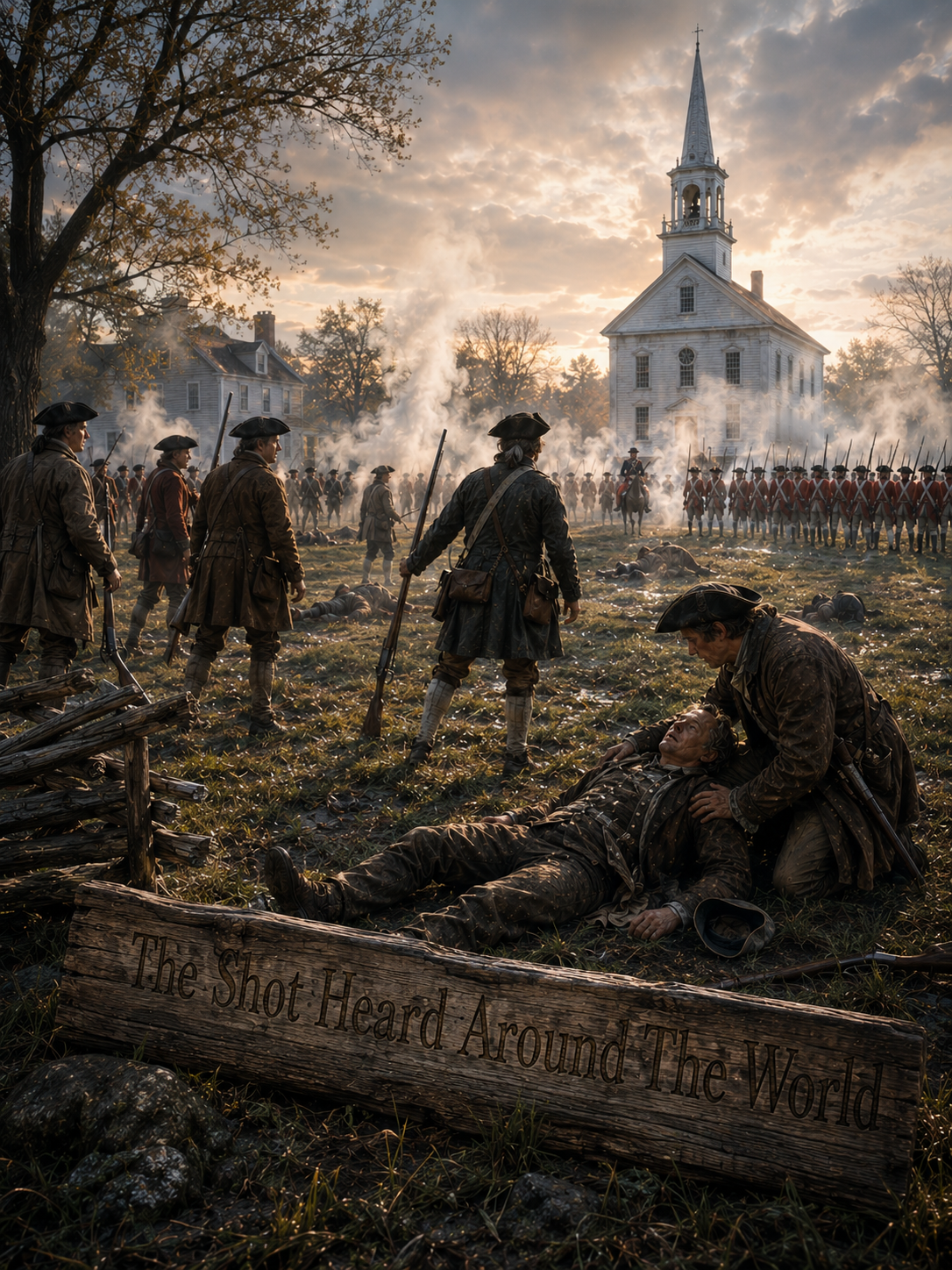
Then a shot rang out.
History changed instantly.
Smoke filled the air. Men fell. The American Revolution had begun.
No one standing there could have understood the full meaning of that sound. They could not see the years of war ahead. They could not see the suffering, hunger, sacrifice, courage, defeat, endurance, and eventual independence that would follow. They could not see future generations repeating the phrase “the shot heard around the world.”
They only knew that blood had been spilled and that something irreversible had begun.
That first violence transformed everything.
Words, petitions, protests, boycotts, meetings, warnings, and preparation had all led to this edge. Once shots were fired, the struggle was no longer only political. It had entered the body. It had entered families. It had entered grief.
Freedom now carried a visible cost.
The people in that moment were human beings before they were symbols.
Some stood from conviction. Some stood from fear. Some stood because their neighbors stood beside them. Some may have wondered whether they would survive the morning. Some may have prayed. Some may have thought of home.
That humanity matters.
If we turn them only into legend, we lose the truth. They were not statues. They were men with trembling hands, families waiting, bodies vulnerable to pain, and futures they could not see.
The courage of the moment becomes more powerful when we remember that they were ordinary people.
Human nature never changes as much as we think. Courage and fear can exist at the same time. Ordinary individuals can be caught in extraordinary moments. Small decisions can alter the course of civilization.
Freedom has always carried sacrifice because human beings must eventually decide what they are willing to defend.
The Emotional Aftermath
After the shots, grief spread quickly.
Families mourned. Communities absorbed the news. Resolve deepened, but uncertainty remained everywhere. The colonies had crossed into a new reality. There would be no easy return to the way things had been.
The emotional aftermath mattered as much as the gunfire itself.
News traveled. People repeated what had happened. Anger grew. Fear grew. Determination grew. Men who had hoped conflict could still be avoided now had to face the fact that armed confrontation had arrived.
The shot heard around the world was not only heard because it echoed across a battlefield.
It was heard because it carried a question through history:
What is freedom worth, and who will bear the cost of defending it?
Freedom has never been free of cost.
Future generations inherit the consequences of courage and sacrifice, even when they do not personally remember the fear that produced them. Ordinary people possess more power than they often realize, especially when history places responsibility in their hands.
Every generation eventually decides what it is willing to defend.
That is why this chapter matters. Lexington and Concord remind us that history does not only belong to famous leaders. It also belongs to the people who stand when they are afraid, answer when they are called, and carry responsibility before they know how the story will end.
The colonies now fully enter war.
Ordinary citizens become soldiers. The struggle for independence begins shaping a new nation. The road ahead will demand endurance, sacrifice, leadership, hardship, and faith in a future no one could yet guarantee.