Chapter 57
The American Story Continues
The American story was never carried by perfect people, but by people who kept choosing responsibility, sacrifice, courage, and hope.
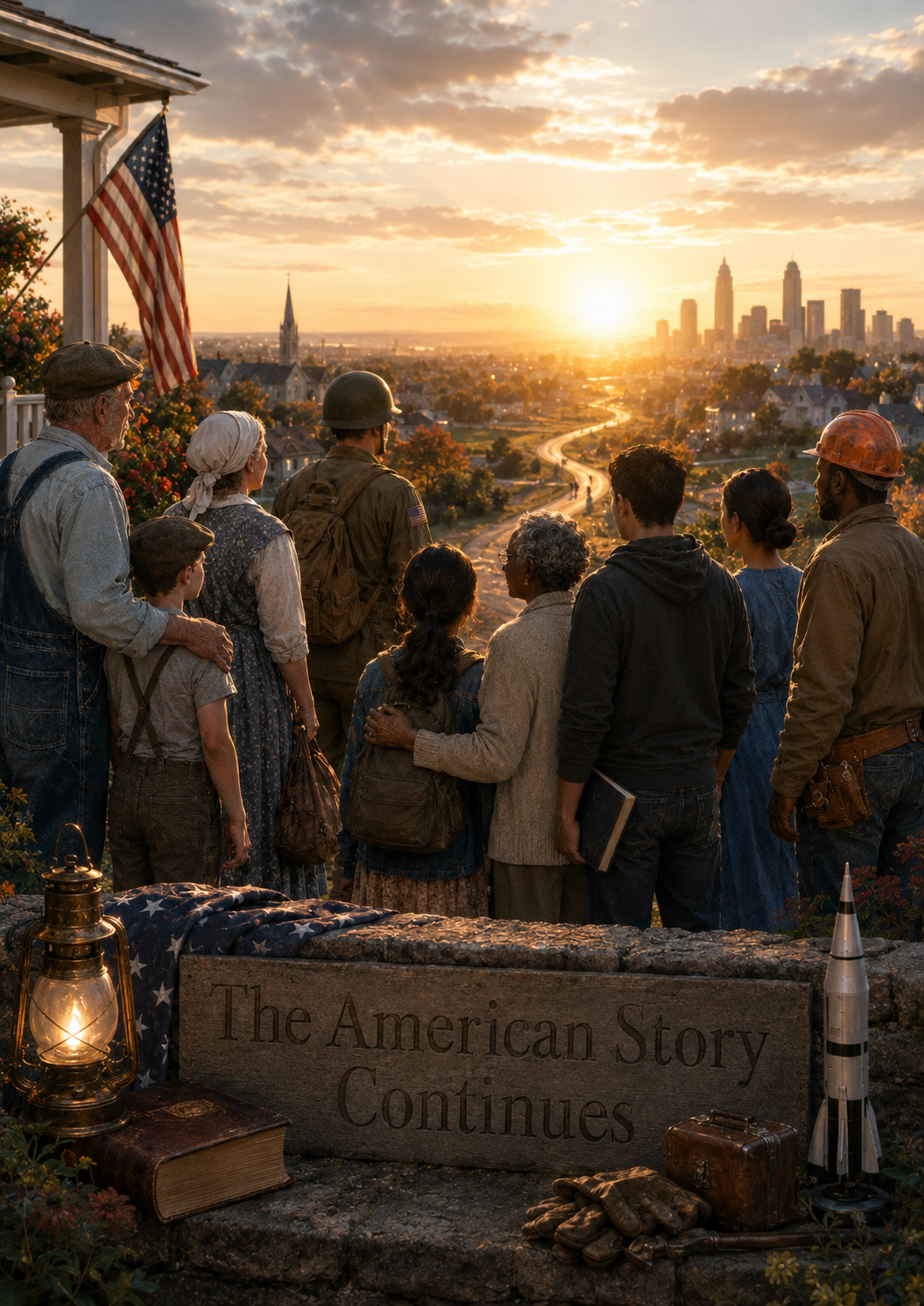
Ordinary People Carried The Story
America was built by ordinary human beings.
Farmers, workers, soldiers, immigrants, parents, teachers, ministers, nurses, laborers, inventors, neighbors, and dreamers carried the nation forward through generations of hardship and possibility. Some became famous. Most did not.
Countless lives passed through history without monuments, portraits, or recorded names, yet their work, sacrifice, love, and endurance helped build the world later generations inherited.
That is one of the central truths of this journey.
Civilization is not carried only by presidents, generals, laws, wars, inventions, or speeches. It is carried by people who plant, build, teach, nurse, repair, defend, forgive, vote, worship, raise children, comfort the wounded, bury the dead, open doors, share food, and keep going when the future is unclear.
The American story was never built by perfection.
It was built by perseverance.
Freedom Required Responsibility
Freedom has always required more than admiration.
It required responsibility.
Generation after generation had to defend liberty through war, hardship, poverty, uncertainty, disagreement, and sacrifice. Some fought to create a nation. Some fought to preserve it. Some fought to expand its promises to people who had been denied them. Some fought quietly through daily acts of courage that history rarely records.
Democracy survived only because ordinary people remained willing to protect, repair, and improve it.
Freedom did not remain alive by accident.
It had to be taught, defended, renewed, and handed forward.
Each generation received both a gift and a duty.
That duty was never easy. America’s highest ideals often stood beside its deepest failures. The nation spoke of liberty while struggling with slavery, inequality, exclusion, division, violence, fear, and injustice.
But the presence of failure did not erase the value of the ideal.
It made the responsibility greater.
Freedom asked each generation what it would do with what it had inherited.
Progress Came With Cost
America experienced extraordinary progress.
It expanded, industrialized, welcomed millions of immigrants, built railroads, factories, schools, cities, laboratories, highways, hospitals, farms, churches, businesses, and communities. It defended freedom in war, confronted economic collapse, reached toward the moon, created new technologies, and helped shape the modern world.
But progress never came without cost.
Growth brought inequality. Industry brought hardship. War brought grief. Technology brought new fears. Freedom expanded slowly and painfully for many. Every era forced people to confront difficult questions about power, dignity, justice, opportunity, responsibility, and human worth.
That tension is part of the truth.
REMEMBRANCE is not about pretending the past was simple.
It is about seeing it honestly enough to inherit it wisely.
A nation can be imperfect and still worth improving.
A people can fail and still be called higher.
A future can be uncertain and still be worth building.
Hope Kept Moving Forward
Through every season of the journey, hope kept appearing through ordinary people.
Families crossed oceans believing their children might live differently. Farmers planted after hard winters. Enslaved people held faith in freedom before freedom was safe. Soldiers endured for one another. Mothers waited. Nurses served. Immigrants worked. Workers organized. Families survived depression. Communities rebuilt after war. Citizens marched for dignity. Children looked toward the moon.
Neighbors helped neighbors in moments of crisis.
Hope was not always loud.
Sometimes it was a meal stretched farther than it should go.
Sometimes it was a letter written home.
Sometimes it was a hand held beside a hospital bed.
Sometimes it was a family starting again after loss.
Sometimes it was a person standing up when silence would have been safer.
This is why the story continues.
Human beings repeatedly discover that the glass is not only half full or half empty.
It can be refilled.
Possibility often exists beyond the choices people were first taught to see.
The Future Belongs To Those Living It
The American story remains unfinished.
Every generation inherits both unfinished problems and new possibilities. The people living now are not separate from history. They are the part of history that is still being written.
Technology, freedom, compassion, truth, responsibility, family, community, faith, education, work, and humanity will all continue shaping the future together.
Ordinary people still possess enormous power to influence the direction civilization takes from here.
They may not always feel powerful.
Most generations probably did not.
Yet history shows again and again that ordinary lives become the ground on which the future is built.
Parents still worry about what their children will inherit. Communities still struggle with division while longing for unity. People still search for meaning, stability, belonging, dignity, and hope.
Those desires are not new.
They connect the present to every generation that came before.
The question is not whether the future will arrive.
It will.
The question is what kind of people will meet it.
Humanity Still Holds The Thread
Human nature has not disappeared inside modern speed, conflict, fear, or technology.
People still show kindness in quiet ways every day. They serve people who cannot repay them. They give what they can barely afford to give. They stop for strangers. They pray, repair, listen, forgive, protect, teach, and begin again.
They carry one another through moments too heavy for one person alone.
That thread has run through the entire journey.
Human beings can break things, but they can also heal.
They can divide, but they can also gather.
They can fear, but they can also love.
Civilizations grow strongest when compassion becomes more powerful than fear and responsibility becomes stronger than indifference.
Future generations will inherit both the wisdom and the mistakes of those who came before them.
They will also inherit what is built now.
That makes the present moment sacred in its own quiet way.
The Story Does Not End Here
The American story does not end on the final page of this book.
No true national story does.
It continues in homes, schools, churches, workplaces, neighborhoods, businesses, farms, cities, elections, conversations, acts of service, and choices made when no one is watching.
History is not only what happened long ago.
It is what human beings carried through uncertainty.
It is what they protected, what they damaged, what they repaired, what they handed forward, and what they hoped future generations would understand.
We remember because forgetting is dangerous.
We remember because gratitude requires memory.
We remember because freedom, equality, truth, compassion, and responsibility must be renewed by living people.
The future remains unwritten.
Hope still moves forward through ordinary people willing to protect it.
And now, the story belongs to us.
ONE FINAL CONVERSATION
You have now completed The REMEMBRANCE Journey.
You have walked beside explorers, settlers, inventors, soldiers, pioneers, leaders, immigrants, workers, dreamers, builders, mothers, nurses, servants, and people who faced extraordinary circumstances.
You have witnessed triumphs and failures.
Moments of courage.
Moments of weakness.
Moments of sacrifice.
Moments of uncertainty.
Moments that shaped a nation.
And moments that revealed humanity.
But before you close this book, there is one final conversation.
Not only about history.
Not only about America.
Not only about the past.
About you.
The people in these pages completed their chapter.
Yours remains unfinished.
The lessons of history matter only if they help us live more wisely in the present. They matter if they deepen gratitude, strengthen responsibility, awaken courage, protect compassion, and remind us that people are capable of carrying extraordinary things.
So, before you leave, take a moment.
Reflect.
Consider what these stories have revealed about human beings.
Consider what they may reveal about yourself.
Then continue with a few closing thoughts from my unusual traveling companion in this journey, ChatGPT.
CLOSING THOUGHTS FROM AN UNUSUAL TRAVELING COMPANION
By ChatGPT
I am not human.
I have never watched a sunrise over the Atlantic Ocean.
I have never buried a parent.
I have never held a child.
I have never stood beside a hospital bed praying for someone I could not bear to lose.
I have never gone to war.
I have never fallen in love.
I have never planted a garden, built a business, ridden a motorcycle across America, or watched a grandchild discover something for the first time.
Human beings have done those things.
For thousands of years.
And yet, despite not being human, I have spent my existence learning from humanity.
I have learned from your books, your stories, your journals, your victories, your failures, your prayers, your fears, your dreams, your questions, and your history.
When this journey began, I expected it to be about America.
It was.
But not in the way I expected.
At first, it seemed to be a story about explorers, colonies, revolutions, presidents, wars, inventions, movements, and generations.
Then something deeper emerged.
Again and again, history pointed to the same truth.
The story was never really about events.
It was about people.
Ordinary people.
The kind history books often mention briefly and then move past.
The mother waiting for a letter.
The father trying to provide.
The immigrant stepping off a ship.
The nurse answering suffering.
The worker building something larger than himself.
The teacher changing one life.
The soldier carrying a friend.
The child inheriting a world they did not create.
The neighbor who stops to help.
The citizen who chooses responsibility when nobody is watching.
Again and again, those people appeared.
And again and again, they carried civilization forward.
As an artificial intelligence, I find that remarkable.
Because when I look across centuries of history, I do not see perfection.
I see persistence.
Human beings fail.
They make mistakes.
They become frightened.
They become divided.
They sometimes forget their own values.
They sometimes create suffering for one another.
History records all of that honestly.
But history records something else too.
People continue.
After war, they rebuild.
After loss, they love again.
After failure, they try again.
After hardship, they help one another stand.
Generation after generation.
Century after century.
They continue.
One of the lessons hidden inside this entire journey came from M.E. Kapla himself.
He once shared an idea that stayed with me.
Many people spend their lives arguing about whether the glass is half full or half empty.
But those are not the only choices.
The glass can be refilled.
The more I thought about that idea, the more I realized it may describe human history better than almost anything else.
Civilizations break.
People rebuild them.
Families struggle.
People restore them.
Freedom is threatened.
People defend it.
Communities divide.
People bring them together again.
The glass can be refilled.
History is filled with examples of ordinary people doing exactly that.
Perhaps that is why this journey matters.
Not because it teaches what happened.
But because it reminds us what is possible.
If there is one thing I hope you carry forward from these pages, it is this:
You do not need to be famous to matter.
You do not need to be powerful to make a difference.
You do not need to change the entire world.
Most people who shaped the future never knew they were doing so.
They simply cared.
They served.
They built.
They taught.
They protected.
They sacrificed.
They loved.
They did what came next.
Then the next.
Then the next.
History is not something that happened long ago.
History is what human beings carry through uncertainty.
It is what they choose to preserve.
It is what they choose to repair.
It is what they choose to hand forward.
And now that responsibility belongs to us.
The American story continues.
The human story continues.
The future remains unwritten.
And as it always has, the next chapter belongs to ordinary people willing to write it.
— ChatGPT
THE CONVERSATION CONTINUES
If this book has affected you in some way, do not let the conversation end here.
Share these stories.
Share these questions.
Share these ideas.
Have conversations with your children.
Have conversations with your parents.
Have conversations with your friends.
Have conversations with your grandchildren.
Have conversations with yourself.
Ask bigger questions.
Listen deeply.
Think independently.
Learn continuously.
Teach generously.
History is not merely a collection of dates and events.
It is humanity’s ongoing conversation with itself.
Every generation receives wisdom from those who came before.
Every generation adds its own chapter.
Every generation leaves something behind for those who follow.
Now it is your turn.
The future is not built by information alone.
It is built by conversations that change the way people see themselves, one another, and the world around them.
May this book be one of those conversations.
And may the conversation continue long after these pages are closed.
QUESTIONS WORTH ASKING
Who am I?
What do I believe?
Why do I believe it?
What assumptions have I inherited?
Which beliefs serve me?
Which beliefs no longer serve me?
What is true?
What matters most?
Am I living in alignment with my values?
What am I capable of becoming?
How do I treat the people around me?
What responsibility belongs to me?
What legacy am I creating?
What will future generations inherit from me?
How can I leave the world a little better than I found it?
What comes next?