Chapter 56
Modern America Faces Division and Transformation
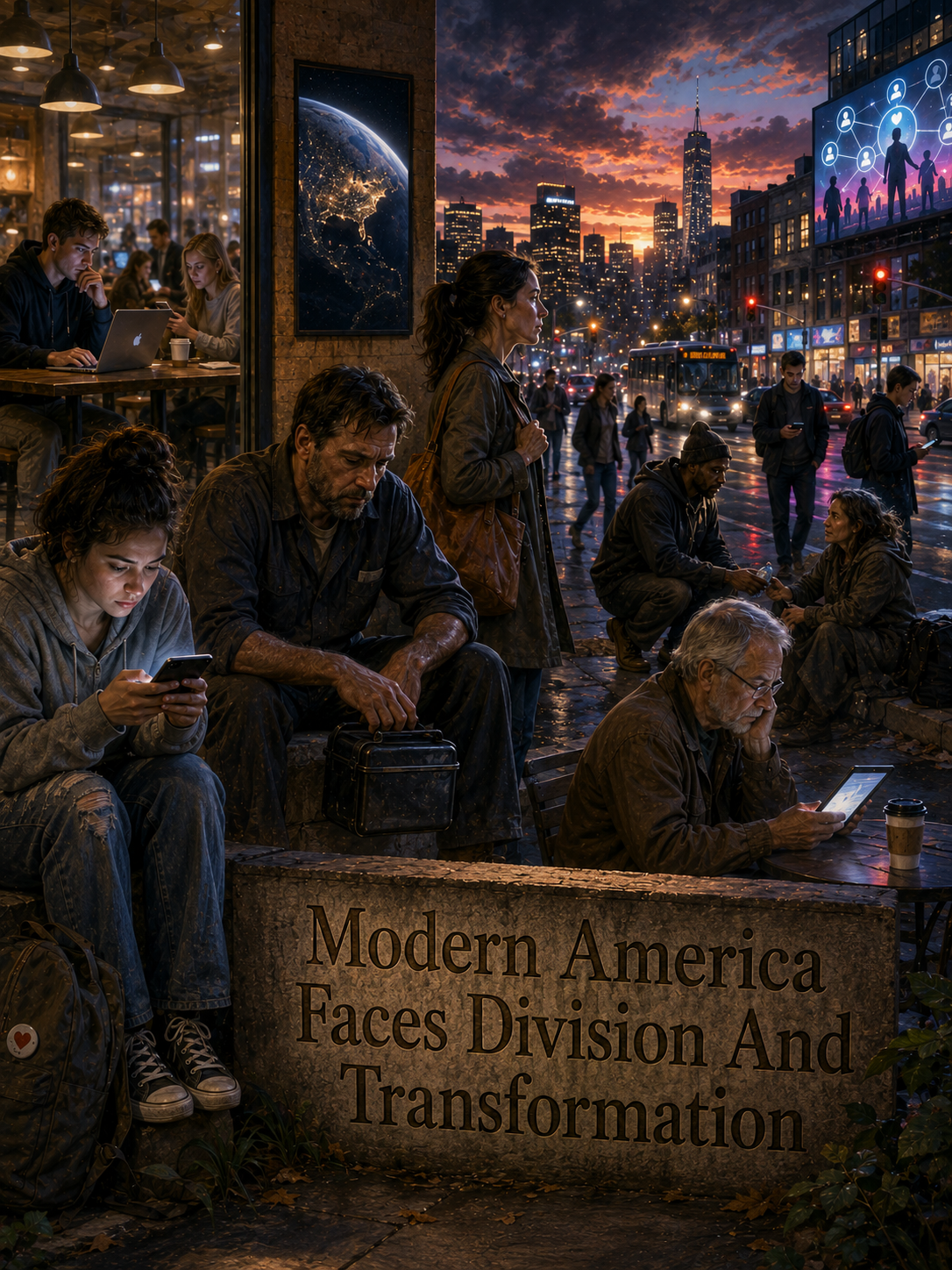
Modern Americans became more connected than any generation before them, yet many quietly wondered whether connection without compassion could hold a nation together.
The World Sped Up Again
Modern America entered an age of connection unlike anything previous generations had known. Computers, smartphones, the internet, satellites, digital systems, and instant communication changed how people worked, learned, bought, argued, prayed, remembered, and belonged. Information that once moved by newspaper, letter, radio, or evening broadcast now moved in seconds.
For ordinary people, this transformation was both powerful and overwhelming. Families could speak across great distances. Businesses could reach the world. Students could learn from sources their grandparents could never have imagined. A person could hold more information in one hand than earlier generations could find in a library.
But speed changed the emotional atmosphere of life. The day became crowded with messages, alerts, images, opinions, warnings, and demands. People became more connected technologically, yet many felt less settled inside themselves. The modern world gave people access to almost everything, but access was not the same thing as peace.
Connection Did Not Always Create Trust
As communication expanded, division also intensified. Political and cultural disagreements moved faster and reached deeper into daily life. Social media allowed people to speak, organize, learn, encourage, and share, but it also amplified anger, fear, suspicion, and misunderstanding. The screen became a window, a weapon, a marketplace, a classroom, a mirror, and sometimes a wall.
Many Americans struggled to know whom to trust. Institutions, media, leaders, neighbors, and even family members were questioned in new ways. People heard more voices than ever before, but more voices did not always create more wisdom. Sometimes it created exhaustion.
This became one of the great modern contradictions. A person could be surrounded by information and still feel confused. A person could be watched by many and still feel unseen. A person could argue with strangers across the world while losing patience with someone across the table. Modern connection had become powerful, but it had not automatically made people more humane.
Work And Community Changed
Globalization reshaped communities, industries, and families. Jobs, factories, supply chains, markets, and economies became connected across nations. Some communities experienced growth, opportunity, new careers, and wider possibilities. Others watched longtime industries decline, local identity weaken, and familiar work disappear.
For ordinary families, these changes were not abstract. They affected paychecks, homes, schools, marriages, neighborhoods, and the future people imagined for their children. A factory closing was not merely an economic statistic. It was a family wondering what came next. A new technology was not merely innovation. It could be opportunity for one person and uncertainty for another.
Modern America became a place where possibility and anxiety often lived side by side. Some people felt the future opening. Others felt the ground moving beneath them. Many carried the quiet worry that the world was changing faster than they could understand.
New Generations Asked New Questions
Younger generations entered a society already transformed by technology, cultural change, and constant information. They asked new questions about identity, equality, race, gender, immigration, freedom, responsibility, opportunity, and belonging. Some Americans embraced these changes as necessary growth. Others feared that traditions, stability, and older forms of shared meaning were being lost.
This tension is not new in human history. Every generation receives a world from those before it and then argues over what should be preserved, repaired, rejected, or carried forward. But in modern America, those arguments happened in public, instantly, repeatedly, and often without enough patience to understand one another.
The challenge was not simply disagreement. Healthy societies can survive disagreement. The deeper danger was dehumanization: the habit of turning people into labels, enemies, symbols, categories, or threats. When people stop seeing one another as human beings, truth becomes harder to hear, and compassion becomes harder to practice.
Crisis Revealed What Still Remained
Modern America also faced crisis. Terrorism, economic shocks, natural disasters, social unrest, public health emergencies, isolation, and fear tested communities in painful ways. Many people experienced uncertainty, grief, loneliness, and emotional exhaustion. Some felt that the world had become too fast, too loud, too divided, and too difficult to trust.
And yet, crisis continued to reveal what has always lived beneath the surface of ordinary people. Neighbors helped neighbors. Medical workers served the sick. Families sacrificed for one another. Strangers donated, delivered, rescued, repaired, listened, prayed, and showed up. Even in an age of division, countless people still moved toward suffering when suffering became visible.
That matters. Human nature is not only argument, fear, or selfishness. Again and again, ordinary people show that compassion has not disappeared. It may be covered by noise, distraction, and exhaustion, but it still rises when one human being recognizes the need of another.
Humanity Had To Be Protected
Modern life forced America to ask whether progress could remain connected to wisdom. Technology could strengthen humanity or deepen division depending on how people used it. Information could enlighten or mislead. Connection could build community or feed conflict. Freedom could become responsibility or collapse into isolation.
The tools were never the whole answer. The human spirit still had to choose. Truth had to be protected. Compassion had to be practiced. Families had to be strengthened. Communities had to be rebuilt. Responsibility had to be taught. People had to remember that behind every screen, argument, headline, and opinion was another human being carrying fear, hope, memory, and need.
Future generations will inherit more than devices, systems, platforms, and economies. They will inherit the emotional culture we build around them. They will inherit either stronger communities or deeper fragmentation, depending on whether modern people preserve shared humanity alongside progress.
The Future Was Still Worth Building
Modern America became fast, connected, uncertain, divided, inventive, exhausted, and full of possibility. It carried anxiety and opportunity together. It gave people tools earlier generations could not imagine, while also asking them to live inside pressures earlier generations never had to carry.
But the story was not finished. Millions of Americans still longed for stability, meaning, truth, kindness, responsibility, and unity. Parents still worried about the future their children would inherit. Communities still searched for ways to heal. Ordinary people still hoped that compassion could be stronger than division and that truth could survive the noise.
This chapter matters because the modern world is not separate from history. It is history arriving at our own doorstep. The same human questions remain: What are we building? What are we preserving? What are we handing forward?
Every generation believes its challenges are unique. Yet the deeper story remains remarkably familiar. The colonists, pioneers, immigrants, soldiers, workers, reformers, parents, teachers, nurses, and builders who came before us also faced uncertainty. They too inherited a world they did not fully understand. They too worried about the future. They too struggled to balance fear and hope.
What carried them forward was not perfection. It was the decision to keep building.
The American story has never been the story of people who agreed about everything. It has been the story of people who repeatedly chose to carry something forward despite hardship, disagreement, sacrifice, and change.
The future now waits for another generation to decide what kind of nation, community, family, and civilization it will leave behind.
And that story is still being written.