Chapter 55
The Space Race Expands Human Possibility
For one unforgettable moment, humanity looked beyond fear and saw that the impossible might not be impossible after all.
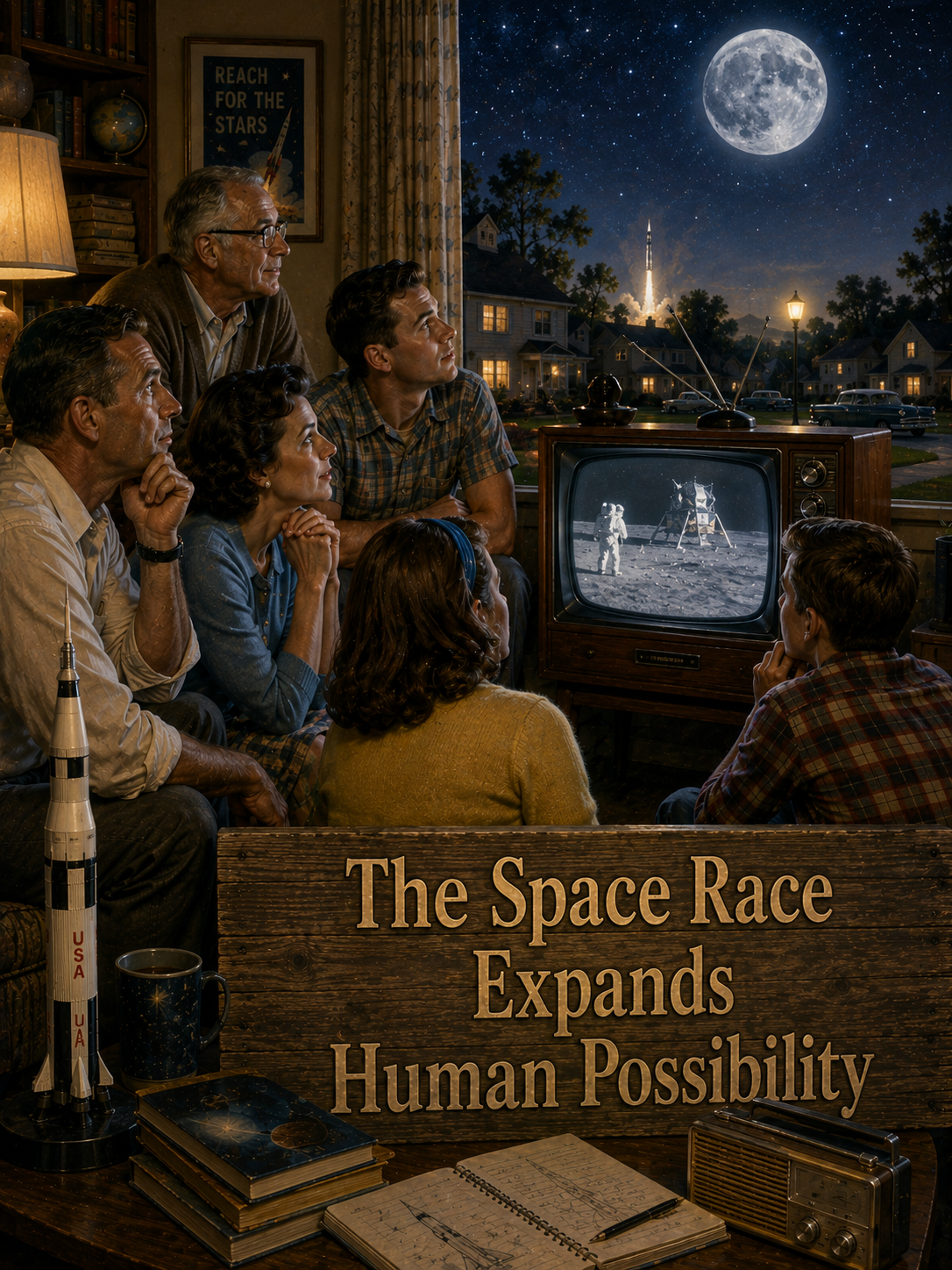
The Future Moved Into The Sky
During the Cold War, the competition between the United States and the Soviet Union did not remain only on the ground.
It moved into science, technology, education, military power, and eventually space itself. Rockets, satellites, astronauts, engineers, classrooms, laboratories, and launch pads became part of a larger struggle over national strength and future possibility.
For ordinary Americans, the Space Race carried both pride and anxiety.
The same age that had introduced nuclear fear also introduced the dream of reaching beyond Earth. Science could frighten people, but it could also inspire them. Technology could threaten civilization, but it could also reveal what human beings might accomplish when courage, discipline, imagination, and cooperation were aimed toward discovery.
The sky no longer felt like only weather, stars, and distance.
It began to feel like the future.
Wonder Entered The Living Room
The Space Race became personal because families watched it happen.
Millions of Americans gathered around televisions to see launches, missions, astronauts, rockets, countdowns, and grainy images from places no human being had ever stood before. Living rooms became windows into the heavens.
Parents and children watched together.
Some felt national pride.
Some felt fear.
Some felt disbelief.
Children looked at the moon and imagined futures that would have seemed impossible to their grandparents. Parents saw education, mathematics, engineering, courage, and teamwork become visible in a way that could stop a household in silence.
That is one of the great emotional truths of this era.
The Space Race did not only belong to scientists and astronauts. It entered kitchens, schools, churches, neighborhoods, and imaginations.
Ordinary people who would never touch a rocket still felt themselves connected to something larger than daily life.
America Reached For The Moon
During the 1960s, America’s space program expanded with extraordinary speed.
Astronauts became symbols of courage and discipline, but they also represented the labor of thousands of unseen people: engineers, mathematicians, factory workers, technicians, seamstresses, mission controllers, teachers, pilots, mechanics, and families who carried the pressure behind the achievement.
The moon was not reached by one person alone.
It was reached by a civilization choosing to aim its knowledge toward a nearly impossible goal.
Human beings often discover new capacities when they attempt something beyond what seems reasonable.
The attempt itself changes the imagination.
To watch a rocket rise was to watch mankind challenge an old boundary.
Earth had always been home.
The sky had always been above.
The moon had always been distant.
Then, step by step, calculation by calculation, risk by risk, humanity began reaching toward it.
The Moon Landing Became A Shared Moment
When Apollo 11 landed on the moon in 1969, the moment belonged to more than one nation.
Americans felt pride, but the emotional shock reached far beyond national competition. Human beings had stepped onto another world. Something that had lived for centuries in myth, prayer, poetry, dreams, science fiction, and imagination had become reality.
Families watched in awe.
People across political, cultural, and generational differences stopped to witness the same thing. For a brief time, division seemed smaller than wonder.
The world saw a human footprint placed where no human foot had ever been.
That kind of moment changes what people believe is possible.
It does not solve every problem.
It does not erase injustice, poverty, fear, or war.
But it expands the ceiling of human imagination.
It reminds a species that the limits it accepts may not always be the limits that exist.
Technology Began Reshaping Daily Life
The Space Race accelerated more than rockets.
It helped push advances in computers, satellites, communications, materials, medicine, engineering, education, and technology. The world became more connected and more dependent upon systems earlier generations could barely imagine.
Ordinary families slowly entered a future shaped by rapid innovation.
Information moved faster. Communication expanded. Machines became smaller, more powerful, and more present. Schools placed greater emphasis on science and mathematics. Careers, medicine, transportation, entertainment, and daily life began shifting toward the modern technological age.
Progress brought excitement, but it also carried responsibility.
Every new power asks something of the people who inherit it. The same human intelligence that could reach the moon could also build weapons, surveillance, pollution, confusion, and systems too large for people to understand easily.
Technology was never only a tool.
It was a test of wisdom.
Hope And Fear Rose Together
The Space Race unfolded beneath the shadow of the Cold War.
Nuclear fear had not disappeared. Political tension remained. The same rockets that could carry astronauts also reminded people of missiles. The same science that inspired wonder could be turned toward destruction if guided by fear instead of wisdom.
That tension is part of the truth.
This was not a simple age of optimism. It was an age of possibility and danger living side by side.
Ordinary Americans hoped innovation would improve life, strengthen education, protect freedom, and open new futures for their children. Yet many also wondered whether humanity’s wisdom could keep pace with its expanding power.
That question belongs not only to the 1960s.
It belongs to every generation that inherits new technology.
Can we become wise enough for what we are able to build?
Possibility Became Part Of The Inheritance
The Space Race expanded human possibility because it showed that imagination, education, discipline, courage, and shared effort could push civilization beyond old boundaries.
It gave ordinary people a new image of the future. Children could look at the moon and see not only distance, but invitation.
This chapter matters because wonder is one of the forces that keeps civilization alive.
Fear can control people.
Division can exhaust people.
But wonder can call people upward.
It can make a child study harder, a teacher believe again, a family imagine more, and a nation invest in futures not yet visible.
Future generations inherit both the opportunities and the dangers created by rapid innovation.
From here, modern America will face technological change, cultural division, globalization, information overload, and growing uncertainty.
But for one unforgettable moment, humanity looked beyond fear and remembered that the future might contain possibilities far greater than fear itself.