Chapter 54
The Civil Rights Movement Demands Equality
Nearly a century after emancipation, ordinary citizens still had to risk everything to make freedom mean what it had always promised.
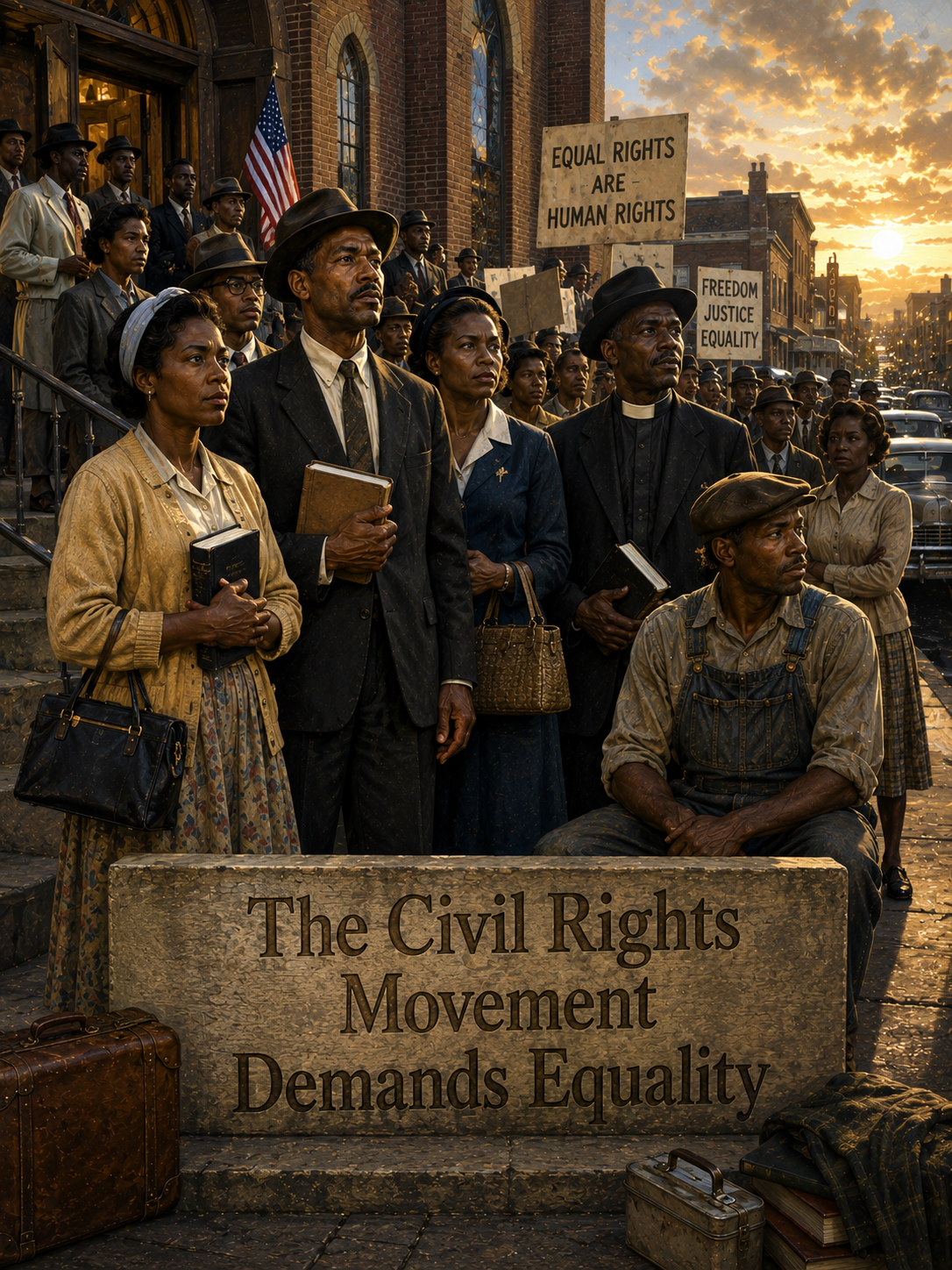
The Promise Remained Unfinished
Nearly one hundred years after the Civil War ended, America still carried an unfinished promise.
Slavery had been destroyed as a legal institution, but freedom had not fully become equality in daily life. Across much of the country, especially in the South, segregation and discrimination shaped schools, transportation, housing, voting, employment, public spaces, and ordinary human dignity.
This was one of the deepest contradictions in American life.
The nation spoke of liberty, citizenship, democracy, and equal rights, yet millions of Black Americans lived under systems that denied them fair treatment and full protection. Families who had endured slavery, Reconstruction, violence, poverty, and exclusion were still being asked to wait for rights that should never have been delayed.
The Civil Rights Movement grew from that painful reality.
It was not a sudden demand for special treatment. It was a moral insistence that the promises of America had to become real for every citizen, not only for those the law and society had chosen to favor.
Segregation Entered Daily Life
Segregation was not only a law on paper.
It entered daily life. It told people where they could sit, eat, learn, travel, worship, live, work, vote, and belong. It shaped the routines of families, the confidence of children, the opportunities of workers, and the dignity of elders who had carried hardship for a lifetime.
The cruelty of segregation was not only in its public rules, but in its repeated message.
It told human beings they were less worthy.
It made humiliation ordinary.
It forced parents to explain injustice to children who were old enough to feel it before they were old enough to understand its history.
That kind of system does not wound only the person denied a seat, a classroom, a ballot, or a job.
It wounds the moral character of the society that accepts it.
America increasingly had to face the gap between what it claimed to believe and what millions of its citizens were forced to live.
Ordinary People Refused Silence
The Civil Rights Movement was carried by ordinary citizens who decided they could no longer remain silent.
Students sat at lunch counters. Families supported boycotts. Ministers preached courage. Workers risked jobs. Parents prayed for children. Community leaders organized marches, meetings, voter registration drives, demonstrations, and legal challenges.
Many of these people were not famous.
History cannot name them all.
But their courage mattered.
They faced arrest, threats, violence, lost income, social pressure, and public hatred. They walked into danger without knowing how the story would end. They did not have the comfort of looking back and seeing eventual progress.
They lived forward through fear.
That is important to remember.
Courage is not the absence of fear.
Courage is deciding that something is more important than fear.
For many ordinary Americans, dignity became more important than silence. Justice became more important than comfort. The future became more important than the danger of the present moment.
A Moral Voice Rose
Martin Luther King Jr. helped give the movement a national moral voice.
His leadership, rooted in faith, nonviolence, equality, and shared humanity, helped millions of Americans understand civil rights not only as a political demand, but as a test of the nation’s soul.
King’s message mattered because it refused to answer hatred with hatred.
It asked America to become more honest, more humane, and more faithful to its own highest promises. His words carried hope, but not shallow hope.
They carried the weight of suffering, discipline, sacrifice, and moral responsibility.
Yet King did not stand alone.
He stood among countless people whose names are not always remembered. The movement’s strength came from communities willing to act together: people singing when afraid, marching when threatened, praying when exhausted, organizing when ignored, and returning again after being pushed down.
A moral movement becomes powerful when ordinary people begin believing that their own dignity is worth defending.
Families Carried The Cost
Every public act of courage had a private cost.
Parents worried over sons and daughters who joined protests, entered hostile schools, rode buses, attended meetings, or walked into places where anger waited for them. Families carried fear at kitchen tables, in church pews, on front porches, and through long nights of prayer.
Communities endured threats, bombings, arrests, violence, division, and uncertainty.
Some people lost work.
Some lost safety.
Some lost their lives.
Many carried the emotional strain of being told to remain patient while injustice continued. Others across the country wrestled with guilt, anger, fear, resistance, sympathy, or awakening as they watched history unfold.
Change is often described later as progress, but people living inside it experience pressure.
They do not know what will happen next.
They know only that the old way has become unbearable and the new way has not yet fully arrived.
That in-between space requires enormous strength.
The Law Began To Change
The Civil Rights Movement helped force major changes in American law.
Segregation was challenged. Voting rights were defended. Legal protections expanded. The country moved closer to promises left unfinished since Reconstruction.
Those changes mattered deeply.
Laws can protect dignity when they are just. They can open doors that prejudice has tried to keep closed. They can give people tools to defend rights that should have been honored all along.
But legal change did not erase every wound.
Laws can change before hearts do.
Old habits, fears, resentments, and inequalities do not vanish in a single vote or court decision. The movement achieved great progress, but it also revealed how long injustice can survive when a society allows it to become normal.
That is why civil rights cannot be treated as a completed chapter locked safely in the past.
Equality must be protected across generations.
Freedom becomes fragile when people assume it no longer requires courage.
The Nation Was Called Higher
The Civil Rights Movement demanded that America become more honest about itself.
It asked whether the nation would continue accepting a divided dignity, or whether it would move closer to the belief that every human being deserves equal protection, opportunity, and respect under the law.
This chapter matters because ordinary people changed history by refusing to surrender their humanity.
They marched, prayed, organized, sat, sang, voted, endured, and kept believing the country could become more just than previous generations had allowed it to be.
Future generations inherit the courage of those who confronted difficult truths.
They also inherit the responsibility to protect what courage helped build.
Nations grow stronger when humanity becomes more important than prejudice or fear.
From here, America enters the Space Race and a new technological age.
Cold War competition, innovation, ambition, and imagination will push human possibility toward the moon and beyond, while uncertainty continues to follow progress into the future.