Chapter 53
America Emerges Into the Atomic Age
The war ended, but humanity had crossed into an age where survival depended not only on strength, but on wisdom.
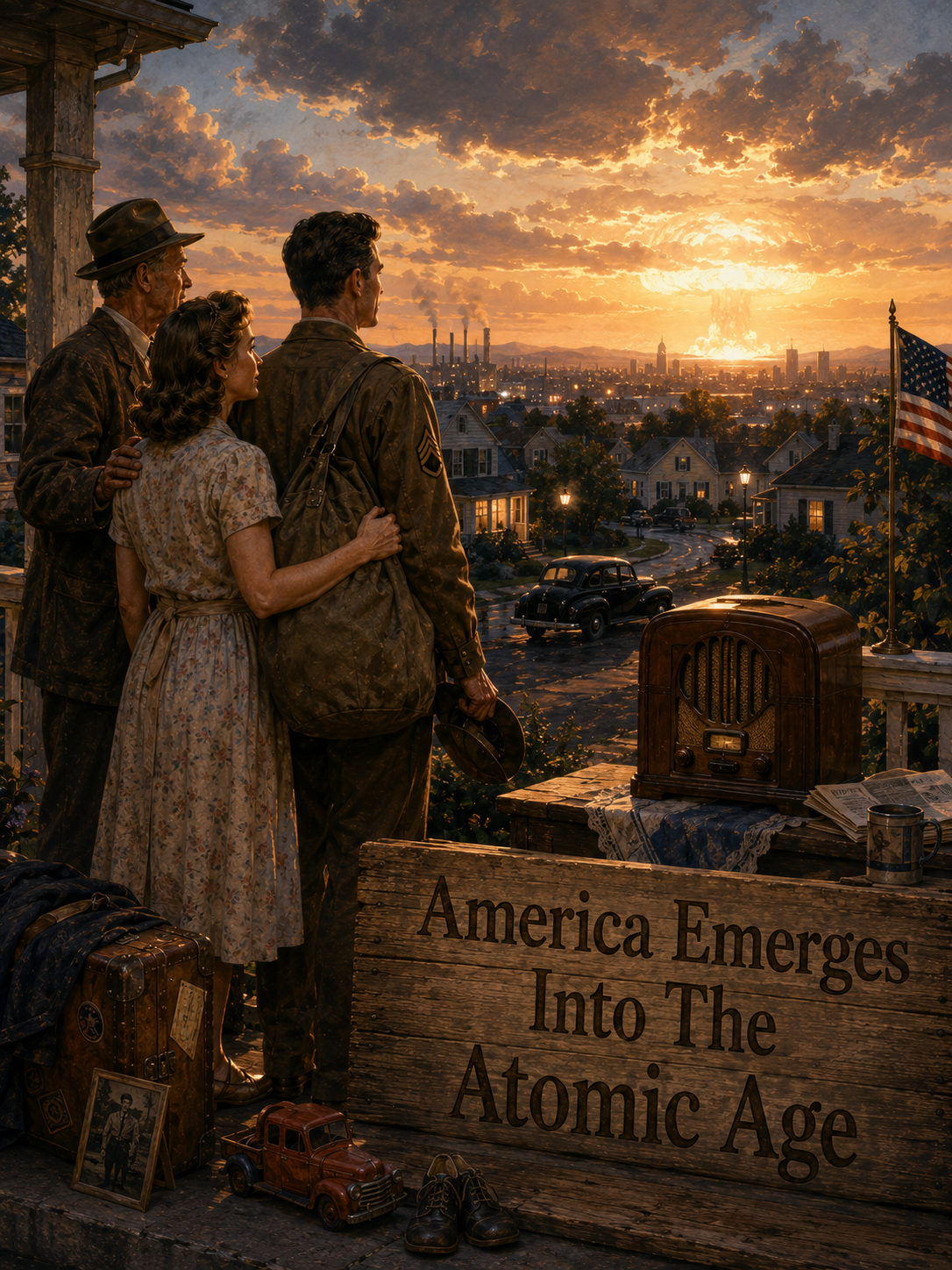
Victory Arrived With Grief Beside It
When World War II finally ended in 1945, relief moved through America with enormous force.
Families poured into streets. Bells rang. Strangers embraced. Churches filled with prayers of gratitude. After years of separation, rationing, telegrams, battle reports, factory labor, waiting, and fear, the war was finally over.
But victory did not arrive alone.
It came carrying grief.
Many families celebrated with empty chairs still in their homes. Some sons, fathers, brothers, husbands, nurses, pilots, sailors, Marines, and soldiers never returned. Others came home changed by what they had seen and endured.
The nation had won the war, but the cost remained inside bodies, memories, marriages, families, and quiet rooms where celebration could not erase loss.
Ordinary Americans stood in a strange emotional place.
They were grateful.
They were exhausted.
They were proud.
They were wounded.
Peace had returned, but the world they were returning to was not the same world that had gone to war.
The Bomb Changed The Meaning Of Power
The atomic bomb changed humanity forever.
When Hiroshima and Nagasaki were devastated, the world learned that human beings had created a weapon capable of destroying an entire city in moments.
Scientific achievement had crossed into moral terror.
The same intelligence that could heal, build, invent, and illuminate had also discovered how to unleash unimaginable destruction.
For ordinary Americans, this realization unfolded slowly. Many first heard the news through newspapers, radios, conversations, and official explanations. Some felt relief that the war had ended more quickly. Others felt unease they could not fully name.
Over time, the deeper truth settled in:
mankind now possessed power that could threaten civilization itself.
This was new.
War had always been terrible, but the atomic age changed the scale of fear. The danger was no longer only armies crossing borders or fleets moving across oceans.
The danger could arrive from the sky.
From science.
From politics.
From one decision.
From one terrible miscalculation.
Humanity had entered an age where wisdom would matter as much as strength.
America Carried New Responsibility
After World War II, the United States emerged with enormous economic, military, and political influence.
American factories had helped arm the Allies. American soldiers had fought across the globe. American resources, leadership, and power now shaped reconstruction, diplomacy, security, and the direction of the postwar world.
Many citizens felt pride in what the nation had helped accomplish.
Tyranny had been resisted.
Civilization had been defended.
Families had sacrificed, workers had labored, and millions had carried the burden of war.
But power also brought responsibility.
America was no longer distant from the world’s crises. Its decisions could affect nations, alliances, economies, and future generations far beyond its shores.
This was a heavy inheritance.
Strength can protect, but it can also tempt.
Power can rebuild, but it can also dominate.
A nation that has helped win a great war must then decide what kind of peace it will help build.
The atomic age made that question urgent.
America had become powerful, but power alone could not guarantee wisdom.
Peace Became Fragile
As World War II ended, new tensions began rising between the United States and the Soviet Union.
The Cold War did not begin all at once in ordinary households, but its shadow slowly entered American life. Fear of communism, espionage, nuclear weapons, and global conflict grew across the country and the world.
For families, this new fear was strange because it lived beside prosperity and rebuilding.
Veterans returned home and tried to reconnect with wives, children, parents, communities, jobs, and ordinary routines. Families bought homes, built careers, raised children, and longed for normal life after years of sacrifice.
A new generation began growing up in a country filled with opportunity and anxiety at the same time.
Children practiced emergency drills.
Parents listened to the news with quiet concern.
Families hoped another global war would never come, but they now understood that the next war might not look like the last one.
Peace existed, but it no longer felt entirely safe.
The world had survived, but survival had become conditional.
Families Tried To Build A Future
In the years after the war, ordinary Americans turned toward home.
They wanted stability, work, marriage, children, neighborhoods, schools, churches, businesses, and the simple peace of daily life. After Depression and war, the desire for normal life was powerful.
People wanted to build what fear had interrupted.
But even as families tried to rebuild, they carried memories and uncertainty. Veterans had to live with what they had endured. Mothers and wives had to welcome home men who were sometimes different from the ones who had left. Children grew up in homes shaped by sacrifice, silence, discipline, gratitude, and worry.
The war was over, but its emotional influence remained.
This is how history often works.
A public event ends before its private consequences do.
Treaties are signed. Headlines change. Celebrations fade. But families continue carrying what happened. In the atomic age, they also carried what might happen.
Hope for peace now existed beside fear of destruction.
Humanity Faced Itself
The atomic age forced humanity to look at itself with new seriousness.
Human beings had always been capable of cruelty and courage, destruction and service, fear and sacrifice. World War II had shown all of that.
But nuclear weapons raised the stakes of human nature.
The future could no longer depend only on bravery after disaster.
It required restraint before disaster.
This is one of the great moral lessons of the modern world.
Technology without wisdom can become danger.
Strength without humility can become threat.
Fear without understanding can become policy.
Division without restraint can become catastrophe.
Yet the atomic age also revealed another possibility.
If human beings could create such power, they could also choose cooperation, diplomacy, rebuilding, moral responsibility, and peace.
The glass was not only half full or half empty.
The question was whether mankind had the wisdom to refill it without breaking it in its own hands.
Future generations would inherit both the innovation and the fear of this era.
A New Age Had Begun
America emerged from World War II changed forever.
Victory brought relief, gratitude, and pride, but it also carried grief, responsibility, and a new kind of fear. The nation became a global superpower. The Cold War began to take shape.
Families built homes and futures beneath the shadow of weapons powerful enough to destroy everything they loved.
The emotional truth of this moment is not simple.
Humanity had survived one of the darkest wars in history, but survival had opened a new question:
Could mankind become wise enough to live with the power it had created?
That question still belongs to future generations.
Strength matters.
Courage matters.
Innovation matters.
But without wisdom, restraint, cooperation, and moral responsibility, power can become its own danger.
From here, America turns inward toward another unfinished moral promise.
The Civil Rights Movement will demand that the nation confront inequality, segregation, and the meaning of freedom within its own borders.