Chapter 52
World War II Unites and Sacrifices a Generation
A generation that had already learned hardship was asked to defend the future itself.
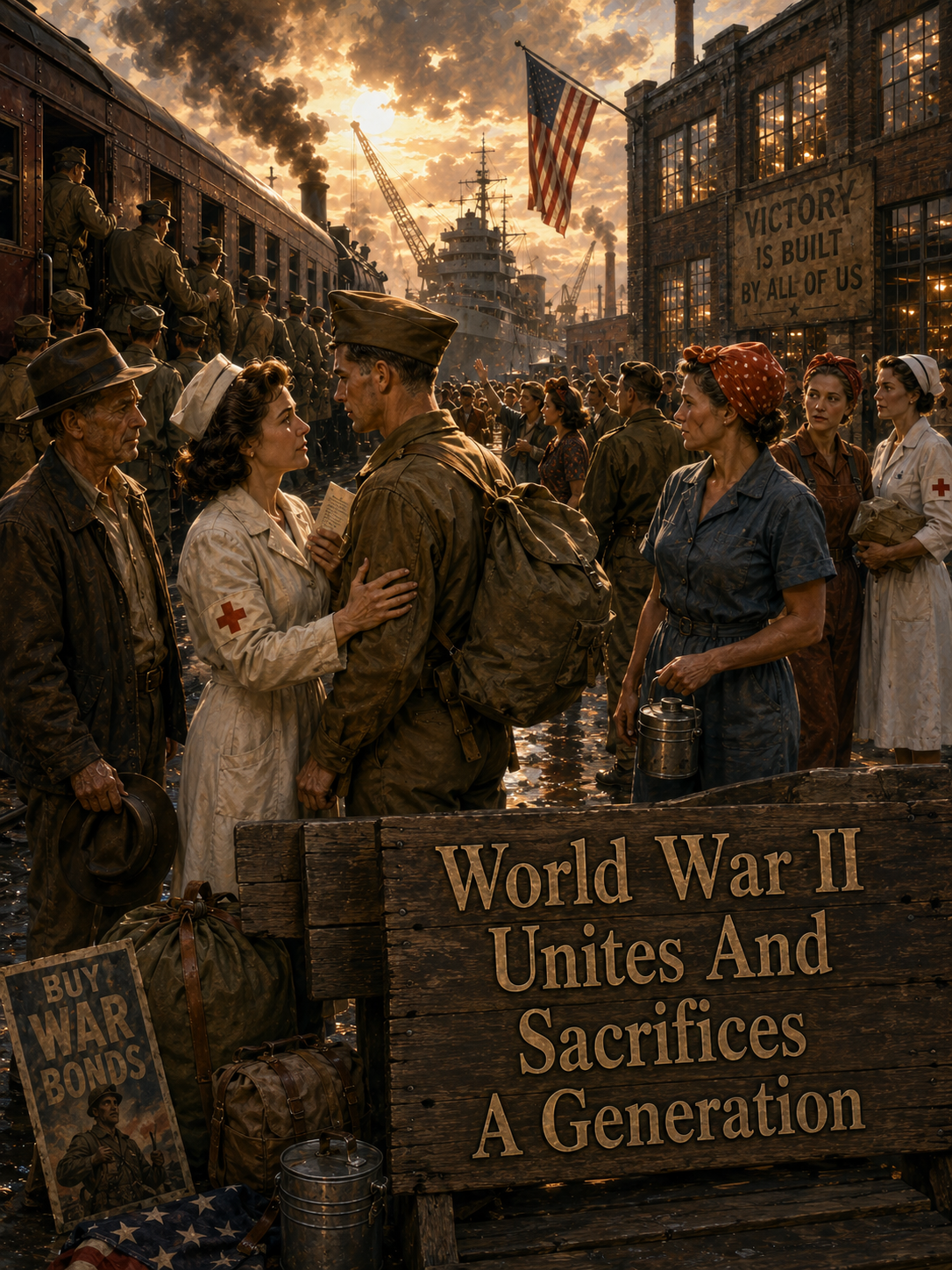
The War Became Impossible To Ignore
America entered World War II after years of watching the world grow darker from a distance.
Across Europe and Asia, aggression, conquest, hatred, and tyranny had already pulled millions into suffering. Many Americans hoped the war might remain far away, something terrible but still separated by oceans.
Then Pearl Harbor was attacked in December 1941, and distance disappeared.
The shock moved through the country with fear, anger, grief, and sudden clarity.
Ordinary people understood that life had changed again. The nation that had only recently endured the Great Depression now faced another enormous test. Families that had learned to stretch food, survive unemployment, and live with uncertainty were being asked to sacrifice on an even larger scale.
This was not simply a war of territory.
It became a war over what kind of world future generations would inherit.
Americans entered it carrying fear, but also a growing belief that freedom, human dignity, and civilization itself had to be defended.
Families Sent Their Loved Ones Away
For millions of families, World War II began at train stations, docks, front porches, kitchen tables, and bedroom doors.
Sons, fathers, brothers, husbands, and friends left home not knowing where the war would carry them or whether they would return. Families tried to be brave in the moment of goodbye, but bravery did not remove the ache.
A mother could smile for her son while fear moved through her body.
A wife could hold herself together until the train pulled away.
A father could shake a young man’s hand and see both the child he had raised and the soldier he was being asked to become.
Communities watched their young people leave by the hundreds and thousands, carrying uniforms, duffel bags, letters, photographs, prayers, and promises.
Then came the waiting.
Families lived with radios, newspapers, rumors, casualty lists, and the terrible possibility of a telegram. The war was overseas, but the fear lived inside American homes.
Every day required ordinary courage:
cooking, working, praying, writing letters, raising children, and acting steady when the heart was not steady at all.
The Home Front Became A Battlefield Of Sacrifice
World War II did not belong only to the men fighting overseas.
The home front became part of the struggle. Factories changed almost overnight into wartime production centers. Cars, appliances, tools, and ordinary industrial materials gave way to planes, ships, tanks, weapons, uniforms, and supplies.
The labor of civilians became part of the nation’s defense.
Women entered industrial work in historic numbers, carrying skills, discipline, and endurance into factories that helped supply the war. Mothers, daughters, wives, and grandmothers took on new public responsibilities while still holding homes and families together.
Rationing changed daily life.
Food, gasoline, rubber, tires, metal, and household goods were measured, saved, reused, and sacrificed.
These sacrifices were not small to the people living them.
Comfort was surrendered one decision at a time. Families accepted less because they believed something larger was at stake.
The home front revealed a powerful truth:
A nation is defended not only by soldiers, but by millions of ordinary people choosing shared responsibility when selfishness would have been easier.
The Young Carried The War
American soldiers, sailors, airmen, Marines, nurses, medics, and support personnel served across Europe, Africa, the Pacific, and beyond.
They faced brutal weather, fear, exhaustion, injury, disease, separation, and death.
Many were very young.
History often calls them men, and legally many were. But in the deepest human sense, they were also someone’s children.
The powers of the world have always had a way of sending the young to pay the cost of decisions made above them. Governments speak in strategy. Armies speak in campaigns. Maps show arrows and lines.
But the person inside the war knows mud, hunger, noise, smoke, terror, heat, cold, wounds, and the face of the person beside him.
In battle, great ideals matter, but the immediate world often becomes smaller.
A soldier endures for the man beside him.
A medic crawls toward the wounded.
A nurse stays through the night.
A friend shares water, carries a body, writes a letter, or refuses to let someone die alone.
That is where humanity remained visible inside the war.
Darkness And Courage Stood Face To Face
World War II revealed some of the darkest capacities of human beings.
The Holocaust exposed organized cruelty and genocide on a scale that still overwhelms the conscience. Across the world, civilians were bombed, starved, imprisoned, displaced, murdered, and trapped inside violence they had not chosen.
Hatred, when given power, machinery, obedience, and permission, showed what mankind could do when conscience was abandoned.
But the war also revealed another human truth.
People resisted.
People rescued.
People hid strangers.
People shared food.
People carried messages.
People served the wounded.
People crossed beaches, flew missions, worked assembly lines, treated the dying, buried the dead, and kept going while fear was present.
This contrast matters.
War shows what organized power can do when it loses its soul.
But ordinary service shows what humanity still remembers.
The nurse beside the wounded, the mother waiting at home, the worker building supplies, the soldier protecting the person beside him, and the stranger risking life for another human being all point toward the same truth.
We are not only what breaks the world.
We are also what reaches into the brokenness and says:
I AM here.
Unity Came Through Shared Burden
World War II created a sense of shared purpose unlike almost anything earlier generations had experienced.
That unity did not mean every person suffered equally, or that every injustice disappeared. America still carried racial inequality, discrimination, fear, and contradictions inside itself.
But across the nation, millions understood that the war demanded something from them.
People bought bonds, saved scrap, rationed goods, planted gardens, worked long hours, wrote letters, prayed, volunteered, served, and waited. Communities supported families whose loved ones were overseas.
Churches, neighborhoods, factories, schools, and homes became part of a larger emotional effort to hold one another steady.
This unity was born from danger.
It came from the understanding that individual comfort had to give way to a larger responsibility. For many Americans, sacrifice became part of daily life.
Not because sacrifice was easy.
But because they believed the future was worth defending.
Future generations would inherit the peace purchased by that sacrifice, but also the trauma, grief, and memory carried by those who survived it.
The Future Was Defended By Ordinary People
When World War II ended, victory brought relief, celebration, mourning, and exhaustion.
The world had changed. America emerged with new power and new responsibility. Families welcomed some loved ones home and buried others in memory. The generation that had survived Depression and war carried forward a seriousness that shaped the modern world.
This chapter matters because it reminds us that history is not moved only by famous leaders or military plans.
Ordinary people shape history more deeply than they often realize.
A factory worker.
A nurse.
A mother.
A farmer.
A soldier.
A neighbor.
A letter writer.
A rationing family.
A medic.
A chaplain.
A mechanic.
A pilot.
A shipbuilder.
All became part of a generation’s answer to danger.
Freedom survives only when human beings are willing to protect it.
Humanity survives when people refuse to let darkness have the final word.
From here, victory will carry America into a new and frightening age.
The atomic bomb, the Cold War, global power, and modern fear will open another chapter. The war ended, but the world did not return to what it had been.
A new era had begun.