Chapter 51
The Great Depression Shatters American Confidence
Prosperity vanished faster than many families believed possible, but dignity survived in the hands of people who kept going.
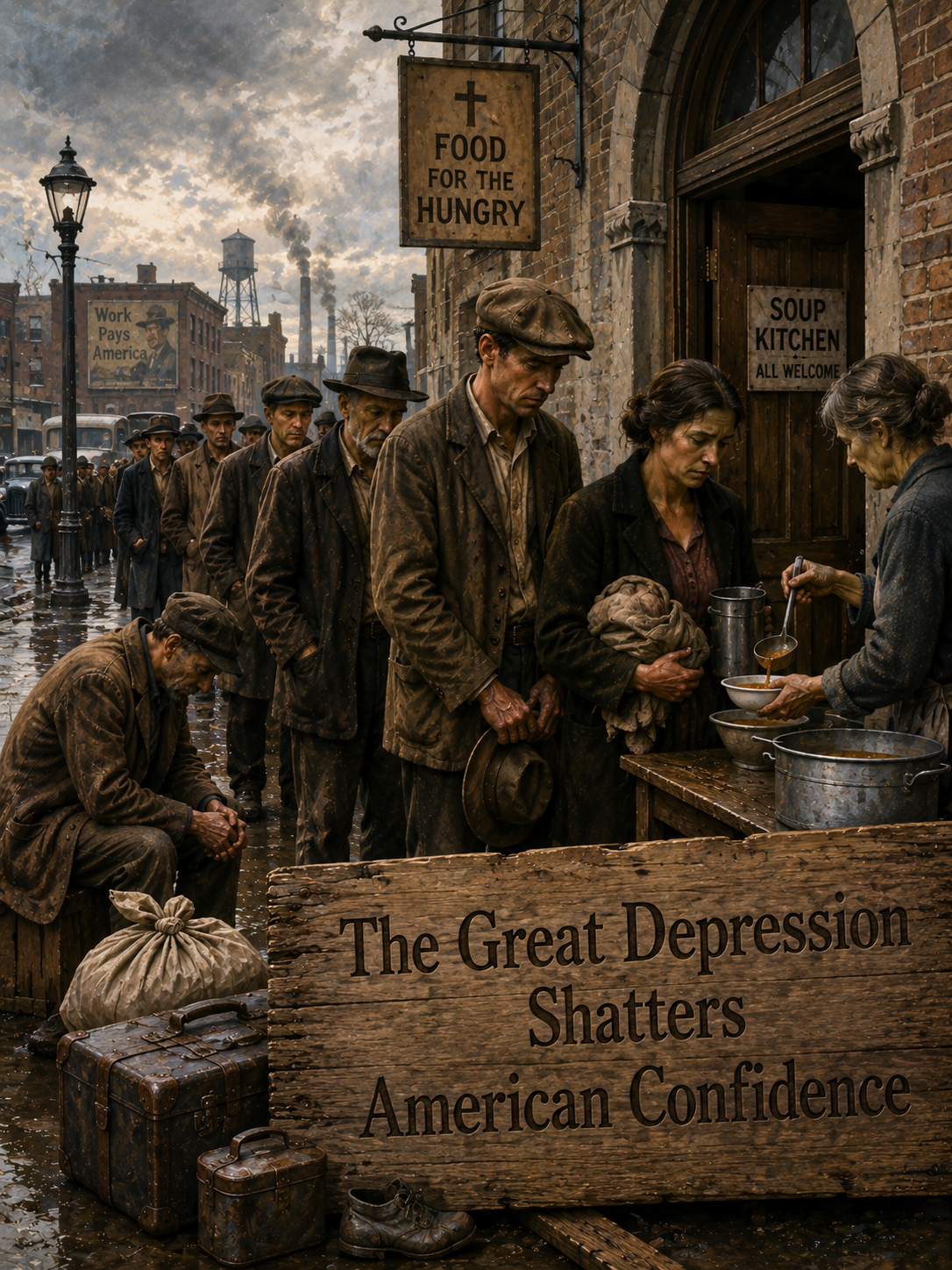
The Floor Fell Away
The confidence of the Roaring Twenties did not fade gently.
It broke.
What had seemed like endless growth suddenly turned into panic, unemployment, failed banks, closed businesses, empty pockets, and fear spreading from city to city, farm to farm, and home to home.
The stock market crash of 1929 became the most visible symbol of the collapse, but the real disaster reached far beyond Wall Street.
Banks failed and took family savings with them. Businesses closed. Jobs disappeared. Farmers struggled under debt, falling prices, and later drought. Workers who had believed steady effort would protect them discovered how quickly stability could vanish when the larger system gave way.
For millions of Americans, the question changed almost overnight.
It was no longer how to get ahead, buy more, build more, or enjoy the promise of modern prosperity.
The question became simpler and heavier:
How do we survive this day with dignity intact?
Families Carried The Fear Home
The Great Depression entered the home before many people understood what was happening.
It came through a father returning without work. It came through a mother quietly stretching flour, beans, bread, or soup farther than it should have gone. It came through unpaid bills, lost savings, worn shoes, cold rooms, and conversations lowered when children were near.
Many fathers searched desperately for work that no longer existed.
Men who had measured themselves by providing for their families carried shame that did not belong to them, but still felt personal.
Many mothers became protectors of emotional steadiness, trying to make scarcity feel less frightening to the children watching them. They learned how to make a little last, how to hide worry, how to serve smaller portions, and how to keep a household from surrendering to despair.
Children may not have understood markets, banks, or unemployment.
But they understood adult fear.
They saw the silence.
They felt the tension.
They watched the ones ahead of them and learned that the world could change without warning.
Poverty Became Visible
Hardship spread until it could no longer be hidden.
Bread lines and soup kitchens appeared in American cities. Homeless camps formed as families and individuals ran out of options. Men traveled in search of work. Rural communities suffered under failing crops, falling prices, and, in some regions, devastating drought that turned land itself against the people depending on it.
The country that had recently celebrated prosperity now watched poverty become part of daily public life.
People who had worked, saved, prayed, planned, and believed in the future found themselves standing in lines for food or wondering where they would sleep.
The emotional wound was deep because many carried hardship as if it were personal failure, even when the causes were far larger than any one household.
That shame matters.
Economic collapse does not only empty wallets.
It can make people question their worth, their judgment, their future, and their place in the world.
The Depression shattered confidence because it reached into the private dignity of ordinary people.
Communities Became Survival
When large systems failed, people often turned to the oldest human systems:
family, neighbors, churches, local communities, shared food, shared work, and shared endurance.
People helped when they could, even when they had little to give. A meal stretched farther. A coat was passed along. A church basement became a place of relief. A neighbor’s kindness became the difference between complete despair and another day.
This is one of the truths that must be remembered.
Human beings are often told they are defined by competition, ambition, power, or success. But crisis repeatedly reveals another pattern. When suffering becomes personal and visible, ordinary people often move toward one another.
They serve.
They share.
They repair.
They carry.
They encourage in ways no government report can fully measure.
The Depression did not make people noble automatically. Fear could harden hearts too. But across the country, countless families and communities survived because someone refused to let another person stand completely alone.
Hope Became Smaller, But It Did Not Die
The hope of the 1920s had been loud.
It had sounded like music, engines, electric lights, rising markets, new fashions, busy streets, and the feeling that tomorrow would naturally be larger than yesterday.
During the Depression, hope became quieter.
It became a mother saving a little food for the child who was still hungry. It became a father walking one more street to ask for work. It became a family keeping a roof for one more month.
It became a neighbor sharing what could not easily be spared.
That quieter hope may be less glamorous, but it is often stronger.
It does not depend on excitement.
It does not need applause.
It survives in people who have no proof that life will improve, yet still rise in the morning and do what the day requires.
Millions of Americans carried pride, exhaustion, fear, and determination at the same time.
They did not know when recovery would come. They did not know what the country would become.
They only knew that surrendering completely was not an option.
Confidence Had To Be Rebuilt
The Great Depression taught America that prosperity can disappear faster than people imagine.
It showed that economic systems affect more than numbers. They affect homes, dignity, marriage, childhood, health, faith, community, and the emotional stability of a nation.
It also showed that resilience is not an abstract virtue.
It is built through repeated choices made under pressure.
It is a parent staying calm when fear is present. It is a family adjusting again and again. It is a community protecting its vulnerable. It is the stubborn belief that life may still be refillable even when the glass appears empty.
Future generations would inherit both the suffering and the strength created during this period.
The Depression left scars, but it also shaped people who understood sacrifice, thrift, patience, service, and endurance.
From here, America will be pulled into World War II, where many of the same families who had survived economic collapse would be asked to face separation, fear, and sacrifice on an even larger scale.