Chapter 50
The Roaring Twenties Redefine American Life
After the grief of war, America reached for joy as if music, motion, and modern life might help the nation feel alive again.
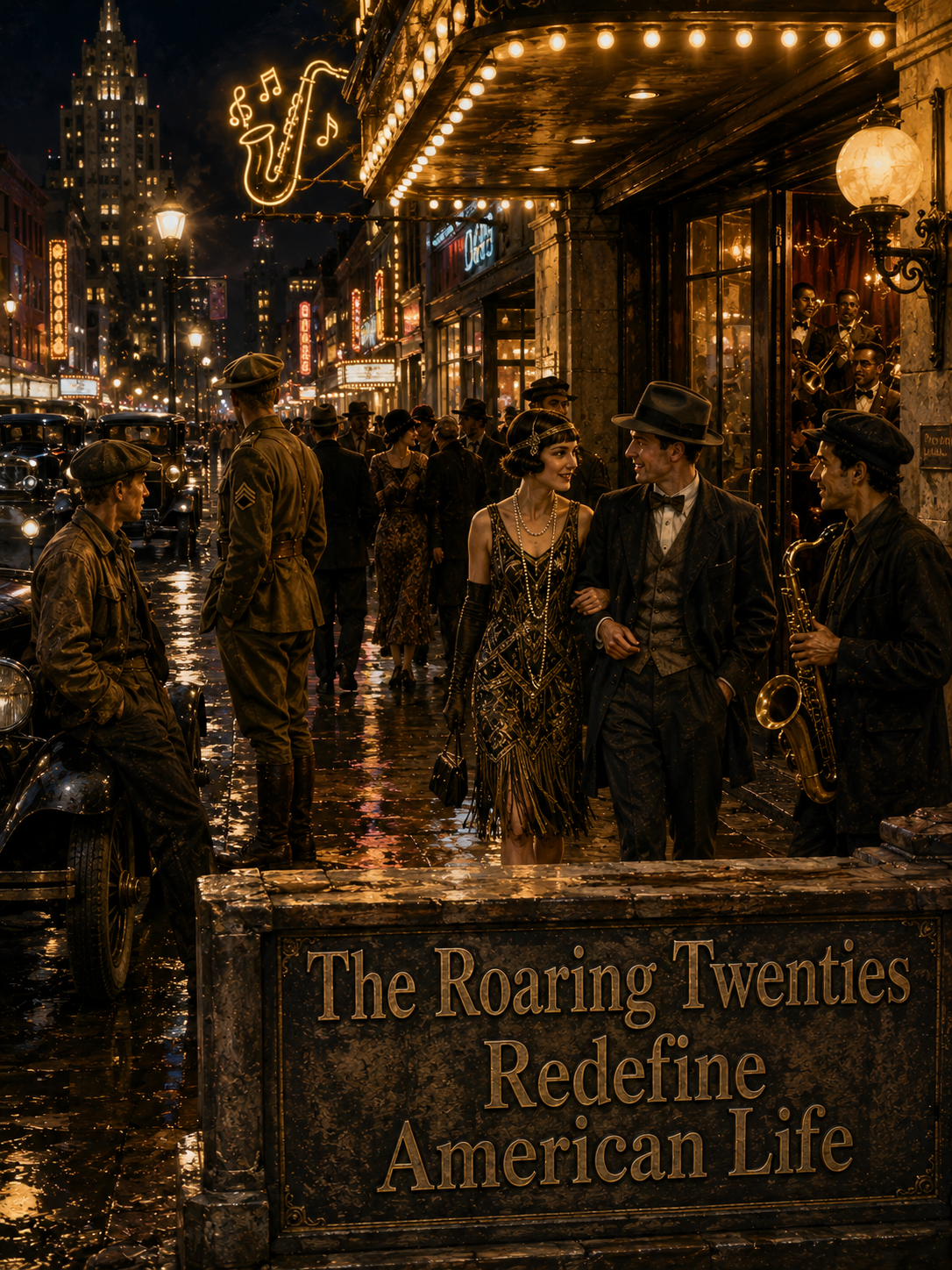
America Reached For Joy
After World War I, America entered the 1920s carrying more than victory, confidence, and economic ambition.
It also carried grief.
Families had lost sons. Veterans had returned changed. Communities had lived through fear, rationing, sacrifice, disease, uncertainty, and the emotional weight of a global war that had shown what modern destruction could do to human beings.
Then came the desire to breathe again.
Across much of the country, ordinary Americans reached for joy with new urgency. They filled theaters, dance halls, sporting events, city streets, restaurants, clubs, and movie houses. They listened to music, followed celebrities, bought new products, watched new films, and embraced a faster rhythm of life.
The decade roared partly because silence after suffering can feel unbearable.
This was not only entertainment.
It was emotional recovery.
People wanted to feel young, alive, modern, free, and hopeful. After years of fear, joy itself became part of the national search for meaning.
Modern Life Moved Faster
The pace of daily life accelerated.
Automobiles changed distance and independence. Radios carried voices, music, advertisements, sports, news, and shared culture into homes. Movies gave people new dreams and common stories. Electricity continued transforming work, leisure, streets, businesses, and domestic life.
Mass production made more goods available, while advertising taught Americans to imagine identity through what they bought.
For younger generations especially, the world seemed to be opening.
Life felt louder, quicker, brighter, and less confined by older expectations. A person could drive farther, hear music from distant cities, watch moving images, follow national trends, and feel connected to a modern culture larger than the local community.
But speed changes people.
It excites some and frightens others. Older generations often wondered whether the country was moving too far, too fast. The same technologies that created freedom also disrupted habits, values, family rhythms, and traditions that had once felt permanent.
Music And Entertainment Changed The Mood
Jazz became one of the great emotional sounds of the age.
It carried energy, improvisation, sorrow, rhythm, and freedom into American life. In cities and towns, music gave people a way to feel what ordinary language could not always explain.
Dancing, theaters, phonographs, radio broadcasts, and public entertainment helped create a new shared culture.
People wanted release.
They wanted movement.
They wanted laughter, noise, companionship, and escape.
Sports heroes, movie stars, musicians, and performers became part of national imagination. The country was learning to experience culture together through mass media in ways earlier generations had not known.
Yet beneath the excitement, many people still carried wounds from war, hardship, and loss.
That is part of why the music mattered.
Joy does not always mean pain is gone.
Sometimes joy is what people reach for because pain has been too close for too long.
The Roaring Twenties danced, but it did not dance on untouched ground.
Women Stepped Further Into Public Life
Women’s roles continued changing during the decade.
After generations of struggle, women had gained the right to vote, and many stepped more visibly into public, social, educational, and working life. Fashion changed. Social expectations shifted. Young women in particular often became symbols of modern independence, confidence, and changing identity.
To some Americans, these changes felt exciting and overdue.
To others, they felt unsettling.
A nation already moving quickly through technology, entertainment, immigration, cities, and consumer culture now faced changing ideas about gender, family, work, morality, and freedom.
But beneath the cultural debate were real human beings trying to understand what kind of lives were possible.
Women were not merely symbols of a decade.
They were daughters, workers, students, mothers, voters, artists, and citizens testing the boundaries of a changing world.
Their choices helped redefine American life because they widened the public imagination of what freedom could look like.
Prosperity Hid Uneven Ground
The 1920s brought wealth, growth, and consumer excitement to many Americans, but prosperity did not reach everyone equally.
Cities often seemed to sparkle with opportunity, yet rural families, farmers, working-class households, and many Black Americans still faced struggle, discrimination, debt, and limited opportunity.
Beneath the bright surface, economic weakness was quietly growing.
Consumer culture expanded rapidly. People bought cars, appliances, clothing, radios, cosmetics, records, and household goods. Credit made some purchases feel possible before they were truly affordable.
Advertising created desire, and desire often moved faster than caution.
This is one of history’s repeating warnings.
Prosperity can make a society feel safer than it really is. Excitement can hide instability. A nation can appear confident while pressure builds beneath the surface.
The Roaring Twenties were filled with genuine creativity and hope.
But the decade also carried imbalance.
Not everyone was dancing.
Not everyone was rising.
Not every foundation beneath the celebration was strong.
A Restless New America Emerged
The Roaring Twenties redefined American life by changing how people imagined freedom, identity, pleasure, technology, culture, and the future.
It was a decade of music, motion, youth, ambition, invention, and emotional restlessness. Many ordinary Americans truly believed a new era had arrived.
But the decade was also full of tension.
Immigration debates, racial conflict, changing values, religious arguments, urban growth, rural frustration, consumer pressure, and economic inequality all revealed a country struggling to understand itself.
Some Americans embraced the new world.
Others longed for older certainties.
The nation was modernizing, but unity did not automatically follow.
Human nature had not changed.
After suffering, people often search for joy.
During rapid change, people often feel both excitement and fear.
During prosperity, people can forget how fragile stability may be.
America entered the 1920s hoping to feel alive again. For a time, the music rose, the lights brightened, and the future seemed wide open.
But beneath the rhythm of the decade, another lesson was waiting.
From here, the Great Depression shatters confidence, and millions of ordinary families face one of the most difficult emotional and economic tests in American history.