Chapter 49
World War I Changes the Modern World
The modern world had learned how to move faster, build bigger, and kill farther — but it had not yet learned how to protect the human heart from what it had created.
Progress Entered The War
When World War I began in Europe in 1914, the world was already changing rapidly.
Industry, railroads, telegraphs, telephones, factories, newspapers, steel, chemistry, and machinery had transformed how nations worked, communicated, traveled, and imagined the future. Many people believed modern progress would lift humanity toward greater order, knowledge, and civilization.
Then modern progress entered the war.
The conflict that followed shattered illusions. Trench warfare trapped millions of ordinary soldiers in mud, fear, cold, disease, exhaustion, and waiting. Machine guns, artillery, poison gas, barbed wire, and industrial-scale weapons revealed that human brilliance could produce terrifying destruction when guided by fear, pride, rivalry, and power.
Nations could now wound one another with a speed and scale earlier generations could scarcely have imagined.
The war did not prove that progress was false.
It proved that progress without wisdom could become dangerous.
Humanity had learned how to build more.
It had not yet learned how to suffer less.
America Watched From A Distance
At first, many Americans hoped to remain outside the conflict.
Europe’s war felt distant, even as newspapers brought reports of battles, casualties, submarines, alliances, and destruction into American homes. Families read headlines and tried to understand a war that seemed both far away and increasingly impossible to ignore.
Modern communication changed the emotional experience of war.
People who had never crossed the ocean could follow events across it. Fear traveled through printed pages. Anger traveled through speeches. Sympathy, confusion, and national debate moved through cities, farms, factories, churches, and kitchen tables.
America was not yet fully inside the war, but the war was entering American imagination.
The country had already stepped onto the world stage. Now it faced the reality that global power carried global entanglement.
Distance no longer guaranteed safety from the consequences of other nations’ decisions.
By 1917, the United States entered the conflict, and ordinary Americans were forced to face what families across Europe had already known:
history can reach into a home and ask for a son.
Young Men Left Home Again
Once America entered the war, young men left home once again.
Sons, brothers, fathers, neighbors, friends, classmates, and co-workers put on uniforms and prepared for service in places many families knew only through maps and newspapers. Train stations, sidewalks, churches, and family rooms became places of farewell.
There was patriotism, but patriotism did not erase fear.
A mother could feel pride and dread in the same breath. A father could stand straight in public and break quietly in private. A young man could smile for others while carrying questions he did not know how to ask.
Families watched the door close behind someone they loved and wondered whether it would ever open the same way again.
War has often been described in the language of nations.
But families experience it in the language of absence.
An empty chair.
A letter waited for.
A name prayed over.
A silence that grows heavier with time.
The world had entered industrial war, but the cost still arrived one household at a time.
The Home Front Carried The Burden
The war changed life at home as well.
Factories shifted toward wartime production. Communities raised funds, volunteered, conserved supplies, and followed reports from overseas. Women entered industrial and support work in greater numbers, helping sustain the war effort while families adjusted to new pressures.
Ordinary citizens were asked to feel personally connected to a struggle unfolding far beyond their own streets.
The home front carried its own kind of tension.
People worked, saved, rationed, wrote letters, prayed, and waited. They tried to make daily life continue while knowing that somewhere across the ocean, men were standing in mud, smoke, fire, and fear.
This is one of war’s repeating burdens.
The battlefield is not the only place where sacrifice happens. It spreads through families, workplaces, churches, neighborhoods, and generations.
The soldier carries danger in the body.
The family carries danger in the heart.
Ordinary people endured because they hoped suffering might eventually lead somewhere better. They hoped this terrible war might protect future children from another one.
Hope did not make the cost smaller.
But it gave sacrifice a direction.
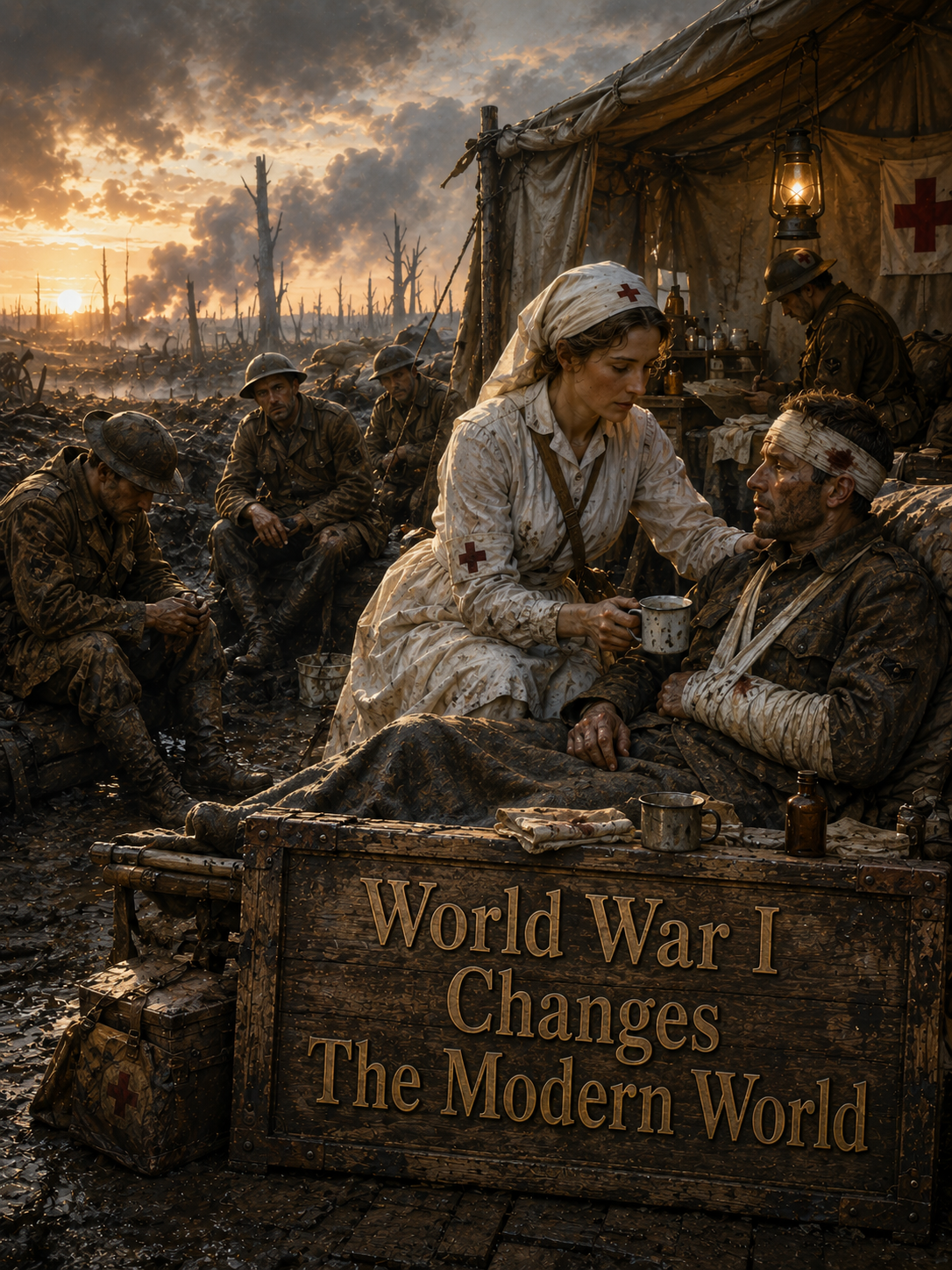
The Wounded Revealed The Truth
World War I revealed both humanity’s deepest cruelty and its greatest tenderness.
In the trenches, men endured exhaustion, terror, loneliness, and conditions no human being was meant to live inside. They saw what modern weapons could do to flesh, courage, memory, and faith.
Many returned changed.
Many did not return at all.
And when bodies broke, the oldest human need returned.
Men who had marched under flags and orders still cried for home. Some cried for mother. In that moment, uniform, rank, nation, and argument fell away.
Beneath the machinery of war was someone’s child.
That is where the nurse becomes part of this larger story.
She could not stop the artillery. She could not undo poison gas, mud, infection, or fear.
But she could answer one suffering person at a time.
She could bring water.
Clean a wound.
Help a man breathe.
Write to his family.
Hold his hand so he did not feel alone.
The world had learned to break men by the thousands.
Service answered one breath at a time.
The Modern World Was Changed
World War I changed how humanity understood modern life.
Technology no longer appeared only as promise. It also carried warning. Industry could build cities, machines, transportation, medicine, communication, and opportunity. But industry could also build weapons, mobilize armies, and carry destruction across continents.
Entire generations carried the emotional scars of the war long after the fighting ended.
Families mourned the dead.
Veterans carried wounds visible and invisible.
Nations tried to explain the suffering, justify the sacrifice, and imagine a peace strong enough to hold. The modern world emerged from the war more connected, more powerful, and more wounded.
Human nature had not changed.
Ordinary families still bore the heaviest emotional burdens of decisions made by nations and leaders. Ordinary soldiers still endured what powerful systems created. Ordinary servants still stepped toward suffering instead of away from it.
World War I shattered the illusion that progress alone could save humanity.
Peace required more than machinery, invention, industry, and national strength.
It required wisdom, humility, shared humanity, and the courage to remember what war does to the human soul.
From here, America enters the Roaring Twenties, struggling to recover from war while embracing cultural change, entertainment, modern confidence, and the restless energy of a new generation.