Chapter 23
The Weight of Command
The burden of an uncertain future rested upon the shoulders of men willing to carry responsibilities far greater than themselves, for a freedom future generations might one day inherit.
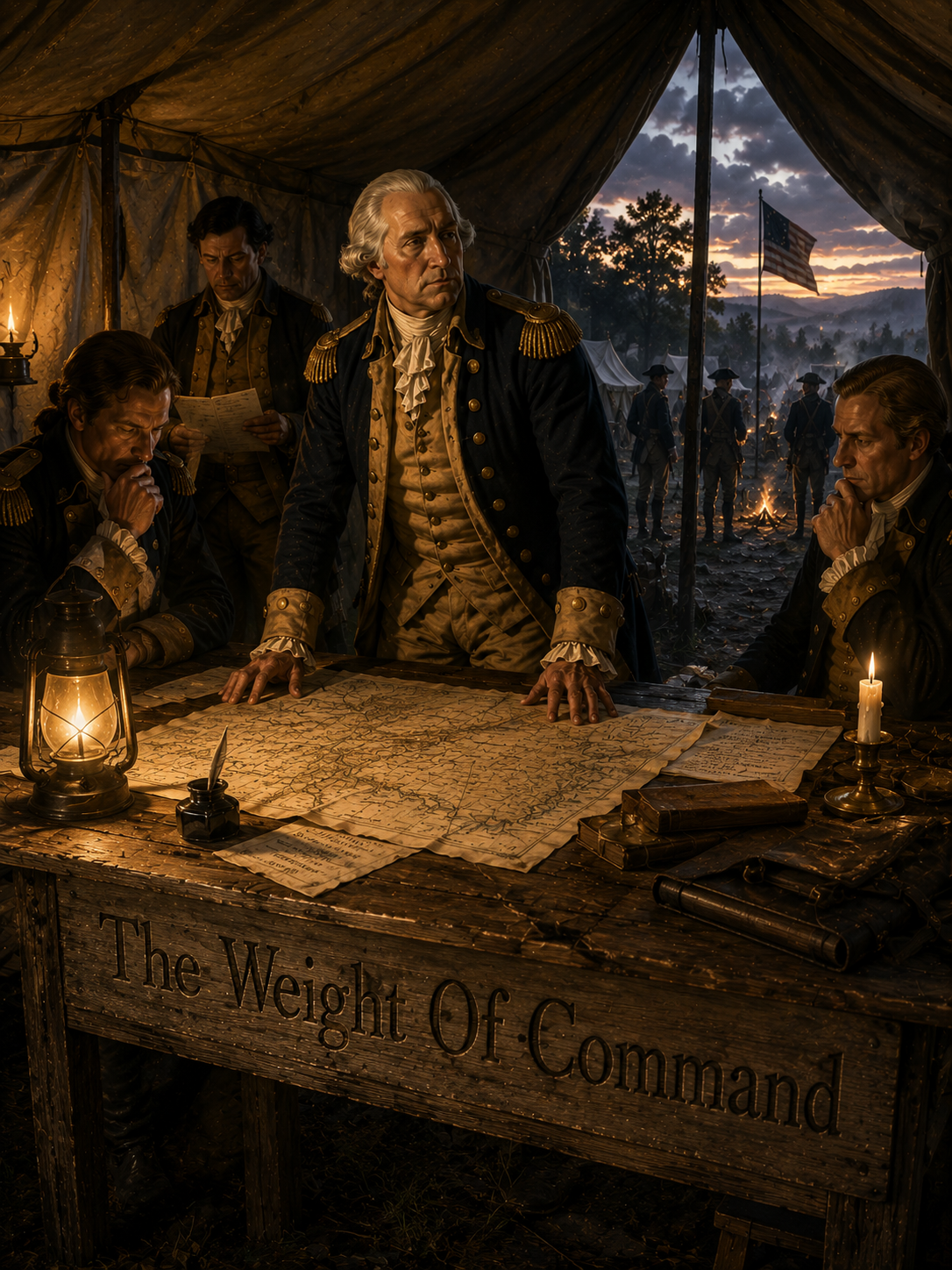
A Leader Was Needed
After the first shots had been fired and ordinary citizens had begun gathering into armed resistance, the colonies faced a hard truth.
Courage alone could not sustain a long struggle.
Local militias could respond to danger, defend their towns, and stand when alarm bells rang, but a prolonged conflict would require something more. It would require organization, discipline, supplies, communication, patience, unity, and leadership strong enough to hold scattered efforts together.
The Continental Congress understood that the war could not be carried by emotion alone.
The colonies were separated by distance, local loyalties, different needs, and different fears. If each colony fought only as its own emergency required, the larger cause could break apart before it ever became strong.
A leader was needed not for ceremony, but for survival.
Someone had to carry the terrible responsibility of turning resistance into an army.
George Washington Emerged
George Washington emerged as the man others believed could carry that burden.
He had military experience from earlier service, and he had earned respect through discipline, seriousness, and personal character. He did not step forward promising easy victory. No honest person could promise that.
The war ahead was too uncertain, the enemy too powerful, and the colonies too untested.
That is what makes the moment more human.
Washington was not entering a finished myth. He was accepting command before anyone could know how the story would end. If the cause failed, he would not be remembered as a founder standing safely in history. He could be remembered as a rebel who helped lead people into ruin.
The weight of command began there, in the space between duty and uncertainty, where responsibility arrives before confidence.
The Continental Army Was Born
With Washington’s appointment and the work of Congress, ordinary citizens began becoming something larger: the Continental Army.
The change did not suddenly make them polished soldiers. Many were still farmers, tradesmen, laborers, sons, husbands, and neighbors. Their clothing varied. Their weapons varied. Their training varied. Some had militia experience, while others had only determination and the belief that their homes and liberties were now tied to a larger cause.
The birth of the Continental Army was more than a military development.
It was an emotional turning point.
Local resistance was becoming shared sacrifice. Men who had first gathered to protect nearby communities were now being asked to endure for a wider future. The cause had moved beyond alarm and response.
It now required staying power.
It required people to remain when the first rush of anger faded and the long work began.
Leadership Meant Sacrifice
Leadership in such a moment was not status.
It was service under pressure.
Washington would have to make decisions that affected thousands of lives. A movement on a map could become a march through mud. A delay in supplies could become hunger. A mistake could become death. A retreat could save the army while breaking the hearts of men who wanted to stand.
A victory could lift the cause, but a defeat could crush morale across the colonies.
That kind of responsibility is difficult to see from a distance.
A commander may appear powerful, but command can also be lonely. Supplies may fail to arrive. Weather may ruin plans. Soldiers may lose confidence. Political leaders may disagree. Families may mourn decisions they never understood.
Leadership meant carrying consequences other people would feel in their bodies, homes, and memories.
The Human Side Of Leadership
It is important not to make Washington less human by making him too large.
He surely felt pressure, concern, disappointment, and uncertainty. Real leadership does not remove fear. It requires a person to continue carrying responsibility while fear remains present.
Courage at the command table is different from courage on the battlefield, but it is still courage.
The human side of leadership makes this chapter matter. Washington had to become steady while the cause itself was still unsteady. He had to stand before men who needed confidence while knowing how fragile their situation remained.
He had to serve something larger than ambition, pride, reputation, or comfort.
True leadership is not measured by how important a person appears. It is measured by what that person is willing to carry for others.
Every generation faces moments when someone must accept responsibility before they feel fully ready. Families, communities, businesses, churches, towns, and nations all depend on people willing to carry burdens they did not ask for and may not know how to bear at first.
Responsibility often arrives before certainty.
People remember leaders who endure alongside them. They remember those who do not abandon the burden when hardship grows. They remember steadiness under pressure, humility in service, and courage that does not need to announce itself.
That is why this chapter reaches beyond the Revolutionary War.
It reminds us that leadership is service, not decoration. A society becomes stronger when people choose contribution over self-interest, and when those entrusted with authority understand that other lives are held in their hands.
Around the new army, hope existed, but anxiety remained everywhere.
The colonies had stepped into a struggle that could not easily be undone. Families feared what a prolonged war would bring. Communities wondered how long men would be gone. Supplies were uncertain. Training was unfinished. The British Empire remained powerful.
No one could guarantee that the army would survive the tests ahead.
Yet something historic had begun.
Not easy confidence.
Not celebration.
Something quieter and more serious.
A people were trying to organize themselves around the belief that liberty was worth sacrifice. Command had been given. Responsibility had been accepted. The future still trembled, but it had not been abandoned.
That is the emotional center of this moment: uncertainty remained, but someone had chosen to carry the weight.
The weight of command reminds us that freedom is not protected by belief alone.
It requires people willing to carry hard responsibilities when comfort would be easier. It requires leaders who understand that service matters more than status. It requires citizens who accept that their future may depend on difficult decisions made in uncertain rooms by people who are still human.
From here, the Revolution will no longer be measured only by courage at the first alarm.
It will be tested by endurance.
Shortages, exhaustion, fear, sickness, confusion, sacrifice, and doubt will press against the cause. The colonies will learn that beginning a fight is different from sustaining one.
The burden will spread from commanders to soldiers, from soldiers to families, and from families to the generations that would one day inherit the meaning of what they carried.