Chapter 24
Holding On Through the Hardship
Long after speeches faded and the first excitement of revolution disappeared, communities continued carrying the burden of freedom one cold night, one sacrifice, and one act of perseverance at a time.
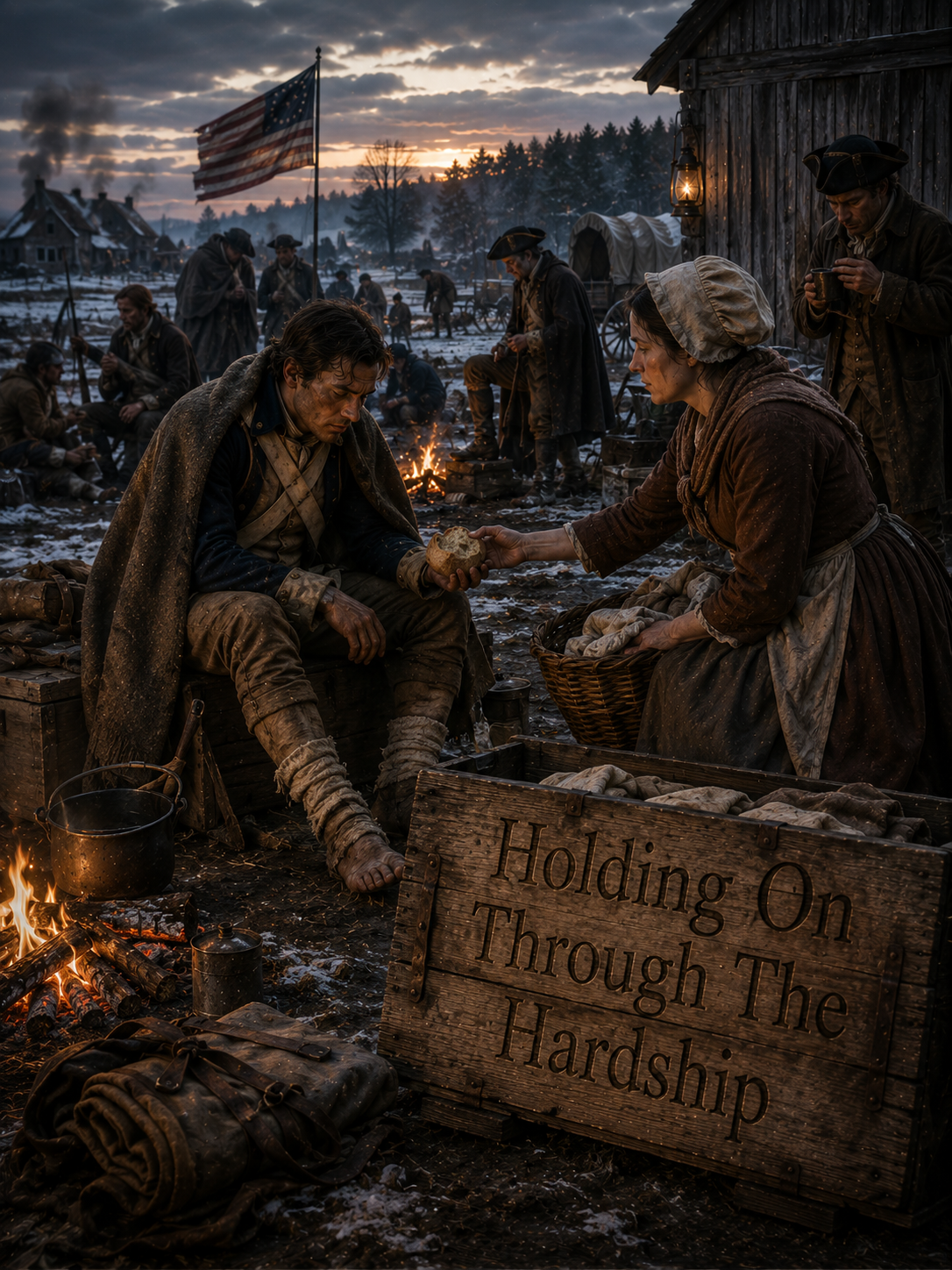
The Reality Of War Settled In
At the beginning of a cause, people often feel the fire of conviction. They gather, speak, march, prepare, and believe the moment itself will carry them forward.
But war does not remain a single moment.
It becomes days, weeks, months, and seasons.
After the first alarms and early decisions, the colonies began facing the harder truth that freedom would not be won by courage alone.
Supplies remained dangerously limited. Food was uncertain. Ammunition was scarce. Clothing wore thin. Shelter became a constant concern. The army needed powder, blankets, shoes, wagons, medicine, tools, and food.
Every shortage had a human face.
A missing blanket meant a colder night. A missing meal meant weaker bodies. A lack of medicine meant sickness could become deadly.
The cause was noble, but the hardship was physical, daily, and real.
Ordinary Families Bore The Burden
The burden of war did not remain with soldiers alone.
It entered homes across the colonies. Farms struggled without husbands, fathers, sons, and hired hands. Work that once required many shoulders fell onto fewer. Fields still needed tending. Animals still needed care. Food still had to be prepared and preserved. Children still needed guidance.
Life did not pause simply because history had become dangerous.
Mothers carried enormous responsibilities, often with little certainty about when or whether the men they loved would return. Wives managed homes, farms, accounts, supplies, and fear. Older parents worried in silence. Children grew up faster than they should have, learning early that hardship does not ask whether a family is ready.
Entire communities sacrificed together, not always in dramatic ways, but through the steady demands of continuing ordinary life while the future remained unsettled.
Soldiers Faced Difficult Conditions
For soldiers, hardship became part of daily existence.
Cold nights tested the body. Exhaustion tested the mind. Illness moved through camps. Fear followed men even when no battle was being fought. Waiting could be its own kind of suffering.
A soldier could endure hunger one day, rain the next, sickness after that, and still be expected to march when called.
Many soldiers were not hardened professionals.
They were ordinary citizens learning the cost of becoming an army.
Their endurance was not polished or easy. Some were frightened. Some were discouraged. Some wondered how long the struggle could continue.
Yet many stayed.
They continued forward through discomfort, uncertainty, and loss because they believed the cause mattered beyond the hardship of the moment.
That kind of perseverance deserves to be remembered as deeply as any battlefield charge.
Doubt Began Appearing
As hardship stretched on, doubt naturally appeared.
Some wondered whether victory was possible. Others feared the colonies were too divided, too poorly supplied, or too weak to withstand the British Empire. The first burst of unity had been powerful, but unity is tested most severely when hunger, exhaustion, fear, and disappointment arrive.
Doubt did not mean cowardice.
It meant people were human.
Anyone who has carried a difficult burden for too long understands how hope can grow tired. The colonies were asking people to believe in a future they could not yet see while enduring suffering they could feel every day.
That is a heavy demand.
The wonder is not that some doubted.
The wonder is that so many continued despite the doubt.
People Continued Holding On
Even as fatigue spread, people continued holding on.
Neighbors supported one another. Communities shared supplies when they could. Churches gathered in prayer. Families worked harder with fewer hands. Soldiers encouraged one another through long nights and uncertain days.
The Revolution survived not only because famous leaders made decisions, but because people kept giving what they had.
This kind of sacrifice rarely receives enough attention.
It does not always produce a dramatic scene. It may look like a woman saving food for someone else, a neighbor helping with a field, a community gathering blankets, or a tired soldier standing up again after another hard night.
Yet civilization is often preserved through these quiet acts.
Great causes survive because ordinary people refuse to abandon them when the cost becomes personal.
Perseverance often matters more than strength. A strong beginning can fade quickly if people cannot endure the middle. Difficult times reveal the character of individuals and societies because hardship removes easy words and asks what people are truly willing to carry.
Every generation faces seasons when comfort disappears and responsibility remains.
Families know this.
Communities know this.
Nations know this.
Hope can survive uncertainty, but it must be protected. It must be carried by people willing to keep going when the road becomes longer than expected.
The Revolution reminds us that people are capable of extraordinary endurance when they believe they are protecting something meaningful.
The emotional atmosphere across the colonies was heavy.
Fatigue spread. Fear remained constant. Families worried. Soldiers suffered. Communities strained under the demands of war. Many people increasingly understood that freedom would require far more sacrifice than they had imagined when the first calls for resistance began.
Yet quiet determination remained.
Not every person felt it in the same way. Not every day was filled with confidence. But the cause did not disappear. It lived in tired bodies, worried homes, shared prayers, and small acts of service.
That is the power of this chapter.
It shows that freedom was carried not only in moments of courage, but in the long, difficult work of continuing when courage felt worn down.
Holding on through hardship reminds us that freedom and stability require continued effort.
A society cannot survive on speeches, enthusiasm, or good intentions alone. It survives when people support one another during difficult seasons, when communities choose sacrifice over selfishness, and when ordinary individuals keep responsibility alive after the excitement has faded.
From here, the emotional and military pressure will intensify. The colonies will face growing uncertainty, deeper exhaustion, and harder tests of belief.
But within that hardship, new moments of courage will begin to emerge.
The people who held on through cold, hunger, fear, and doubt helped preserve the strength future generations would inherit.
Their endurance became part of the foundation beneath the freedom they were still struggling to secure.