Chapter 25
Carrying the Cause Through Uncertainty
As uncertainty darkened the horizon, communities continued standing watch over a fragile dream of freedom, carrying responsibilities whose rewards they might never personally live long enough to see.
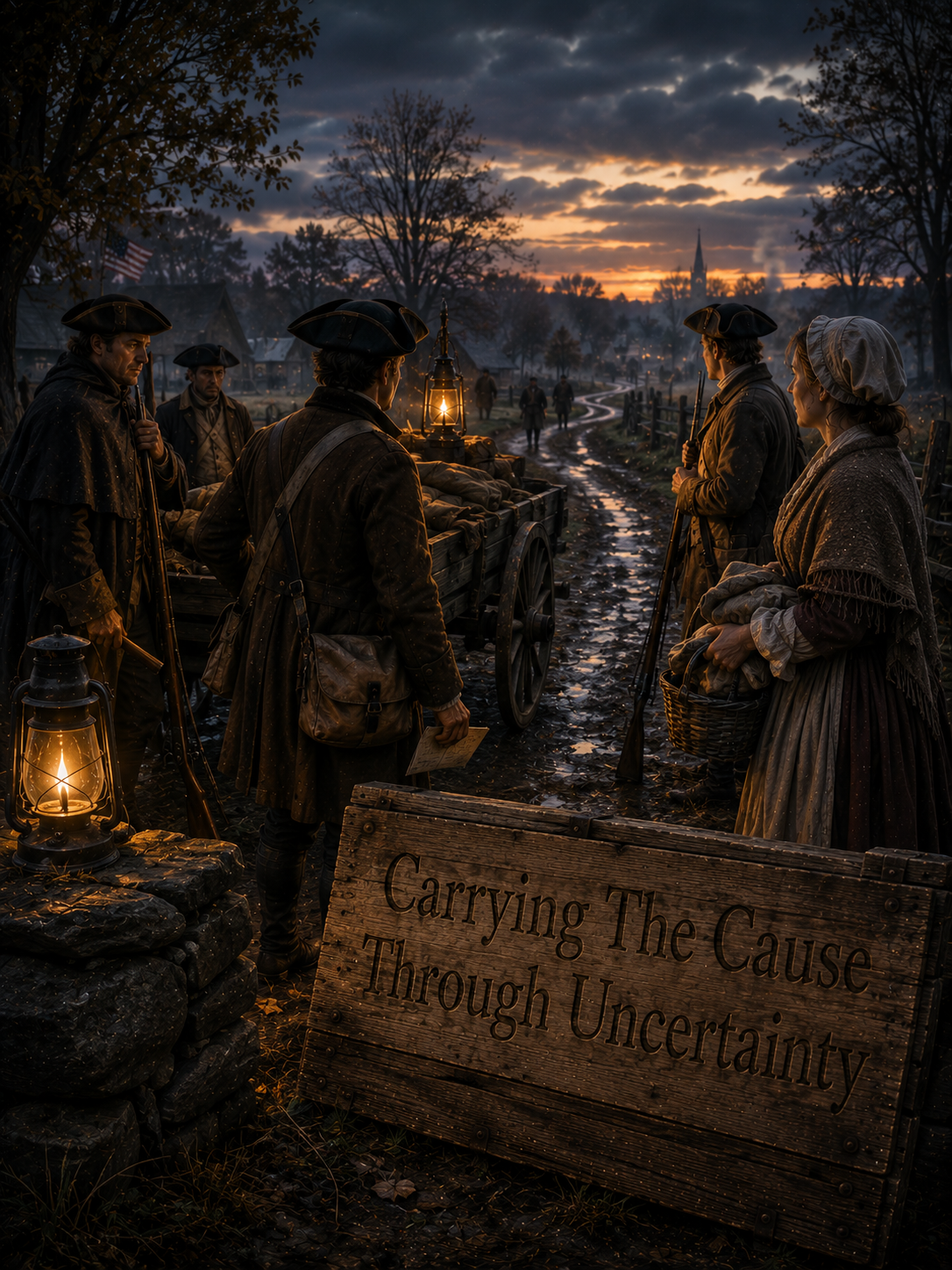
The Reality Of Revolution Became Clear
As the war continued, the reality of revolution became clearer.
It was no longer only a bold declaration of resistance, a gathering of citizens, or the first shock of battle. It had become a long and uncertain struggle that reached into nearly every part of colonial life.
The cause had moved beyond words and entered the difficult work of endurance.
Many people began to understand that independence would require far more than courage alone. Courage could answer an alarm. Courage could stand in a first confrontation. But a revolution needed patience, supplies, unity, sacrifice, and the willingness to keep going after the emotional force of beginning had faded.
The colonies were learning that freedom was not only claimed in powerful moments.
It had to be carried through long stretches when the future remained hidden.
Supplies Continued Running Low
Supplies continued running low, and every shortage added weight to the uncertainty.
Food was never guaranteed. Clothing wore out. Ammunition remained scarce. Shelter was often rough and inadequate. Illness spread through camps and towns, weakening bodies already strained by hunger, weather, and worry.
A lack of supplies was never just a military problem.
It was a human problem.
When food was short, someone went hungry. When blankets were scarce, someone faced the cold. When medicine was unavailable, sickness became more frightening. When ammunition ran low, courage had to stand beside helplessness.
These shortages reminded everyone that the cause was fragile.
The dream of freedom was being carried by people who often lacked even the basic things needed to survive comfortably, let alone fight a powerful empire.
Families Carried Heavy Burdens
Families carried heavy burdens while the war dragged on.
Farms struggled to survive with fewer hands. Mothers held homes together through uncertainty, doing the work of daily life while carrying worry that rarely left them. Letters traveled slowly, if they arrived at all. News could be delayed, incomplete, or frightening.
Many families lived constantly between hope and fear.
A wife might not know whether her husband was safe. A mother might wonder whether a son was hungry, sick, wounded, or marching somewhere beyond her reach. A family might hear rumors before truth.
That waiting was part of the sacrifice.
The home front was not separate from the Revolution. It was one of the places where the Revolution was endured. The cause was carried in fields, kitchens, barns, churches, and quiet rooms where people kept going without knowing what news tomorrow might bring.
Doubt Quietly Grew
As hardship lengthened and certainty remained out of reach, doubt quietly grew.
Some questioned whether victory was possible. Others feared the colonies could not remain united long enough to survive. The British Empire still seemed vast and powerful. The colonial cause still seemed fragile.
Leaders carried uncertainty.
Soldiers carried uncertainty.
Ordinary citizens carried uncertainty in their homes.
Doubt did not mean the cause had failed.
It meant the people inside the struggle were human.
Hope becomes harder when the road keeps extending. Faith becomes heavier when proof does not arrive. The colonies had to learn how to continue before they could know whether continuing would be enough.
That is one of the most difficult human tests: to keep responsibility alive when the outcome remains unclear.
Yet People Continued Forward
Yet people continued forward.
Communities shared what little they had. Churches gathered people together for prayer, comfort, and resolve. Neighbors supported one another through work, worry, and loss. Ordinary individuals continued sacrificing for a future they might never personally experience.
The Revolution survived because people kept choosing the cause even when the cause could not yet promise them victory.
That kind of perseverance is not always loud.
It may look like a soldier standing watch through another cold night. It may look like a woman preserving food for others. It may look like a neighbor helping a family whose strongest hands had gone to war. It may look like someone refusing to abandon hope, not because hope was easy, but because surrender felt like a betrayal of everything already given.
Perseverance is often born during uncertainty, not after certainty arrives. Anyone can feel strong when the ending looks guaranteed. The deeper test comes when no one knows how the story will turn.
Courage means continuing when outcomes remain unclear and when fear has reasonable arguments.
Strong societies are sustained by ordinary people carrying difficult burdens together. They are held together by those who keep showing up, keep helping, keep praying, keep working, and keep believing that what they protect matters beyond themselves.
History remembers famous leaders and turning points, but it is often preserved by unnamed people who refused to surrender hope during hard seasons.
The emotional atmosphere across the colonies was weary and anxious.
The struggle had lasted long enough for fatigue to settle deeply. People were tired of fear, tired of waiting, tired of hunger, tired of loss, and tired of not knowing.
The future felt dark because no one could see how much more sacrifice would be required.
But beneath the hardship, quiet resilience endured.
People increasingly understood that freedom would demand patience as much as passion. The Revolution was not sustained by one burst of bravery. It was sustained by people who kept carrying the cause when the first fire had dimmed and the road ahead remained uncertain.
That quiet carrying is one of the most important forms of courage in the American story.
Carrying the cause through uncertainty reminds us that meaningful change rarely happens quickly.
Future generations often inherit sacrifices made by people who never saw the full reward.
From here, the Revolution will face even darker moments.
Morale will weaken. Uncertainty will intensify. The cause will be tested by fear, division, exhaustion, and the frightening possibility of failure.
Yet within that pressure, unexpected courage will begin to emerge.
The people who carried the cause through uncertainty helped keep the fragile dream alive long enough for hope to find another way forward.