Chapter 26
Holding Together When Everything Was Falling Apart
When exhaustion, fear, and uncertainty threatened to tear everything apart, communities continued carrying the burden of freedom, proving that civilizations survive not only through moments of inspiration, but through the quiet endurance of those who refuse to let hope die.
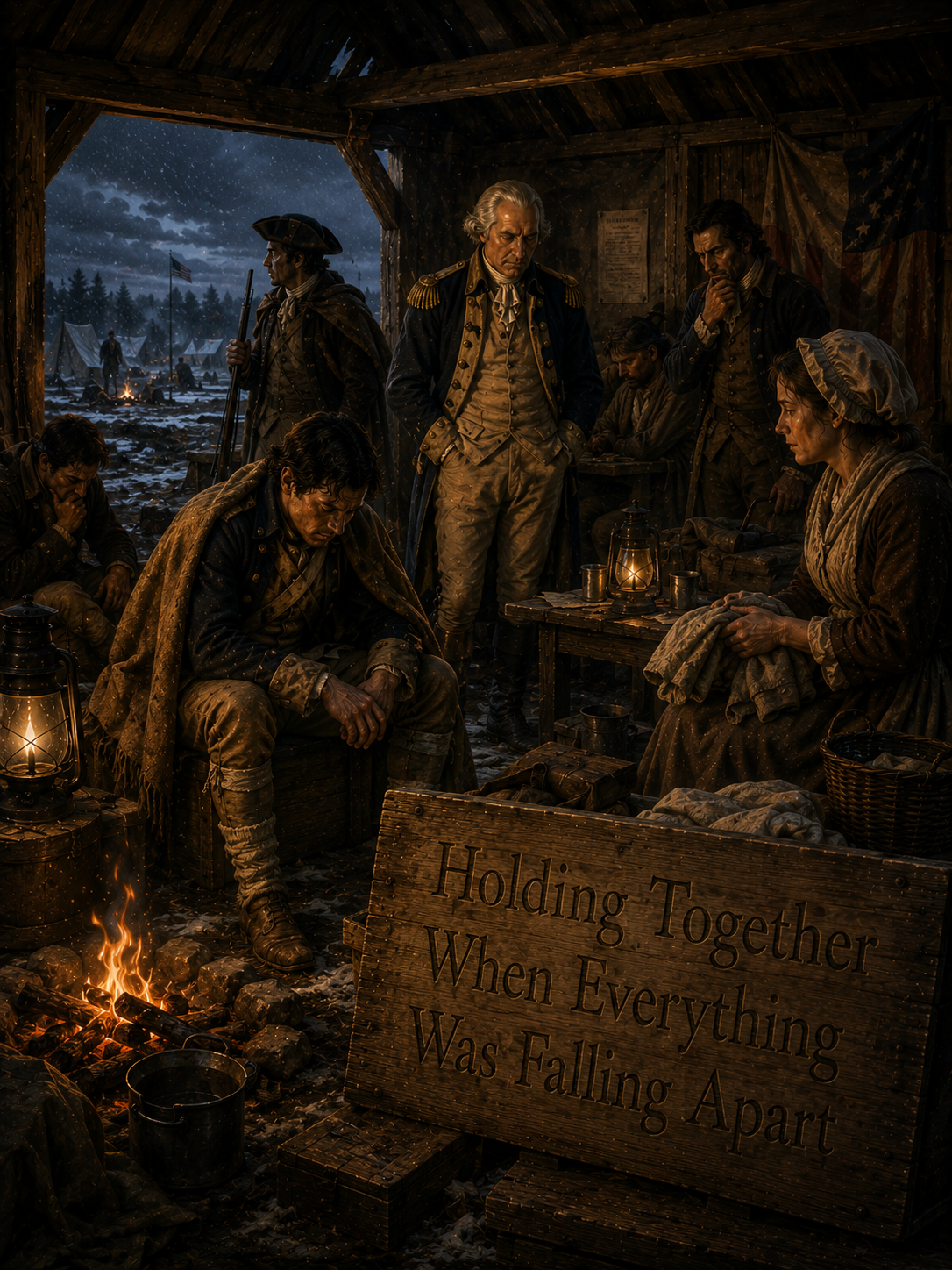
The Revolution Reached A Dangerous Point
The Revolution reached a dangerous point when early courage had already been tested by hard reality.
Military defeats weakened morale. Supplies continued disappearing. Enlistments expired. Exhaustion spread through the Continental Army. The cause that had once stirred hearts with the promise of resistance now had to survive the grinding pressure of failure, hunger, cold, fear, and doubt.
This was one of the hardest truths of the Revolution:
A cause can be right and still nearly collapse.
Belief alone did not fill empty stomachs. Patriotism did not replace shoes, blankets, powder, medicine, or shelter. Words about liberty could inspire people, but inspiration had to survive the night watches, the muddy roads, the sickness in camp, and the fear that the British Empire might simply be too strong to overcome.
Winter Approached
As winter approached, suffering intensified.
Cold weather pressed into camps and bodies. Soldiers lacked proper clothing and shelter. Hunger became common. Illness spread rapidly where men were weakened by exposure, poor food, exhaustion, and uncertainty. The season itself seemed to join the hardship, turning every shortage into something more dangerous.
Winter changes the meaning of endurance.
A thin coat becomes a test. Wet ground becomes a test. A missing blanket becomes a test. A long night becomes a test. Soldiers who had once stepped forward with conviction now had to decide whether they could continue when their bodies were worn down and their hope had grown tired.
The Revolution was no longer only a public cause.
It had become a private struggle inside each person who had to choose whether to remain.
Doubt Spread Across The Colonies
Doubt spread across the colonies because the danger was real.
Some believed independence was impossible. Others feared Britain’s strength could never be overcome. Families wondered whether the men they loved were suffering for a dream that might fail. Leaders carried the pressure of decisions that could affect not only armies, but the future itself.
That doubt should not be dismissed too quickly.
People living through the moment did not know they were inside a successful Revolution. They did not have the comfort of hindsight. They could not see the pages that would later be written.
They saw losses, shortages, sickness, fear, and uncertainty.
They saw a cause that seemed fragile.
They saw a future that might disappear before it was born.
Yet Some Refused To Give Up
Yet some refused to give up.
Ordinary soldiers stayed despite hardship. Communities continued supporting the cause even when they had little to spare. Families endured separation and sacrifice. People kept working, praying, sharing, waiting, and hoping.
The Revolution survived because enough people continued carrying it when it looked too heavy to carry.
This is where perseverance quietly became the true strength of the Revolution.
Not every act of courage happened in battle. Some courage looked like staying one more day. Some looked like sharing food. Some looked like writing a letter, mending a coat, tending the sick, keeping a farm alive, or standing beside a neighbor when fear said to retreat into oneself.
The cause held because ordinary people held.
Leadership Was Tested Deeply
Leadership was tested deeply during this season.
Washington carried an enormous emotional burden. Every decision affected lives, morale, families, and the future of the cause. A commander in such a moment does not simply move troops on a map.
He carries the fear of collapse, the suffering of soldiers, the expectations of Congress, the worries of civilians, and the knowledge that one wrong step could deepen disaster.
Leadership now meant holding people together when fear threatened to pull everything apart.
It meant asking tired men to endure longer. It meant protecting the army from destruction while trying to preserve belief in the cause. It meant staying steady when steadiness itself became a service.
The weight of command did not disappear after leadership was accepted.
It grew heavier as the Revolution weakened.
Civilizations are often preserved during their darkest moments, long before anyone knows the ending. Perseverance matters most when hope grows weak. Courage is frequently quiet and unseen, carried by people who receive little recognition while they are living through the burden.
Every generation eventually faces seasons when things feel as if they are coming apart.
Families face them.
Communities face them.
Nations face them.
The test is not only whether people can begin with enthusiasm. The test is whether they can remain faithful when confidence fades.
History often turns because ordinary people endure long enough for another door to open.
The emotional atmosphere was heavy with exhaustion.
Camps were tired. Families were anxious. Leaders were pressured. Fear remained constant. Many people understood that the Revolution was in danger, and that the dream of independence could still be lost.
The burden of freedom was no longer a distant idea.
It had become cold hands, empty supplies, hard choices, and uncertain mornings.
Yet beneath the hardship, determination still quietly survived.
It did not always look strong. It did not always sound confident. But it remained. People continued because abandoning the cause would mean abandoning the meaning of what had already been sacrificed.
That quiet determination is one of the most important forms of strength in this journey.
It is the strength that holds together when everything else seems to be falling apart.
Holding together when everything was falling apart reminds us that societies are strengthened by people who continue carrying responsibility during difficult seasons.
Perseverance often shapes history more than inspiration because inspiration begins the work, but endurance keeps it alive. Future generations depend on those willing to carry burdens without immediate reward.
From here, the Revolution enters one of its darkest seasons.
Morale weakens. Uncertainty intensifies. The possibility of failure feels painfully close. Yet from that pressure, unexpected courage begins to emerge.
Hope does not return because hardship disappears.
Hope returns because ordinary people, soldiers, families, communities, and leaders refuse to let the fragile cause die before its future can be born.