Chapter 27
Courage in the Darkest Winter
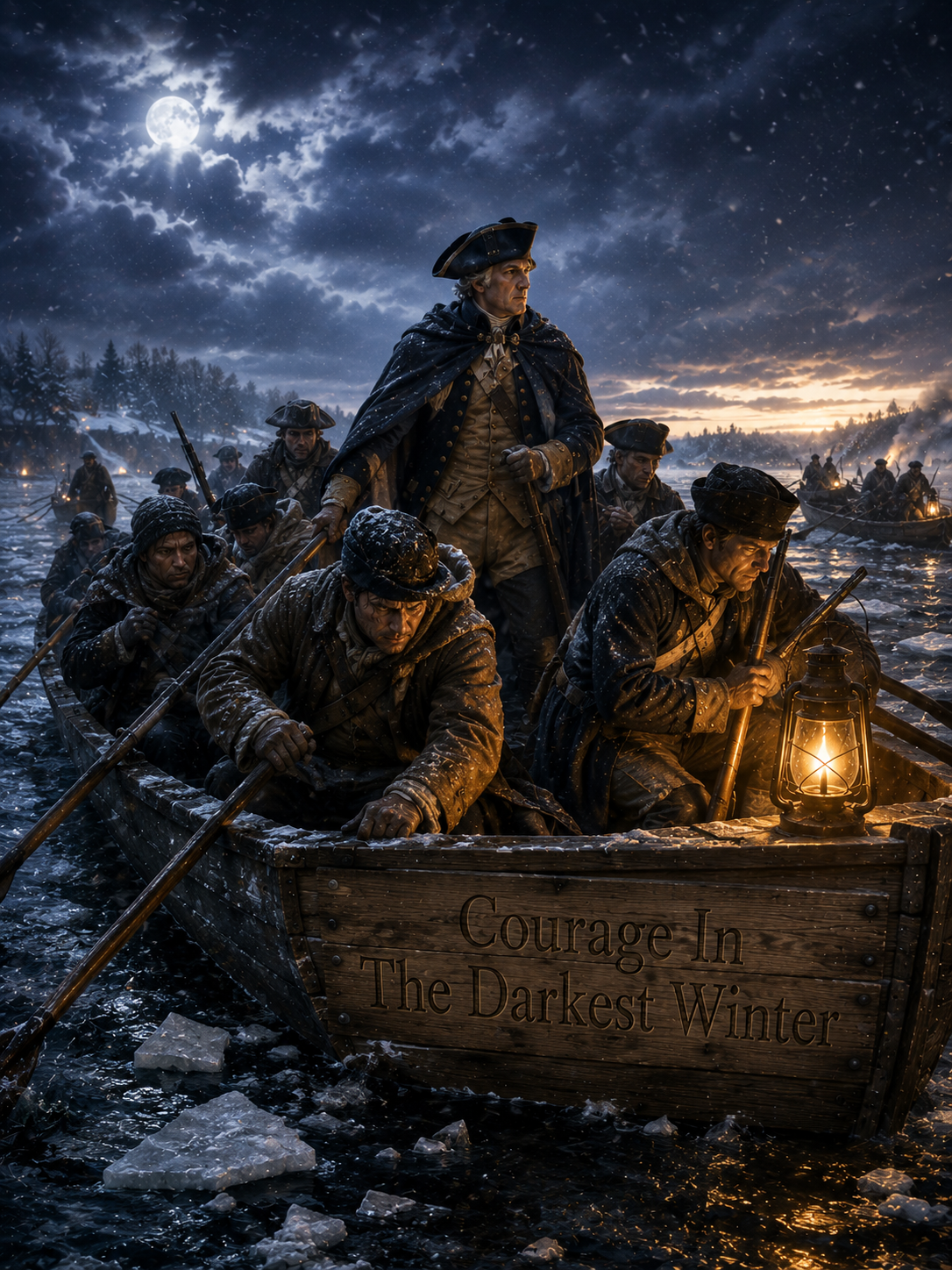
On a freezing night beneath a dark and uncertain sky, exhausted ordinary men carried more than muskets across the Delaware. They carried the fragile hope that future generations might one day inherit a world where freedom could survive even humanity’s darkest winters.
The Revolution Stood Near Collapse
The Revolution stood near collapse when winter tightened around the cause.
Morale remained dangerously low. Enlistments were expiring. Supplies had disappeared or failed to arrive. Soldiers were hungry, cold, poorly clothed, and exhausted. Many people feared the Revolution itself might not survive the season.
This was not the bright beginning of resistance.
It was the long, punishing middle, when courage had already been tested by hardship and hope had become difficult to hold. The army had suffered. The colonies had doubted. Families had waited through fear and uncertainty.
The dream of independence, which had once stirred people with possibility, now seemed fragile enough to break beneath the weight of cold, defeat, and exhaustion.
Washington Faced Impossible Pressure
Washington faced impossible pressure.
He was not commanding from the safety of hindsight. He stood inside the uncertainty, carrying the burden of men whose bodies were worn down and whose spirits had been tested again and again. Defeat seemed increasingly possible.
Every decision carried consequences that reached beyond the army into homes, families, communities, and the future of the cause itself.
Leadership now required emotional strength as much as military judgment.
It was not enough to understand strategy. Washington had to hold together men who were tired, discouraged, and nearing the end of their enlistments. He had to see beyond the present misery without pretending it was not real.
He had to act while knowing that failure could deepen despair and perhaps destroy what remained of the Revolution.
A Risk Had To Be Taken
A risk had to be taken because remaining passive could destroy the cause.
Waiting might appear safer, but in that season waiting carried its own danger. An army that did nothing could dissolve. Morale could collapse. Men whose enlistments were ending might go home. The fragile belief that independence could survive might fade beyond repair.
Washington chose action despite uncertainty.
Plans formed quietly during freezing winter nights. The movement required secrecy, discipline, timing, and endurance from men who had little comfort left to give. It was a desperate plan, but not a careless one.
Sometimes history turns because someone recognizes that fear cannot be allowed to make the final decision.
The choice to move forward became its own act of leadership.
The Delaware Crossing
The Delaware Crossing placed exhausted men into the darkness, cold, and danger of the river.
Icy water surrounded the boats. Wind and winter weather made every movement harder. Men carried muskets, equipment, and the burden of not knowing what waited ahead.
The river was not merely a physical obstacle.
It became a passage through uncertainty.
Every face in that crossing belonged to a human being. Some were frightened. Some were numb with cold. Some may have wondered whether they would survive the night. Others may have thought of home, of family, of the promises that had brought them this far.
Yet together they continued forward.
In that moment, the Revolution did not look powerful.
It looked fragile, cold, tired, and determined.
The humanity of the moment matters.
If we see only the famous painting in our minds, we may miss the truth beneath it. These men were not statues arranged for memory. They were ordinary people in danger, moving through brutal conditions while carrying a responsibility larger than themselves.
Few could fully understand how important the moment would become.
They did not cross because victory had already been promised.
They crossed because responsibility remained.
Some lacked proper shoes or blankets. Many were exhausted from previous hardship. The cold touched every part of the body. Fear had reason to be present.
But courage does not require fear to disappear.
Courage often means continuing while fear walks beside you.
Courage often appears when circumstances seem hopeless. Perseverance matters most during the darkest seasons, when comfort is gone and confidence has weakened. Ordinary people are capable of extraordinary endurance when they believe they are protecting something meaningful for those who will come after them.
Every generation faces dark crossings of its own.
Families, communities, and nations all encounter moments when the way forward is uncertain and the cost of stopping is too great. The Delaware reminds us that a society endures because some individuals refuse to surrender hope, even when hope feels small, cold, and nearly exhausted.
They move forward before the outcome is visible.
Cold and fear surrounded everything.
The sky was dark. The river was dangerous. The men were worn down. The cause remained uncertain. Nothing about the night guaranteed success.
That is why the emotional atmosphere carries such weight.
The moment was not powerful because it was easy. It was powerful because action continued when everything seemed to argue against it.
Yet beneath the cold and fear, something deeper quietly emerged:
Resolve.
Not loud confidence.
Not celebration.
Resolve.
The kind that rises when people have already suffered and still decide that the future is worth one more step.
The Revolution was still fragile, but it had not died.
In the darkest winter, men kept moving.
Courage in the darkest winter reminds us that difficult seasons do not last forever, but they must still be endured before they pass.
Hope can return even during moments of despair, but often it returns first through action, not feeling. Future generations depend upon people willing to keep moving forward through uncertainty, even when the road is cold, dark, and unfinished.
From here, the Revolution reaches an emotional turning point.
The crossing will lead into a moment that begins restoring belief when almost everything seemed lost. The colonies will not yet be safe. The war will not yet be over.
But after the darkest winter night, hope will begin to reappear, carried by ordinary men who crossed because surrender could not be allowed to have the final word.