Chapter 29
Rebuilding Belief in the Future
After enduring cold, sacrifice, fear, and uncertainty, ordinary people slowly began believing again not only in victory, but in the possibility that future generations might one day inherit a freer, more hopeful world because they refused to give up when everything seemed lost.
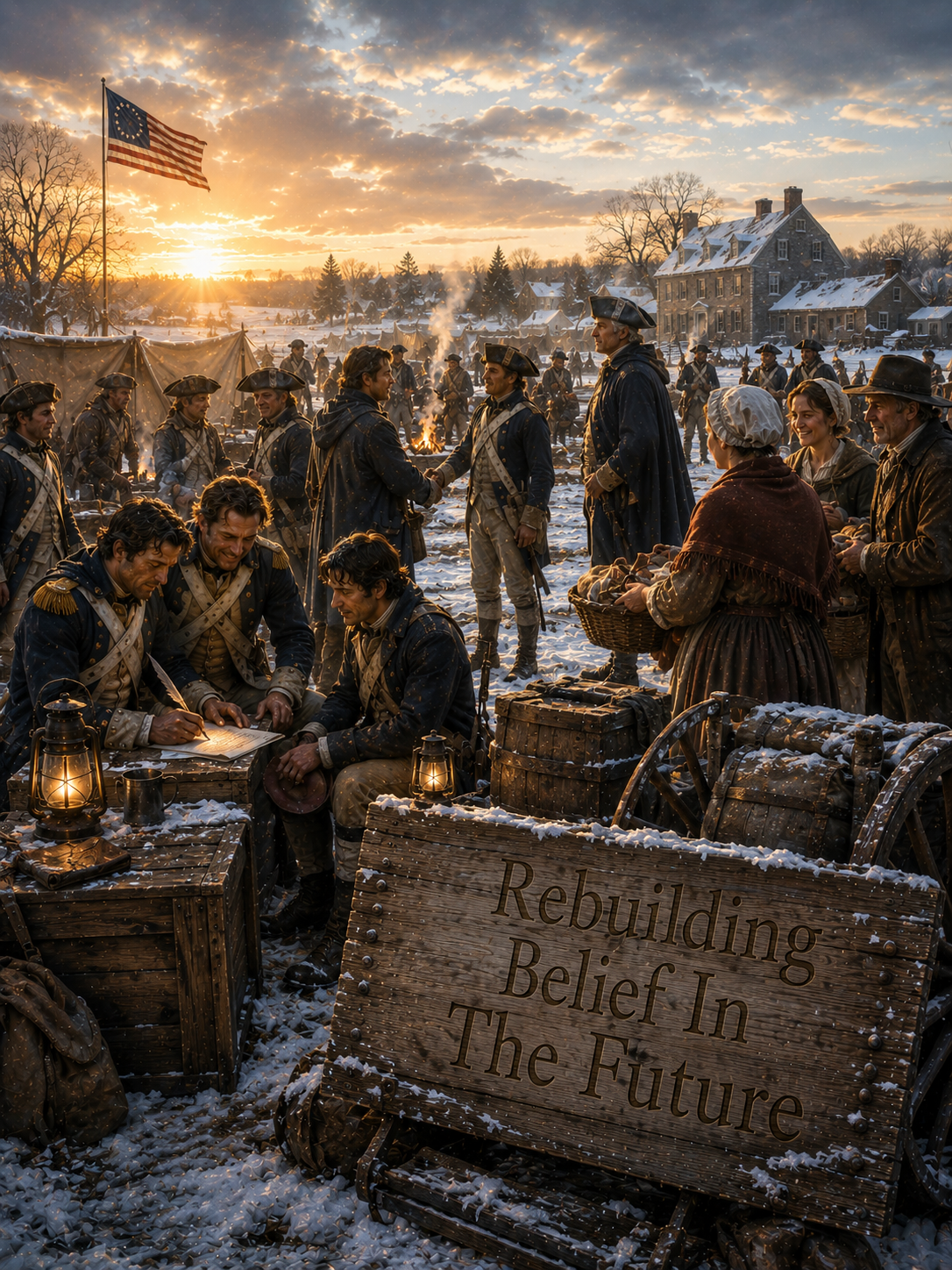
The Victories At Trenton And Princeton
The victories at Trenton and Princeton were modest when measured only by military size, but emotionally they were enormous.
They came after a season when the Revolution seemed dangerously close to collapse. Soldiers had been cold, hungry, discouraged, and exhausted. Families had waited in fear. Communities had wondered whether the cause could survive.
Then, in the depth of winter, the story changed.
These victories did not end the war. They did not remove the British threat or solve the shortages that had weakened the army. But they gave the colonies something they desperately needed:
proof that defeat was not inevitable.
The Revolution no longer felt doomed. A cause that had seemed fragile now appeared alive again, and that emotional shift mattered as deeply as any battlefield result.
Soldiers Began Reenlisting
As belief returned, some soldiers chose to stay despite the hardship.
That decision carried tremendous meaning. These were not men choosing comfort. They were choosing more cold, more danger, more uncertainty, and more separation from home. They had already seen enough suffering to understand that the path ahead would not be easy.
Reenlistment was more than a military necessity.
It was an act of renewed faith.
Ordinary men continued sacrificing for something larger than themselves. They were not guaranteed victory. They were not promised ease. But the victories had reminded them that endurance could matter.
Their choice to remain helped keep the army from dissolving and allowed the cause to continue breathing when it had nearly run out of strength.
Communities Felt Renewed Strength
Communities also felt renewed strength.
Families who had lived between hope and fear began hearing news that lifted their hearts. Towns became more supportive of the cause. Conversations that had been centered on survival slowly began turning toward possibility.
People still worried, but worry no longer had the same power to silence hope.
This mattered because revolutions are not sustained by armies alone.
They are sustained by households, churches, farms, workshops, towns, and neighbors. A soldier’s commitment needed a community behind it. Families had to keep working. Supplies had to be gathered. Encouragement had to be shared.
When communities began believing again, the Revolution gained more than morale.
It gained a deeper foundation of shared endurance.
Leadership Earned Trust
Washington’s willingness to endure hardship beside the soldiers strengthened confidence.
Leadership became associated not merely with rank or status, but with sacrifice, perseverance, and responsibility. The men had seen him carry pressure when the cause seemed weakest. They had seen action taken when fear could have frozen everyone in place.
Trust is not built by words alone.
It grows when people see that a leader is willing to remain under the same burden they are being asked to carry. Washington did not make hardship disappear, but his steadiness helped people believe the army still had direction.
In a fragile moment, leadership became one of the bridges between despair and renewed belief.
The humanity of this moment should not be forgotten.
Exhaustion still remained everywhere. Grief still existed. Uncertainty still lingered. Men who chose to stay still missed home. Families still feared loss. Communities still faced shortages.
The Revolution was not suddenly safe because hope had returned.
Yet ordinary people began imagining a future worth preserving.
That is a powerful human change. A tired soldier could look beyond the next cold night. A family could believe sacrifice still had meaning. A community could imagine that endurance might become inheritance.
The future was not visible in full, but it no longer felt entirely closed.
People began to believe again that what they carried might one day bless those who came after them.
Hope is one of humanity’s greatest sources of strength. It does not remove hardship, but it helps people continue through hardship with renewed purpose. Perseverance can inspire others long after suffering begins, especially when people see that sacrifice has not been wasted.
Communities grow stronger when people continue believing in one another.
Families, towns, and nations all need moments when hope returns after fear has done its damage. Future generations are often protected by people who refuse to surrender belief during difficult seasons.
The Revolution reminds us that civilization is not only defended through battles.
It is also preserved through renewed faith in what is still worth building.
Winter remained cold and dangerous.
Hardship remained real. The army still faced uncertainty, and the colonies still had a long road ahead. But emotionally, light had begun returning to the horizon.
Not full daylight.
Not final victory.
A first light.
Enough for people to see that the road did not end in darkness.
That is the emotional atmosphere of this chapter: renewed belief rising slowly over exhausted people. The Revolution was still fragile, but the spirit around it had changed.
Men stayed.
Families hoped.
Communities strengthened.
Leaders earned trust through endurance.
The cause began to feel less like a desperate resistance and more like a future struggling to be born.
Rebuilding belief in the future reminds us that meaningful change requires both sacrifice and hope.
A people can suffer greatly and still rise again when they begin to believe their endurance has purpose. Societies rebuild through renewed belief in the future, and ordinary individuals shape civilization through perseverance, responsibility, and the refusal to abandon what is worth protecting.
From here, the Revolution begins attracting growing international attention.
The colonies slowly transition from fragile resistance toward emerging nationhood. The world begins noticing America differently.
But before outside attention grows, this moment matters because belief had to be rebuilt from within.
A future could not be inherited until people first believed it was still possible.