Chapter 30
The War Was Ending
The American Revolution was never only about winning a war. It was about whether citizens could carry the responsibility, sacrifice, unity, and perseverance required to build a future worthy of the freedom they had fought so hard to achieve.
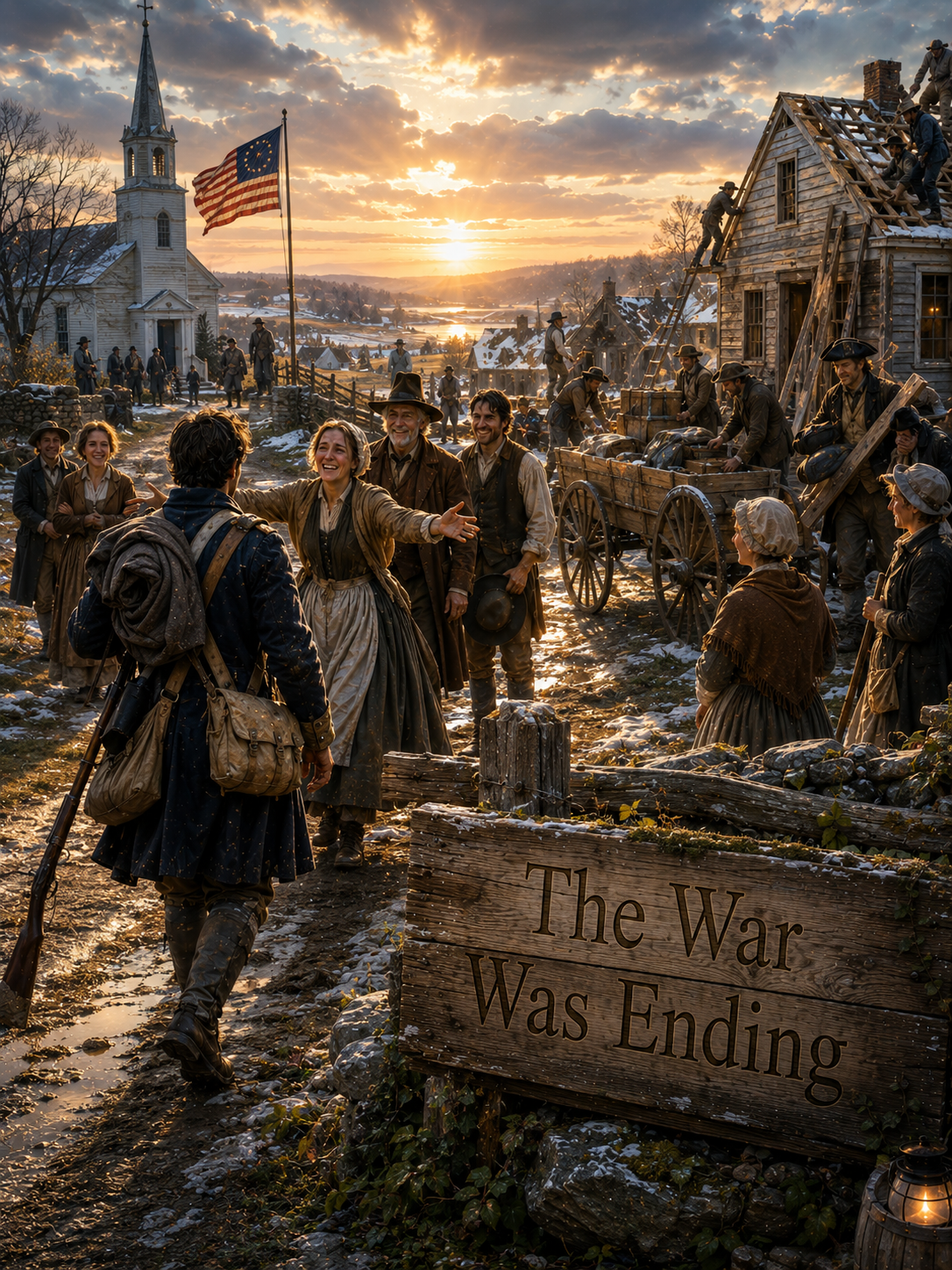
The Fight Was Slowly Ending
After years of fighting, hunger, fear, sacrifice, and uncertainty, the fight for independence was slowly moving toward its end. Peace negotiations began emerging. The fighting had exhausted both sides. Independence no longer felt impossible in the same way it once had. Ordinary people, who had spent years living under the shadow of war, cautiously allowed themselves to imagine life after it.
That imagination must have felt strange. For so long, the future had been measured by survival: the next battle, the next winter, the next shortage, the next letter, the next loss. Now people had to begin thinking beyond the war. What would home feel like after so much absence? What would communities look like after so much strain? What would freedom require once it was no longer only a cause to defend, but a life to build?
America Faced A New Challenge
Winning freedom was only the beginning. The colonies now had to learn how to govern themselves. That was a different kind of test. It required unity where there had often been local interest. It required leadership without monarchy. It required laws, responsibility, trust, patience, and the willingness to think beyond immediate survival.
The Revolution slowly transitioned from rebellion toward nationhood. That change was enormous. During the war, people could unite around what they opposed and what they hoped to secure. But after the war, they would have to decide how to live together. Freedom would need shape. Liberty would need order. Independence would need responsibility. A new country could not survive on victory alone.
Soldiers Began Returning Home
As the war neared its end, soldiers began returning home. Many carried physical and emotional scars that would remain long after the fighting stopped. Some returned to farms that had struggled without them. Some returned to families changed by years of waiting. Some returned to grief, debt, damage, or uncertainty. Others did not return at all, and their absence became part of the cost carried by those left behind.
Reunion was powerful, but it was not simple. A family embrace could hold joy and sorrow at the same time. A soldier might come home alive, but altered. A wife, mother, father, child, or neighbor might feel relief while still remembering everything the war had taken. The burden of rebuilding now replaced the burden of survival. Ordinary citizens had to repair homes, businesses, farms, roads, churches, families, and trust.
Washington’s Leadership Deepened Respect
Washington’s leadership deepened in the eyes of many because he became associated not only with military endurance, but with restraint, humility, and responsibility. He had carried command through defeat, hunger, uncertainty, exhaustion, and long seasons when the cause seemed fragile. But what mattered just as deeply was the way he placed the cause above personal ambition.
That kind of leadership shaped trust. People had seen enough of power in the old world to understand its danger. The Revolution had not been fought so one person could replace another as master. Leadership now had to be connected to service, not domination. Washington’s example helped many ordinary people believe that authority could be held with restraint, and that the future might be protected by sacrifice rather than ambition.
Communities Began Rebuilding
Communities began rebuilding in quiet ways. Churches reopened more fully. Trade slowly returned. Town meetings increasingly focused on the future instead of immediate survival. Farms needed repair. Businesses needed customers. Roads needed use. Families needed healing. Neighbors needed one another again, not only to endure war, but to build peace.
This work rarely appears as dramatic as battle, but it is just as necessary to civilization. A country is not built only by soldiers and statesmen. It is built by people who plant again, trade again, worship again, meet again, teach again, and trust again. Ordinary people quietly began constructing the foundations of a new nation through daily responsibility. The Revolution had asked them to resist. Peace would ask them to rebuild.
The humanity of this moment was complicated. Grief still existed everywhere. Many families mourned loved ones who would never return. Uncertainty lingered across the fragile young country. No one could fully know whether independence would produce unity, peace, prosperity, or disorder. The future was opening, but it was not yet secure.
Yet hope slowly began feeling stronger than fear for the first time in years. That did not erase the cost. It gave the cost meaning. People could begin to imagine children growing up without the same shadow of war. They could imagine farms restored, homes repaired, laws debated, communities strengthened, and a future shaped by citizens rather than distant rulers. The dream was still fragile, but it had survived long enough to become a responsibility.
Ending conflict is often easier than building lasting peace. A crisis can force people together, but peace asks whether they will continue working together after the immediate danger fades. Freedom requires responsibility long after victories are won.
Ordinary people sustain civilizations through sacrifice carried across generations. They do not only defend a society in moments of danger. They preserve it afterward through patience, cooperation, humility, and service. Future societies are built by citizens willing to continue after hardship ends, when no one is cheering, when the work is ordinary, and when responsibility must become a way of life.
The war had not fully disappeared from people’s lives. Hardship remained visible throughout the colonies. Grief, debt, damaged property, uncertain government, and fragile unity all remained real. The years of sacrifice could not be undone simply because the fighting was ending.
But emotionally, light had begun returning beyond the years of sacrifice and uncertainty. People could breathe differently. They could look ahead without seeing only war. Relief did not remove responsibility. It revealed it. The next task would be harder in a quieter way: to turn independence into a society worthy of the sacrifices that had made it possible.
The war was ending, but the meaning of the Revolution was still unfolding. Meaningful freedom requires stewardship and long-term responsibility. Societies survive when ordinary people continue contributing after crises fade. Future generations inherit the character previous generations choose to build.
From here, America begins confronting the enormous challenge of transforming thirteen separate colonies into one fragile republic. The Revolution gives way to the difficult work of building a nation. The American experiment begins, not as a finished certainty, but as a living responsibility placed into the hands of people who had already learned that freedom is never preserved by inspiration alone.