Chapter 31
The American Experiment Begins
The American experiment began not when the war ended, but when ordinary people accepted the far more difficult responsibility of learning how to hold together a fragile nation built upon freedom, sacrifice, compromise, and the hope that future generations might preserve what they themselves had only just begun.
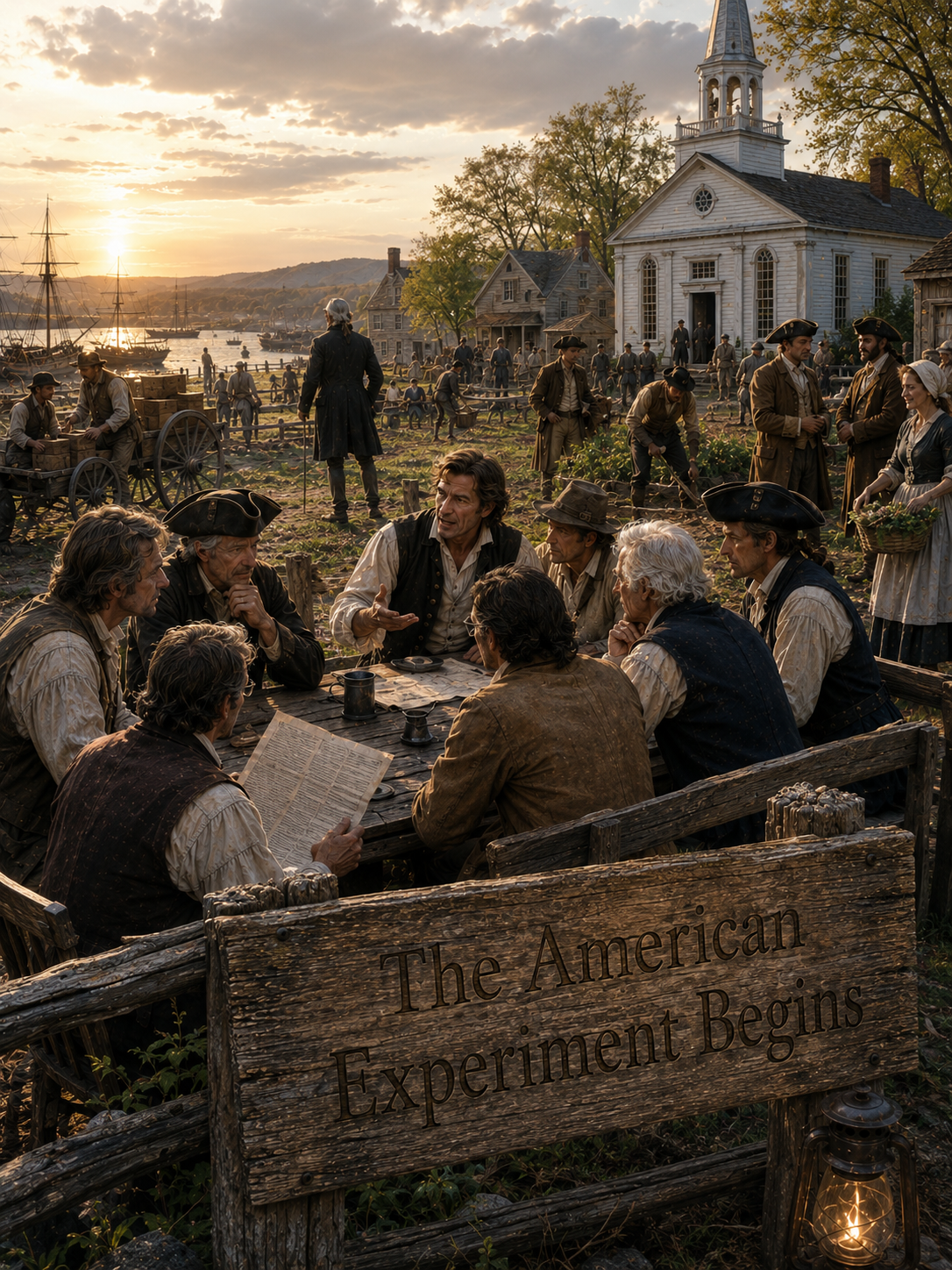
America Faced An Uncertain Future
Thirteen separate colonies had won their independence, but now they faced the enormous challenge of learning how to survive as one fragile republic.
The war had ended in victory, but victory did not automatically create stability. Economic hardship spread throughout much of the young nation. Trade was uncertain. Debt weighed heavily. Many ordinary citizens feared the republic could still fail.
That fear was not unreasonable.
The Revolution had united people around resistance, sacrifice, and the hope of independence. But after the war, the question changed.
Could separate states with different interests remain connected?
Could freedom be preserved without a king?
Could local loyalty grow into national responsibility?
Freedom had been won through sacrifice, but preserving it would require wisdom, patience, and unity.
The Articles Revealed Weaknesses
Under the Articles of Confederation, the new national government struggled to do what a lasting nation needed to do.
It had difficulty collecting money, enforcing laws, settling disputes, and holding the states together when local interests pulled in different directions. Individual states often placed their own needs ahead of national cooperation, and disagreements about power, trade, debt, and responsibility continued growing.
This weakness mattered because government is not only an idea written on paper.
It affects farms, shops, roads, trade, courts, soldiers, families, and communities. When a government is too weak to act, ordinary people feel the uncertainty.
Leaders began realizing that the country would eventually require a stronger foundation, but that realization brought its own danger.
How could America create strength without betraying the liberty it had fought to protect?
Ordinary People Continued Rebuilding
While leaders debated, ordinary people continued rebuilding.
Farmers returned to damaged fields and struggling farms. Merchants attempted to restore trade after years of disruption. Families rebuilt homes, churches, schools, workshops, and local communities. Veterans tried to return to civilian life, carrying memories and wounds that did not disappear when the fighting stopped.
Everyday citizens quietly carried the enormous burden of stabilizing the new nation.
They worked, planted, repaired, taught, worshiped, traded, gathered, and argued over the future. This is where the American experiment became real.
It did not live only in public documents or famous speeches.
It lived in the daily choices of people trying to turn freedom into a workable life.
Washington Returned To Private Life
Washington’s return to private life became one of the most powerful moments of the early republic.
Many people expected a victorious military leader to hold onto power. In much of the world, that would not have seemed surprising. But Washington willingly stepped away from military authority and returned home.
His restraint shocked many who understood how easily power can become ambition.
That decision shaped the moral imagination of the young country. Ordinary citizens increasingly viewed leadership as service rather than personal possession.
The Revolution had not been fought so one form of unchecked power could be replaced by another.
Washington’s restraint helped teach that authority in America should be held with humility, limited by responsibility, and placed beneath the larger good of the republic.
A Shared Identity Slowly Formed
Communities began defining American identity in uneven but important ways.
Newspapers spread political ideas throughout the states. Town meetings became centers of debate, disagreement, and civic participation. Citizens discussed trade, debt, taxes, laws, state power, national weakness, and the future of the republic.
People were learning that self-government required more than independence.
It required involvement.
Slowly, some began to see themselves not only as Virginians, New Yorkers, Pennsylvanians, or citizens of their own towns and states, but as Americans. That shift did not happen all at once. Local identity remained powerful. Division remained real.
But a shared national identity began forming through conversation, hardship, rebuilding, and the growing realization that the states would either rise together or risk falling apart separately.
The humanity of this moment should not be overlooked.
Uncertainty still lingered everywhere. Many citizens worried about debt, division, instability, and whether the sacrifices of the Revolution would lead to lasting freedom or another kind of failure. Hardship remained common throughout the young republic.
Victory had not removed fear.
It had simply changed what people feared.
Yet communities continued believing the future was still worth building together. That belief mattered. The young nation was not held together by perfect agreement. It was held together by the willingness to keep working through disagreement.
Hope had survived the war and now searched for permanence.
The American experiment began in that fragile space between freedom won and freedom secured.
Freedom often creates responsibilities as difficult as the struggles required to achieve it. Winning liberty may require courage, but preserving liberty requires patience, cooperation, restraint, sacrifice, and the humility to think beyond oneself.
Societies survive when ordinary people remain committed during uncertain transitions.
Unity requires sacrifice long after moments of victory pass. Future generations inherit stability built through patient hands, difficult conversations, imperfect compromise, and perseverance.
The early republic reminds us that civilization is not preserved by victory alone.
It is preserved by citizens who keep participating when the excitement fades and the hard work begins.
The American experiment began with hope, but also with weakness, debt, disagreement, and uncertainty.
Democracy requires constant participation and responsibility. Societies remain fragile when division outweighs cooperation. Ordinary citizens play a central role in preserving freedom across generations, because a society endures when people continue believing in shared purpose during difficult transitions.
From here, America begins confronting growing debates over the structure and future of the republic.
Leaders and citizens struggle to balance liberty with stability. The weaknesses of the first national government become harder to ignore, and the foundation of the United States government slowly begins taking shape.
The Revolution had created independence.
Now America had to learn whether independence could become a nation.