Chapter 32
The Constitution Takes Shape
The Constitution was not created because Americans trusted power. It was created because ordinary people understood that freedom could only survive if future generations were willing to balance liberty, responsibility, compromise, and unity within a nation still fragile enough to fail.
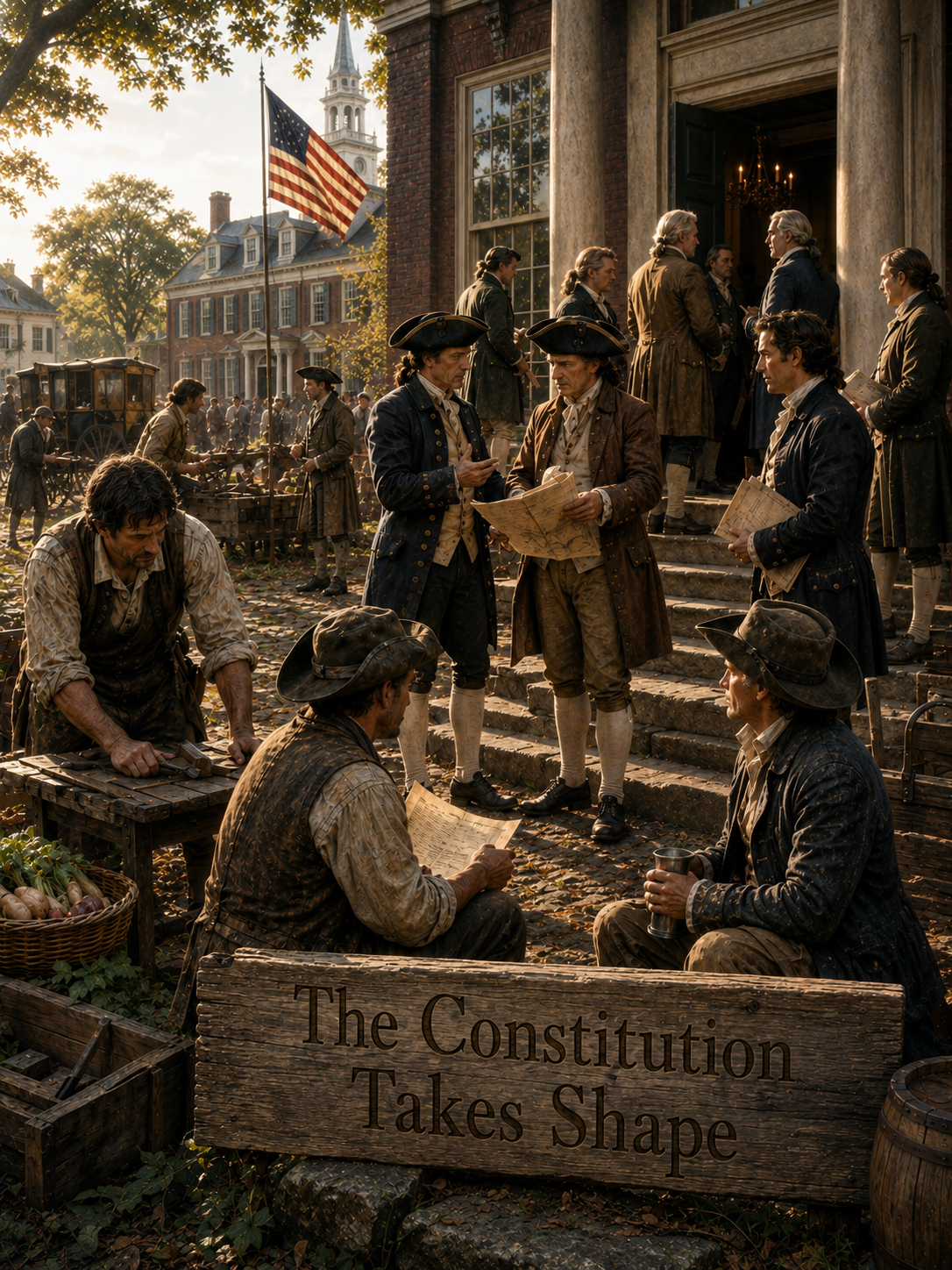
The Young Republic Remained Fragile
America had won its independence, but ordinary people now faced a difficult new question:
How could freedom survive without strong unity holding the nation together?
Victory had removed British rule, but it had not removed debt, division, uncertainty, or the practical problems of governing thirteen separate states. The Revolution had created independence. It had not yet created permanence.
The young republic still felt fragile.
Many citizens worried about economic hardship, unstable trade, unpaid debts, weak national authority, and disagreements between states. Farmers, merchants, veterans, families, and local communities all felt the uncertainty in different ways.
Freedom had been won through sacrifice, but preserving it would require wisdom.
The country needed enough strength to hold together without becoming the kind of distant power Americans had resisted.
The Articles Revealed Weakness
The Articles of Confederation had helped hold the states together during and immediately after the Revolution, but their weaknesses became harder to ignore.
The national government struggled to collect money, enforce laws, regulate trade, or respond effectively when state interests pulled in different directions. Individual states often placed local needs ahead of national cooperation, and disputes over commerce, debt, authority, and responsibility continued growing.
This weakness mattered because a government that cannot act can leave ordinary people exposed to instability.
Trade becomes uncertain. Debts become harder to settle. Confidence weakens. Communities begin wondering whether the sacrifices of war will produce lasting freedom or only disorder.
Many leaders came to believe the country needed a stronger foundation, but that realization raised another fear:
How could America become stronger without surrendering the liberty it had fought to secure?
Debates Over Power Intensified
Debates over federal power slowly intensified.
Citizens feared tyranny, but they also feared instability. They had lived through the dangers of concentrated power, yet they could now see the danger of a government too weak to protect unity.
The question was not simple.
Liberty needed protection.
Order needed strength.
Representation needed fairness.
Taxation needed legitimacy.
National authority needed limits.
Ordinary Americans followed these arguments because the future of the republic was not an abstract matter. It touched their farms, shops, courts, churches, roads, families, and local governments.
Political disagreement often became emotional because people understood what was at stake.
The country was trying to answer a question that has never been easy:
How can free people govern themselves without destroying either freedom or unity?
The Convention Began Taking Form
As the weaknesses of the young republic became clearer, leaders from different states prepared to gather and discuss the nation’s future.
Compromise increasingly became necessary for survival. No clear blueprint existed for building a republic of this size across such distance and difference. America was entering one of the most important political experiments in human history.
The Constitutional Convention did not begin as a guaranteed success.
The men who gathered carried different state interests, different fears, different ideas about power, and different visions of what the country should become. They were not working with perfect certainty.
They were trying to shape a government strong enough to endure, yet restrained enough to protect liberty.
The Constitution began taking shape in that tension.
Ordinary Citizens Sustained The Nation
While leaders debated, ordinary citizens continued carrying daily life.
Farmers worked through difficult seasons and uncertain markets. Merchants struggled to restore reliable trade. Families rebuilt homes, churches, schools, and local communities damaged by years of war. Veterans tried to settle back into civilian life while the country they had fought for searched for stability.
This part of the story matters because the nation was not sustained by convention halls alone.
The American experiment remained alive because everyday people kept working, trading, teaching, worshiping, repairing, and participating.
Their patience gave the republic time to search for a stronger foundation.
Their labor kept the country breathing while its structure remained unfinished.
Washington Remained A Symbol Of Stability
Washington remained a symbol of stability during uncertain times.
Many citizens trusted his judgment because they had seen restraint in his leadership. He had stepped away from military authority instead of clinging to power, and that decision strengthened confidence in his character.
In a fragile republic, trust became one of the nation’s most valuable resources.
Character mattered because written systems alone cannot protect a people if leaders treat power as personal possession.
Ordinary citizens increasingly understood that leadership required more than intelligence or ambition.
It required restraint, responsibility, and service.
Washington’s reputation helped reassure people that the search for a stronger government did not have to mean surrendering the principles of the Revolution.
The humanity of this moment is easy to miss if we remember only documents and famous names.
Fear and uncertainty still existed throughout the nation. Many Americans worried that freedom itself remained fragile. Political disagreements became emotional and personal because people cared deeply about what might be lost.
The future still felt unfinished.
Yet communities continued believing the experiment was worth protecting. They did not all agree on how to preserve it, but enough of them understood that liberty could not survive without some form of shared responsibility.
Hope had survived the war and now searched for permanence.
America was no longer merely fighting to be free.
It was learning how difficult freedom could be once it had to become a lasting nation.
The Constitution taking shape reminds us that freedom requires balance between liberty and responsibility.
Societies survive through compromise during periods of uncertainty, but compromise is never easy when fear and division grow stronger than trust. Future generations inherit the systems previous generations choose to strengthen or neglect.
From here, the Constitution begins reshaping the future of the United States.
Debates over rights, power, representation, and authority intensify across the republic. America slowly begins constructing the framework that will guide generations to come.
The challenge now is no longer only whether the young nation can survive.
It is whether free people can build institutions strong enough to preserve liberty without forgetting why liberty mattered.