Chapter 33
The Bill of Rights Emerges
The Bill of Rights emerged because ordinary Americans understood that freedom could never depend solely upon the goodness of leaders. It had to be permanently protected by principles strong enough to defend future generations from the same unchecked power they themselves had once fought to escape.
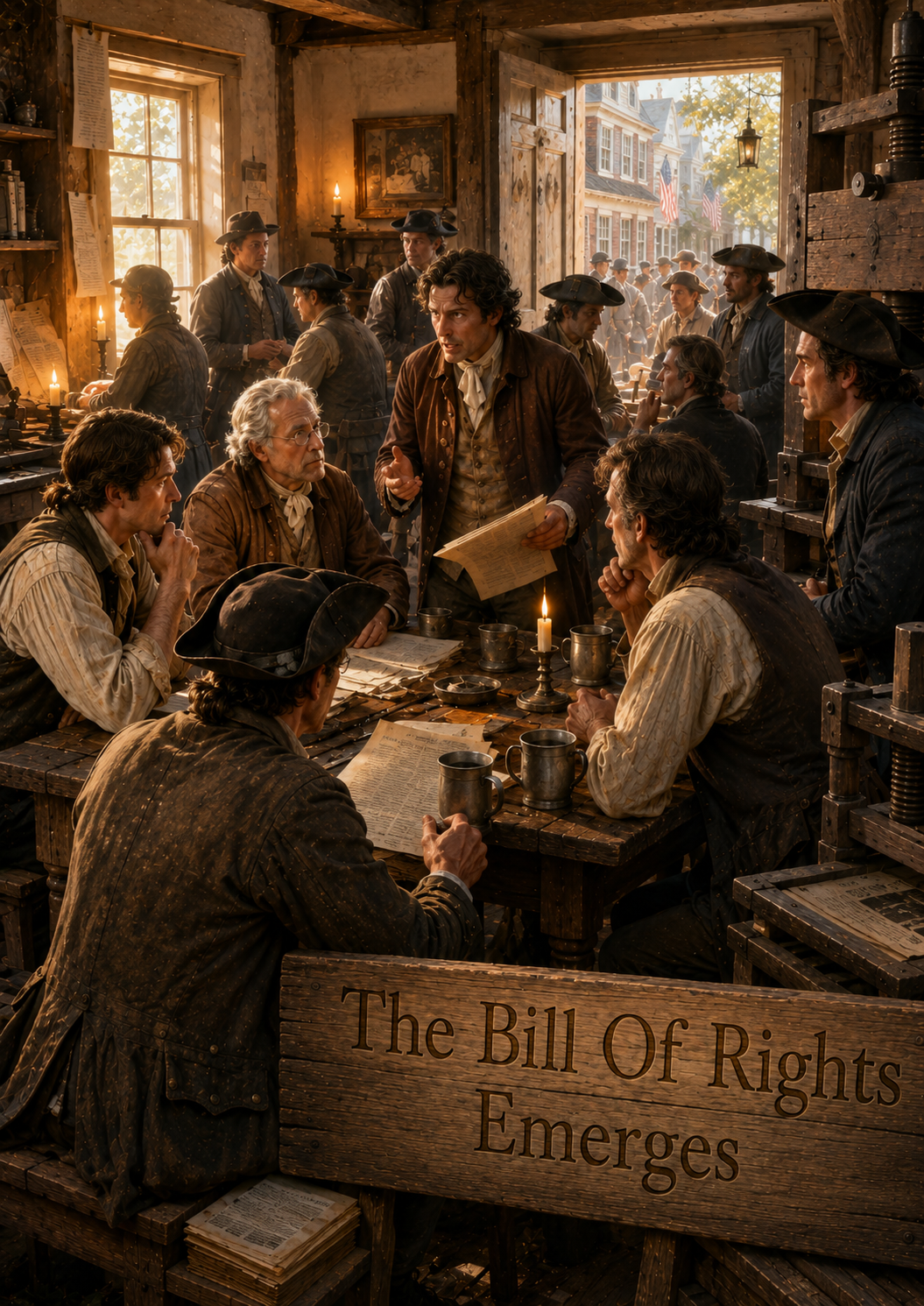
The Constitution Sparked New Debates
Americans had fought a revolution against unchecked power, and now many ordinary citizens demanded clear protections for the freedoms they feared future governments might someday threaten.
The Constitution offered a stronger national framework, but strength itself raised difficult questions. A government powerful enough to hold the nation together might also become powerful enough to overreach.
Many Americans supported a stronger national government because they had seen the weakness of the young republic. Others feared centralized authority could eventually become dangerous.
Debates over liberty, individual rights, representation, taxation, and national power intensified throughout the states.
The Revolution had ended British rule, but it had not ended the human struggle over power. Americans now had to decide how freedom could be protected inside the very government created to preserve it.
The Demand For Rights Grew Stronger
The demand for individual rights grew stronger because many citizens believed liberty required clear safeguards.
They wanted freedoms protected in writing, not left to custom, trust, or the character of whoever happened to hold office. Speech, religion, self-defense, fair trials, due process, protection from unreasonable searches, and limits on government authority were not abstract ideas.
They were protections ordinary people believed could matter in real life.
That concern came from experience.
The Revolution had taught Americans that power without restraint could reach into homes, churches, courts, businesses, communities, and consciences. Many believed the new republic needed more than structure.
It needed boundaries.
The idea of a Bill of Rights slowly gained national support because people understood that freedom survives best when power is clearly limited before abuse begins.
Public Discussion Expanded
Newspapers became central to political debate throughout the republic.
Arguments moved from public halls into homes, taverns, town meetings, workshops, and fields. People read, listened, questioned, argued, and repeated what they heard. The future of constitutional rights became part of everyday conversation because ordinary citizens understood that the decisions being made would reach far beyond the men writing them.
This public disagreement became part of the democratic experiment itself.
It was not always calm. It was not always comfortable. Political arguments could become emotional because people feared losing what had been won through sacrifice.
Yet the very act of public debate showed that the young republic was alive.
Ordinary people were not merely watching history.
They were helping define what freedom would mean.
The Young Nation Continued Growing
While these debates unfolded, the young nation continued growing.
Merchants slowly rebuilt trade networks. Farmers worked uncertain land and difficult markets. Families tried to establish stability after years of war, debt, separation, and loss. Communities attempted to balance freedom with order, local loyalty with national responsibility, and independence with cooperation.
This matters because rights were not being discussed in a peaceful world untouched by hardship.
They were being debated by people trying to rebuild real lives.
The question was not only what government should look like on paper. It was whether ordinary citizens could live under a system strong enough to protect the country but limited enough to protect the person.
The Bill of Rights emerged from that human need for both order and liberty.
Trust And Leadership
Washington remained a stabilizing figure during uncertain times.
Many Americans trusted his judgment, and his reputation for integrity was nearly unmatched. His restraint after the war had strengthened the belief that leadership could be service rather than personal ambition.
In a fragile republic, trust was one of the nation’s most valuable resources.
But the Bill of Rights reminds us that even trusted leadership was not enough.
A free society cannot rely only on good individuals. Good character matters deeply, but systems must be strong enough to endure when character fails. Americans increasingly understood that future generations might not always be led by people of restraint.
Rights had to be protected by principle, not merely by personality.
The humanity of this moment was filled with both hope and fear.
Political disagreements remained intense throughout the country. Fear of government overreach still lingered after the Revolution. Uncertainty about the future remained common. Some worried that too much power would threaten liberty. Others worried that too little power would leave the nation weak and divided.
Yet communities continued believing liberty was worth protecting for future generations.
That belief gave the debate its meaning. They were not arguing only for themselves. They were trying to build protections that would outlive them.
The Bill of Rights became part of the promise that the sacrifices of the Revolution would not be handed over carelessly to future power.
Freedom often depends upon limits placed upon power. Societies remain strongest when citizens stay engaged in protecting their rights, but disagreement becomes dangerous when people stop viewing one another as part of the same community.
The early republic had to learn how to argue about freedom without destroying the shared purpose freedom required.
Future generations inherit the freedoms previous generations choose to defend.
Rights do not preserve themselves automatically. They depend on memory, participation, courage, restraint, and public responsibility.
The Bill of Rights reminds us that liberty is not only won in revolution.
It must also be defined, protected, and carried forward by ordinary citizens who understand how easily freedom can weaken when people stop guarding it.
The Bill of Rights emerged from a young nation still fragile, divided, hopeful, and afraid.
America had begun defining what freedom itself would truly mean. Constitutional rights would require ongoing protection and participation. Democracy would depend on informed and engaged citizens.
Liberty would remain fragile whenever people stopped valuing compromise, restraint, and shared responsibility.
From here, George Washington officially becomes the first President of the United States. The peaceful movement from revolution into republican government begins astonishing the world.
America takes another uncertain step toward permanence, not because every fear had disappeared, but because ordinary people had begun placing both power and liberty under principles meant to protect generations still to come.