Chapter 34
George Washington Becomes President
When George Washington peacefully accepted the presidency and later willingly surrendered power, the world witnessed something far more revolutionary than war itself: ordinary people proving that freedom, restraint, trust, and constitutional government might actually survive beyond the ambitions of any single man.
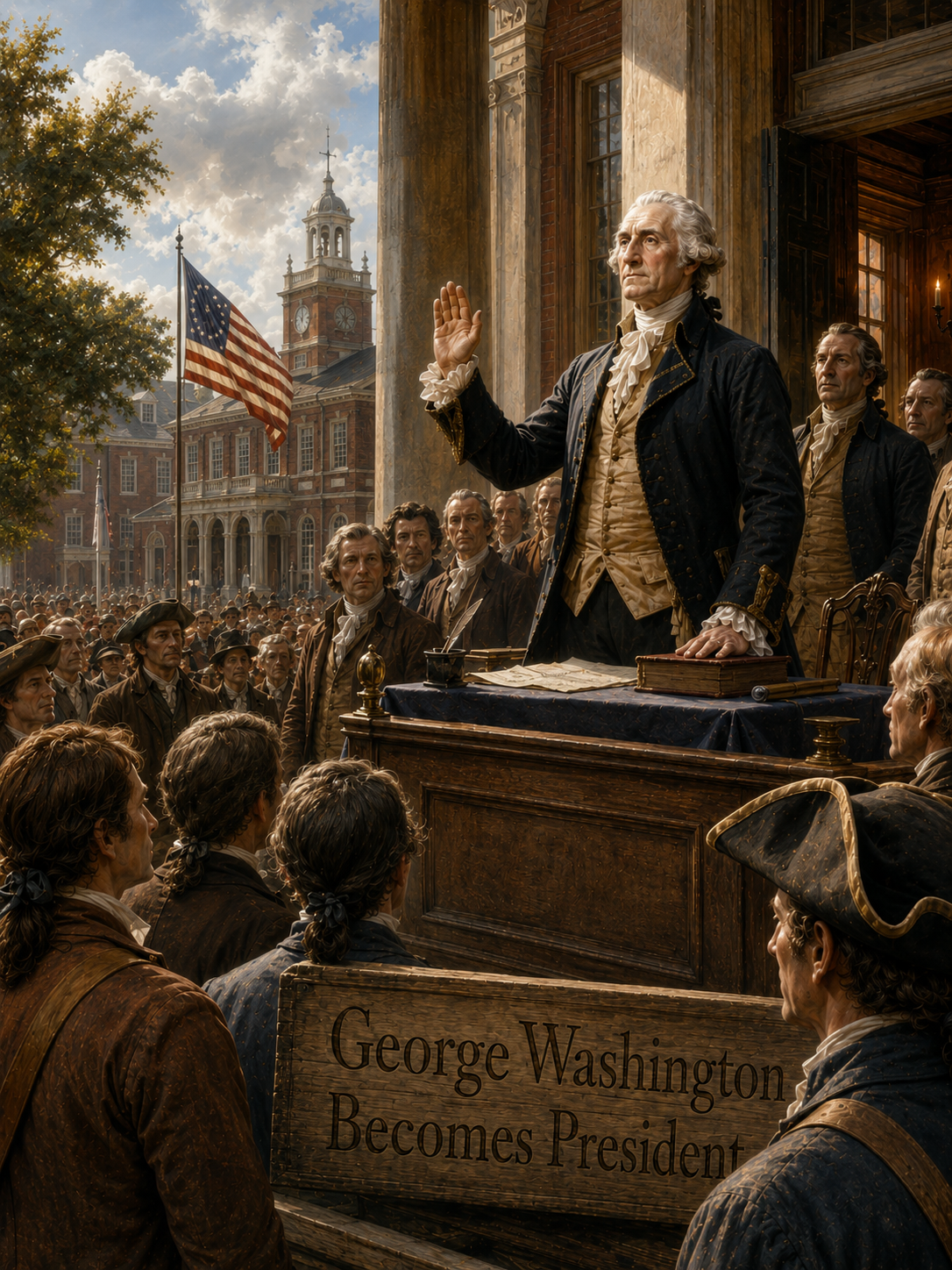
America Chose Its First President
The world watched with disbelief as a revolution that had overthrown a king now attempted something almost unheard of in human history:
the peaceful transfer of authority to an elected leader under a written Constitution.
America chose George Washington as the first President of the United States, and many citizens viewed him as the only figure trusted enough to help unify the fragile republic.
That trust mattered because the nation was still young, uncertain, and emotionally close to the Revolution. Many people remembered war, hardship, sacrifice, and the fear of unchecked power. They did not want to trade one kind of domination for another.
Washington’s leadership symbolized stability during uncertain times, but ordinary citizens also hoped the nation could survive beyond the Revolution itself.
The presidency would test whether freedom could become government without losing its soul.
The World Watched The Experiment
Many European nations expected the republic to eventually collapse.
Elected self-government on this scale remained largely unproven, and monarchies doubted citizens could successfully govern themselves. To many observers, a government without a king seemed unstable, fragile, and temporary.
They had seen revolutions turn into disorder or new forms of power before.
America became one of history’s most closely watched political experiments because it was trying to prove something larger than independence. It was trying to show that citizens could build institutions, respect limits, choose leaders, debate disagreements, and preserve order without surrendering liberty.
The world was not merely watching Washington.
It was watching whether citizens could carry the responsibility of freedom after the violence of revolution had passed.
Washington Understood The Weight
Washington understood the weight of the moment.
Every decision he made would help shape the expectations of future generations. No clear example existed for how an American president should lead. He was not stepping into an office with long-established customs.
He was helping define the office itself.
That made restraint essential.
Washington had to balance authority with humility, strength with limitation, visibility with service. If he acted like a king, the Revolution’s meaning would be wounded. If he appeared too weak, the young republic might lose confidence.
Leadership increasingly became associated with service instead of personal power because Washington treated the presidency as a responsibility held under law, not as a possession belonging to himself.
Ordinary Citizens Continued Building
While the new government took shape, ordinary citizens continued building daily life.
Merchants reopened trade routes throughout the growing republic. Farmers worked their fields and pushed settlements farther westward. Families rebuilt stability after years of uncertainty and war. Communities slowly transformed from former colonies into parts of a functioning nation.
This daily work mattered as much as ceremony.
A republic cannot live only in official rooms. It must live in farms, shops, churches, courts, roads, schools, homes, and town meetings. Ordinary citizens were still carrying the practical burden of the American experiment.
Their lives gave the new government something to serve.
The presidency mattered because real people needed stability, trust, law, and leadership that would not betray the sacrifices already made.
The Government Took Shape
The federal government slowly took shape.
New departments and institutions began forming. Debates continued over taxes, courts, representation, national authority, and the proper balance between federal power and local freedom. Citizens closely followed political disagreements because the structure of government would affect the future of their communities and families.
This was not a finished nation stepping confidently into permanence.
It was a fragile republic building its machinery while people were already depending on it.
Constitutional government had to become more than words. It had to become practice. Laws had to be respected. Offices had to be defined. Authority had to be limited. Public trust had to be earned.
America was beginning the difficult work of turning revolutionary principles into operating institutions.
The humanity of this moment was filled with both confidence and unease.
Uncertainty still existed throughout the country. Many Americans feared freedom remained fragile. Political divisions continued emerging between different visions of the future. Some worried the government would become too strong. Others feared it would not be strong enough to hold the nation together.
Yet ordinary people increasingly believed the republic might truly endure.
That belief did not come from blind optimism.
It came from example.
Washington’s conduct gave people a visible model of power restrained by duty. Citizens could begin imagining a future where leadership did not require domination and government did not require surrendering liberty.
The young republic was still unfinished, but it had begun stepping from revolution into permanence.
Leadership becomes most important during uncertain transitions, when people are afraid, institutions are young, and ambition can easily disguise itself as necessity. Free societies require citizens and leaders willing to place long-term stability above personal power.
Trust is difficult to build and easy to destroy.
A founding moment can shape political culture for generations because people remember the examples leaders choose to establish when no one yet knows what tradition will become.
Washington’s presidency reminds us that restraint can be as powerful as action.
Future generations inherit not only laws and institutions, but also the habits of leadership modeled at the beginning.
George Washington becoming president reminds us that democracy depends on peaceful transfers of authority, public trust, and leaders willing to respect limits upon power.
Strong institutions require more than written rules. They require citizens who continue participating beyond moments of crisis and leaders who understand that authority must serve something larger than ambition.
From here, the young republic begins expanding westward.
America enters an era of growth, opportunity, and rising national contradictions. The nation slowly stretches beyond the original thirteen states, and the American story begins moving toward expansion across an entire continent.
But before that wider movement begins, this moment matters because the republic first had to show that power could be accepted peacefully, exercised responsibly, and surrendered without destroying the freedom it was meant to protect.