Chapter 35
America Begins Expanding Westward
As America expanded westward, ordinary families carried enormous hope, relentless determination, and the belief that a better future waited beyond the horizon. Yet the nation’s growing promise also carried deep moral contradictions whose consequences future generations would eventually be forced to confront.
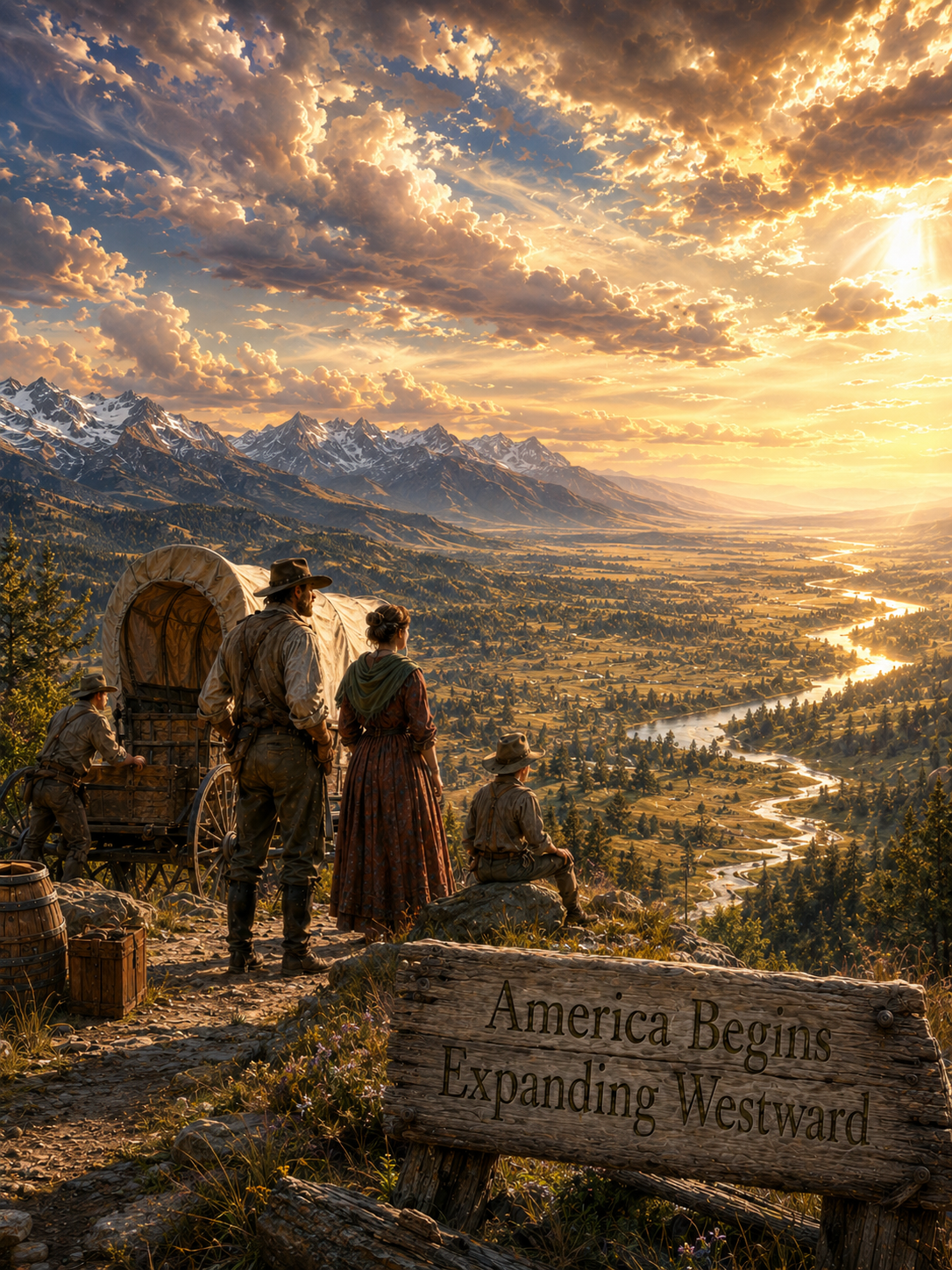
The Frontier Drew Thousands Westward
As the young republic slowly stabilized, ordinary Americans began pushing beyond the original thirteen states, carrying with them both enormous hope and the contradictions that would shape the nation’s future.
Settlers increasingly moved beyond the Appalachian Mountains, drawn by land, independence, opportunity, and the possibility of building a life that felt more fully their own.
For many families, the frontier represented more than geography.
It represented a second chance.
Land could mean survival, dignity, inheritance, and freedom from crowded towns or limited opportunity. New communities began forming across frontier territories as people built cabins, cleared fields, opened roads, gathered in churches, and created schools from almost nothing.
America slowly transformed from a coastal republic into an expanding continental nation.
Opportunity And Hardship Traveled Together
Opportunity and hardship traveled together.
Frontier life was physically exhausting, dangerous, and uncertain. Roads were rough. Towns were isolated. Supplies could be scarce. Illness, weather, distance, accidents, and loneliness tested families who had already taken enormous risks simply by leaving what they knew behind.
Ordinary people built new lives through constant labor.
Trees had to be cut. Fields had to be cleared. Cabins had to be raised. Food had to be grown, preserved, hunted, carried, or traded. Families depended on one another and on the strength of nearby communities.
Perseverance became one of the defining traits of early American expansion because survival itself required discipline, courage, and the willingness to keep working when comfort was far away.
Native Nations Faced Growing Pressure
But westward expansion was not only a story of hope.
Native American nations faced growing pressure as settlers moved into lands that were already home to peoples with their own histories, communities, governments, spiritual traditions, and relationships to place. Conflicts over territory and sovereignty continued growing as the young republic expanded.
Many Americans saw the frontier as opportunity while failing to fully face the human cost of that opportunity.
The same movement that promised land and independence for some brought fear, loss, and displacement for others. That moral contradiction must remain part of the story.
America’s growth carried optimism, courage, and industry, but it also carried choices whose consequences would echo across generations.
New Roads And Connections
As settlers moved westward, roads, trade routes, and transportation slowly began connecting distant communities.
Improved paths, river travel, wagons, and early infrastructure helped link frontier settlements to older towns and markets. Trade expanded farther into the interior, and small workshops, mills, and local industries began supporting new communities.
These changes did not transform the country overnight, but they hinted at the larger economic movement to come.
America was becoming more connected, more ambitious, and more mobile. Distance still mattered deeply, but the young nation was beginning to stretch its practical reach.
Ordinary citizens experienced this transformation in the movement of goods, news, tools, letters, and people across widening space.
A National Identity Expanded
The nation’s identity continued evolving as the frontier widened.
People increasingly viewed themselves not only as citizens of separate states, but as Americans moving within a shared national story. Newspapers spread information farther across the growing republic. Political arguments, market news, religious ideas, and stories of opportunity traveled with settlers and merchants.
Patriotism slowly became tied to expansion, land, opportunity, and national growth.
This gave the American experiment a new confidence, but also a new danger.
Ambition can inspire people to build, sacrifice, and create. It can also blind a society to what its growth costs others.
The American identity was becoming larger, but not yet fully honest about everything expansion required.
The humanity of this moment was complicated.
Many families still lived with uncertainty and instability. Frontier life demanded sacrifice, endurance, adaptation, and faith in a future that could not be guaranteed.
A family moving west might feel courage and fear in the same wagon.
A mother might look toward land with hope while wondering whether her children would survive the journey. A father might see possibility while carrying the weight of risk.
At the same time, Native families and communities faced the anxiety of watching newcomers arrive in growing numbers. Their future was also uncertain, but in a different and often more threatening way.
This chapter matters because both realities must be held together.
Hope was real.
So was loss.
The horizon looked bright to some and dangerous to others.
Opportunity often inspires people to take enormous risks for a better future. Families still move, work, sacrifice, and endure because they believe tomorrow may offer something today does not. That hope is powerful and deeply human.
But expansion frequently brings progress and moral conflict at the same time.
Societies grow strongest when ambition remains balanced with responsibility and humanity.
Future generations inherit both the achievements and the consequences of earlier expansion. Remembering this honestly does not erase courage. It deepens responsibility.
It teaches us that growth without conscience can leave wounds beside accomplishments.
America no longer felt like a fragile experiment struggling merely to survive.
The nation had begun moving outward with growing confidence and energy. The horizon ahead appeared larger, brighter, and more uncertain than ever before.
National growth carried opportunity, but also responsibility.
Societies are shaped by how they balance ambition with justice.
From here, America enters an era of rising invention, transportation, and industrial growth. Canals, factories, workshops, roads, and eventually railroads begin transforming daily life across the nation.
The same restless energy that carried families westward will soon reshape labor, trade, cities, and the American future itself.