Chapter 36
The Industrial Revolution Transforms America
The Industrial Revolution transformed America, and ordinary people were suddenly living through a world changing faster than any generation before them. Invention, machinery, ambition, and expansion created extraordinary new possibilities while also forcing the nation to confront the growing human cost of unchecked progress.
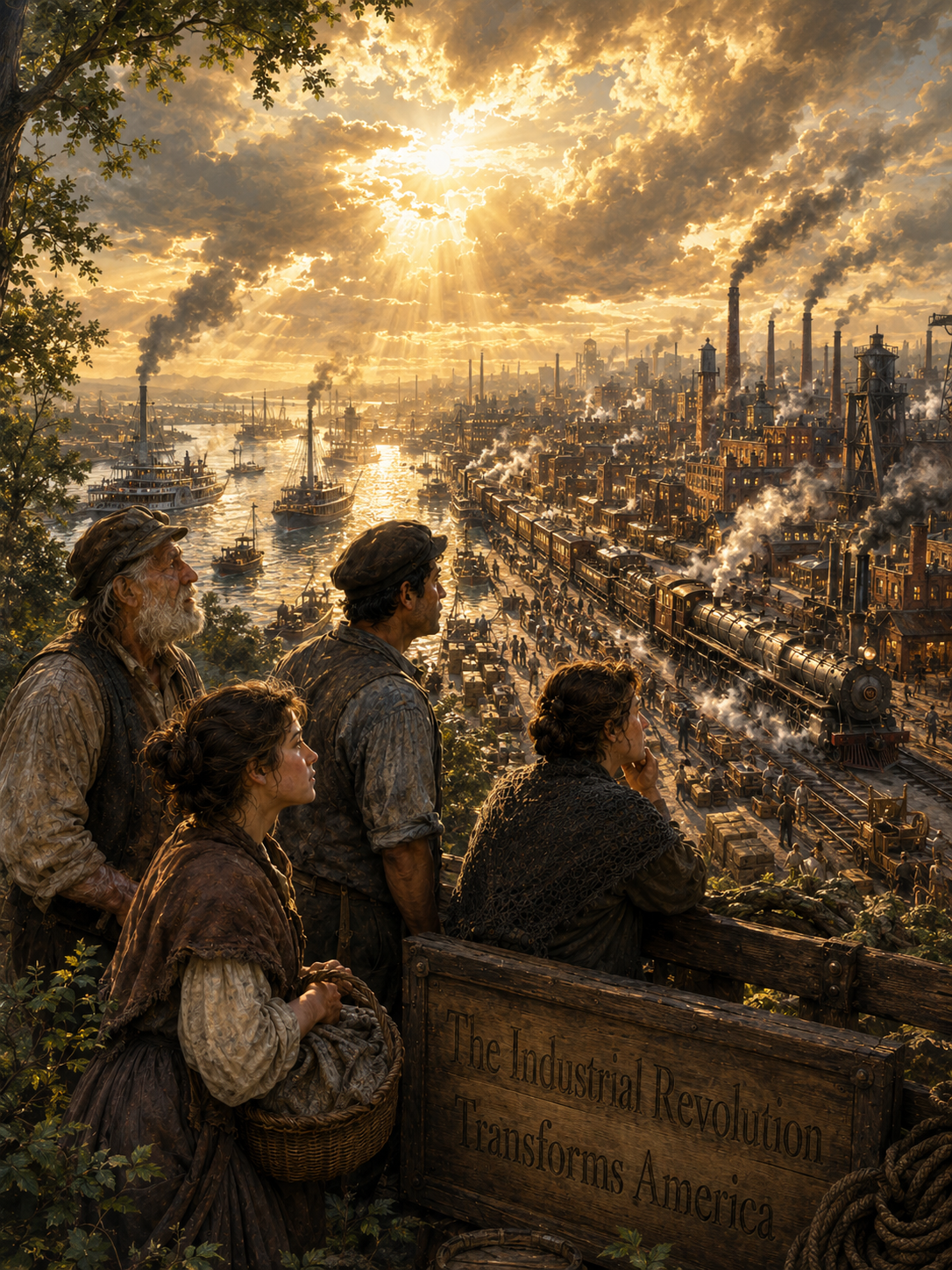
The World Began Moving Faster
For thousands of years, most people had lived by rhythms that would have been familiar to their grandparents.
Sunlight, seasons, animal strength, hand tools, rivers, roads, weather, and human labor shaped the pace of life. A person could understand the world because the world changed slowly enough to be understood.
Then, almost suddenly in the span of history, machines began altering that ancient rhythm.
As factories, canals, railroads, steamboats, and new inventions spread across America, citizens began witnessing changes that must have felt overwhelming. A machine could do work that once required many hands. A boat could move goods upriver with new power. A train could cross distances that had once consumed days or weeks.
News, products, people, and ideas began moving faster than memory expected.
The world did not merely become busier.
It began accelerating.
Factories Changed The Rhythm Of Work
Factories reshaped daily life by changing not only how goods were made, but how people experienced time.
Textile mills and manufacturing centers expanded rapidly throughout parts of the Northeast. Work that had once belonged to homes, farms, workshops, and small communities increasingly moved into buildings where machines set the pace.
That change must have felt strange to people raised under older rhythms.
On a farm, work followed weather, daylight, seasons, animals, and necessity. In a factory, the bell could command the day. The machine did not tire the way a human body tired. It did not pause for conversation, family need, or natural rhythm.
For some workers, factories brought wages and opportunity.
For others, they brought long hours, dangerous conditions, noise, smoke, strict schedules, and the feeling that human labor was being pulled into something larger and less personal.
Transportation Shrunk The Nation
Transportation revolutionized America by making distance feel different.
Canals connected communities and markets that had once seemed far apart. Steamboats changed river travel and trade. Early railroads began shrinking the enormous physical spaces of the country. Goods could move farther. People could travel faster. Letters and newspapers could reach communities with greater speed.
The nation became more connected, and that connection changed imagination itself.
Imagine a person who had known only wagon roads and river currents seeing a locomotive for the first time. The sound alone must have felt like the future arriving before anyone had language for it.
Imagine a farmer watching goods appear from places he had never visited, or a merchant realizing that trade was no longer limited by the same old boundaries.
The American landscape was still vast, but transportation began teaching people to think in wider distances and shorter time.
First Encounters With A New Future
The emotional power of this chapter lives in the first encounters.
The first time someone saw machinery produce cloth faster than skilled hands.
The first time a family bought an item that had traveled farther than they could imagine.
The first time a town heard a factory whistle.
The first time a child watched a train pass and realized the world was larger, louder, and faster than the stories of older people had prepared them for.
Every generation that lives through a true technological break feels some version of this shock.
Wonder and fear arrive together.
People are amazed by what is possible, but they also wonder what will be lost. Will the new world make life easier, or will it make people smaller? Will machines serve families, or will families be forced to serve machines?
The Industrial Revolution forced ordinary Americans to ask those questions long before they could know the answers.
Cities Expanded Around The Change
Cities expanded rapidly throughout industrial regions.
People moved toward mills, factories, ports, canals, and workshops looking for wages and possibility. Immigrant communities slowly reshaped American culture and labor, bringing languages, traditions, skills, hopes, and burdens into growing urban centers.
Towns became crowded. Streets grew busier. Markets widened. Life became less local and more connected to forces beyond the neighborhood.
Opportunity and hardship grew side by side.
A young worker might earn wages that were impossible on a struggling farm, but those wages could come with exhausting labor. Families might find new possibilities in towns and cities, but also crowded housing, poverty, sickness, and uncertainty.
Industrial America created movement, but movement did not always mean security.
The same growth that filled cities with energy also placed ordinary people under pressures their grandparents may never have imagined.
Innovation Expanded Possibility
Innovation changed everyday possibilities.
Inventors introduced tools, machines, manufacturing techniques, communication improvements, and transportation systems that expanded what Americans believed could be done. Businesses grew beyond local markets. Newspapers and information spread more quickly. Goods became more available. Production increased.
A future driven by speed, technology, and ambition began taking shape.
This created real hope.
Progress was not imaginary. Machines could reduce some forms of labor. Transportation could connect isolated communities. Manufacturing could produce useful goods at greater scale. New industries could create livelihoods.
A country that had once struggled to hold together began seeing itself as energetic, inventive, and capable of enormous growth.
For many ordinary people, the Industrial Revolution opened a door to possibility that had not existed before.
The Human Cost Of Progress
But progress carried a cost.
Workers often faced dangerous machinery, long hours, low wages, and little protection. Families adapted to factory schedules and crowded living conditions. Communities changed faster than people could emotionally absorb. Older skills lost value.
Some workers found opportunity, while others felt trapped inside systems that valued production more than human dignity.
This is one of the great lessons of human history.
Innovation can improve lives while also creating new forms of hardship. A society can become wealthier and still leave many people exhausted. It can move faster and still lose sight of those being carried along by the speed.
The Industrial Revolution revealed both the brilliance and danger of human ambition.
America was learning that progress must be guided by conscience, or it can begin treating people as fuel for the machine.
The Nation’s Contradictions Deepened
Beneath the optimism, the nation’s contradictions continued growing.
Industrial growth increased wealth, confidence, and national ambition in some regions. At the same time, slavery continued expanding across the South, binding millions of human beings to a brutal system that stood in direct conflict with America’s language of freedom and progress.
The North increasingly industrialized.
The South remained deeply tied to plantation agriculture and enslaved labor.
Economic differences between regions intensified political tension. America was becoming more powerful, more connected, and more ambitious, but not more morally united.
The same century that brought factories, canals, railroads, machines, and invention also carried the nation closer to crisis.
Progress did not erase the deeper question of whether America would live up to its own promises.
The humanity of this moment is easy to miss if we only remember machines.
Ordinary people were living inside the transformation before anyone knew what it would become. Some were excited. Some were frightened. Some were proud. Some were exhausted. Parents wondered what kind of world their children would inherit.
Workers wondered whether the new age would lift them or consume them.
Communities wondered whether speed would strengthen life or tear old bonds apart.
They were not looking back on the Industrial Revolution as history.
They were standing inside it.
The ground was moving beneath them.
That is why this chapter matters. It reminds us that civilization is often changed by people who do not yet understand the full meaning of what they are surviving.
They endure the confusion first.
Future generations inherit the result later.
The Industrial Revolution reminds us that technological change can transform civilization faster than people are emotionally prepared to follow.
It can create opportunity, wealth, connection, and imagination. It can also create inequality, exhaustion, dislocation, and moral blindness when human dignity is not protected alongside progress.
America no longer felt small or isolated.
Energy, movement, invention, smoke, iron, waterpower, steam, labor, and ambition spread across the country. But emotionally, the nation had begun accelerating toward a future few people fully understood.
From here, rising tensions over slavery, expansion, labor, and political power begin pulling America toward crisis.
The same nation racing into the future would soon be forced to confront divisions that machinery, wealth, and speed could not solve.