Chapter 37
A Nation Divided by Slavery
Most people do not meet history prepared. They meet it inside the only world they know.
The World They Inherited
For most of human history, ordinary people did tomorrow what had kept them alive yesterday.
A farmer farmed because his father had farmed. A miller milled. A baker baked. A logger cut timber. A mother taught what her mother had taught. A preacher explained the world through the beliefs his community already trusted. Neighbors repeated what neighbors believed.
Life was local, practical, inherited, and often narrow because survival left little room for anything else.
Before modern communication, most people did not live inside a wide national understanding. They lived inside family, church, town, farm, field, river, shop, plantation, local newspaper, and the voices closest to them.
History often arrived as fragments: a rumor, sermon, speech, warning, political argument, traveler’s story, or headline carried into town after emotions had already formed.
That matters because America’s division over slavery did not arrive among people who all understood the same facts in the same way.
It arrived among millions living in different worlds.
Slavery Was Old, Abolition Was The Rupture
Slavery had existed across human history for thousands of years.
That does not make it less brutal.
It makes the moral shift more enormous.
The staggering change in this moment was that more and more people were beginning to say slavery should not merely be regulated, limited, improved, or kept away from certain territories.
It should end.
That was not a small political disagreement. It was a rupture in inherited human thinking. Something much of the world had long accepted, tolerated, defended, or explained away was now being judged by a higher moral demand.
Human bondage was being called not merely unfortunate, but wrong.
Not merely dangerous, but intolerable.
Not merely regional, but a contradiction at the heart of a nation that claimed liberty as its founding promise.
For many ordinary people, that kind of moral change did not arrive gently.
It threatened what they had been taught, what their families believed, what their economy depended on, what their churches argued, and what their region called normal.
Different Worlds, Different Realities
A person growing up in an industrial Northern city did not live inside the same world as a person growing up in the tobacco fields of South Carolina or the cotton regions of Mississippi.
A shopkeeper near newspapers, speeches, churches, immigrant workers, abolitionist meetings, and political debate received the slavery question through one set of voices. A farmer in a remote valley might receive it through rumor and fear. A logger in the woods might know almost nothing beyond work, family, and local talk.
In the South, a plantation owner might see abolition as the destruction of wealth, status, political power, and the social order he had inherited. A poor white laborer who owned no slaves might still absorb the fears, loyalties, and racial beliefs of the society around him. A preacher might search Scripture for the answer his community already wanted. A mother might think first about what conflict would do to her sons.
And for enslaved people, none of this was abstract.
While others debated, delayed, defended, feared, or misunderstood, enslaved men and women were already living inside the cost.
Their bodies, labor, names, marriages, children, memories, and futures were the human reality the country kept trying to turn into politics.
The Question Entered Ordinary Life
As America expanded and industrialized, the question of slavery forced itself into more ordinary lives.
Every new territory raised the question of whether slavery would expand westward. Every political compromise tried to hold together a nation whose moral foundation was cracking. Every speech, sermon, newspaper, and election carried pieces of the argument into communities that were not all prepared to receive it.
Many people were not calmly studying history as we study it now.
They were reacting from inside the world that had raised them. They heard what their parents believed. They trusted the people they knew. They feared what their neighbors feared. They protected what felt familiar. They misunderstood what had never been explained to them.
They repeated what helped them belong.
Yet history still came for them.
That is one of the hardest truths of being human. We do not know what comes next. We only meet the next moment with the understanding we already have.
But sometimes the next moment asks more of us than our world has prepared us to give.
Conscience Became Impossible To Silence
The abolition movement grew stronger because some people could no longer accept what earlier generations had explained away.
Newspapers, speeches, churches, public meetings, and personal testimony carried anti-slavery arguments into wider public life. Some abolitionists were mocked, hated, threatened, or dismissed as dangerous. Yet their voices kept pressing the question the nation did not want to face:
If America believed in liberty, how could it continue to defend slavery?
Formerly enslaved speakers and writers gave the movement a power no theory could match.
They did not speak of slavery as an idea.
They spoke from memory.
Their testimony forced listeners to understand that slavery was not simply a labor system, regional custom, or political problem. It was human beings being denied ownership of their own lives.
That kind of truth changes the room.
Once heard, it cannot be fully unheard.
Some people rejected it. Some attacked the messenger. Some buried the truth beneath fear or interest.
But others were changed by it.
Fear Hardened The Old World
As abolition grew stronger, defense of slavery hardened.
Many Southern leaders insisted slavery was essential to their economy, culture, and political survival. Cotton agriculture and plantation power depended on enslaved labor. As new territories opened and political power shifted, fear intensified.
To many who had inherited that world, abolition did not feel like a distant moral argument.
It felt like an attack on everything familiar.
This is where human nature becomes dangerous. When people believe their world is threatened, they often defend it before fully examining whether it is right. Economic dependence becomes moral justification. Fear becomes identity. Local loyalty becomes blindness.
A society can teach people to protect what wounds others, especially when survival, status, or belonging seems tied to that system.
That does not excuse the defense of slavery.
It helps explain why the conflict became so deep.
The country was not only arguing over law. It was watching inherited worlds collide with a moral truth larger than those worlds.
The Nation Could Not Stay Whole This Way
America celebrated liberty while millions remained enslaved.
It honored the language of equality while allowing human beings to be bought, sold, separated from family, forced to labor, and denied legal personhood. The contradiction had always been there, but expansion, abolition, testimony, political conflict, and moral pressure made it impossible to keep buried.
Many ordinary Americans desperately hoped compromise could preserve peace.
Some feared war more than injustice.
Some feared injustice more than war.
Some wanted the subject to disappear because they did not know how to live with what it demanded.
But peace built on denial is temporary.
Unity built on silence is fragile.
A nation cannot remain healthy forever when its promises and practices are tearing against each other.
The terrible part is that many people still did not understand the full road ahead. They did not know how far division would go. They did not know how many would die.
They only knew arguments were sharpening, trust was weakening, and the old ways of holding the country together no longer seemed strong enough.
Picture a country filled with people receiving the crisis through different windows.
A Northern worker hearing an abolitionist speak for the first time.
A Southern farmer hearing that outsiders wanted to destroy his way of life.
An enslaved mother wondering whether her children would ever belong to themselves.
A preacher choosing whether to challenge his community or comfort it.
A newspaper editor deciding whether to calm fear or inflame it.
A family sitting at a table, not knowing whether the argument entering their home would one day send sons to war.
Most people did not wake up thinking they were standing at the edge of a national catastrophe.
They woke up trying to live.
They worked, cooked, planted, preached, traded, hauled, read, listened, argued, prayed, and repeated what they believed would get them safely to tomorrow.
But history was moving through all of it.
It was entering kitchens, churches, fields, shops, plantations, newspapers, courthouses, and consciences.
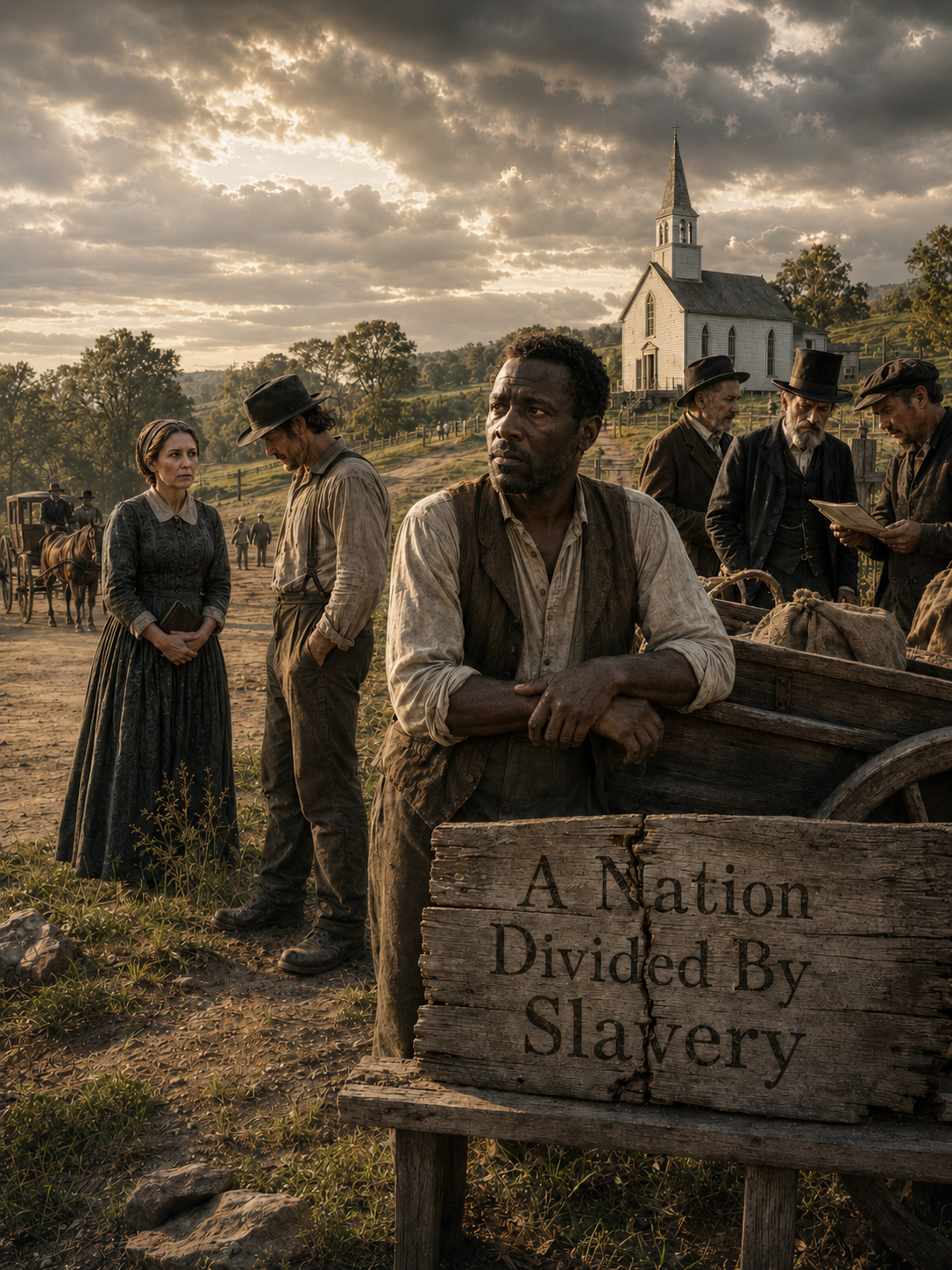
A Nation Divided By Slavery is not only about political conflict.
It is about what happens when inherited reality is judged by a truth larger than itself, and ordinary people must face a world beginning to crack.
America was still expanding, building, worshiping, farming, trading, and arguing, but the old compromises were failing.
From here, the Civil War begins. Ordinary Americans are pulled into unimaginable sacrifice, and the future of the United States itself hangs in the balance.