Chapter 38
The Civil War Begins
The Civil War began because the United States could no longer avoid the painful consequences of its deepest divisions. Ordinary Americans on both sides were suddenly forced to endure unimaginable sacrifice in a struggle that would determine whether the nation, and the meaning of freedom itself, could survive.
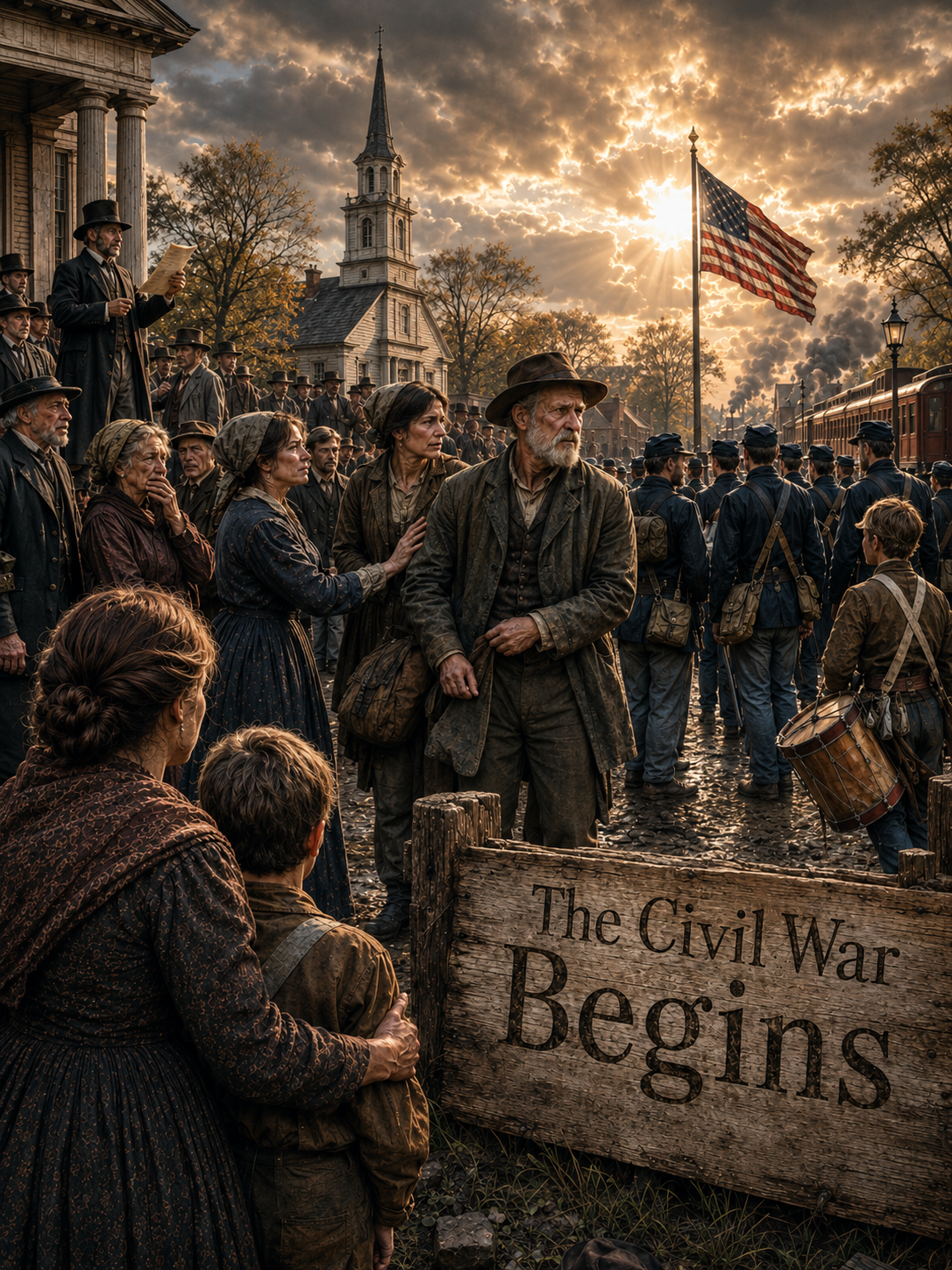
When History Entered The Door
Most people do not know they are living at the beginning of a catastrophe.
They wake up inside ordinary life. They feed animals, open shops, cook meals, read letters, listen to neighbors, attend church, argue politics, and try to carry tomorrow from what worked yesterday.
Then one day the news arrives, and the world they trusted is no longer the same.
That is how the Civil War began for many Americans.
Not as a finished chapter in history, but as shock moving through towns, farms, ports, churches, newspapers, and dinner tables. After decades of rising division, compromise finally collapsed. Southern states began seceding from the Union. Political disagreement became open national crisis.
Americans who had once called themselves countrymen increasingly stood on opposing sides.
Fear, anger, rumor, loyalty, and uncertainty spread faster than understanding.
Fort Sumter Made The Break Real
When Confederate forces fired on Fort Sumter in South Carolina, the crisis became war.
The conflict many had feared and many others still hoped to avoid could no longer be held back by speeches, compromises, elections, or waiting. The United States had reached the moment when its deepest contradiction broke into open conflict.
For people hearing the news, the meaning would not have arrived evenly.
Some understood the danger immediately. Others heard only fragments. A farmer might hear it from a neighbor. A shopkeeper might read it in a newspaper. A mother might hear men speaking in urgent voices outside a store or church. A young man might feel excitement before fear had time to form.
A family might sit in silence, suddenly aware that national division had entered their own future.
The country had crossed a line, but millions still did not know how far the road would go.
Families Faced Impossible Choices
Ordinary families faced choices no family should have to face.
Brothers, friends, and neighbors sometimes joined opposite armies. Communities divided according to state, region, conscience, pressure, and inherited loyalty. Young men rushed to enlist, many believing the war would be brief.
They could not see the long years ahead.
They could not imagine the number of graves, the letters home, the hospital tents, the empty chairs, or the faces of parents who would wait for sons who never returned.
This is where history must be felt from the ground.
Many did not leave home thinking they were entering one of the bloodiest struggles in American memory. They left because their friends were going, because their town expected it, because their state called, because the Union seemed worth saving, because their way of life seemed threatened, because honor demanded it, or because they believed courage would settle the matter quickly.
They stepped forward without knowing what history would ask of them.
Lincoln Carried The Weight Of A Breaking Nation
Abraham Lincoln faced enormous responsibility as the Union came apart.
He worked to preserve the nation during its greatest crisis, surrounded by pressure that would have broken many men. Every decision carried danger. Every delay had consequences. Every military failure deepened fear. Every political choice had to be made while the country itself was bleeding into uncertainty.
But even Lincoln could not see the whole future at the beginning.
He knew the Union had to be preserved, but the meaning of the war would deepen as the war unfolded. Leadership became tied to endurance, patience, moral growth, and the terrible responsibility of guiding a wounded people through something larger than any one person could fully control.
Many Americans looked toward him for stability, but he too was moving forward through history without knowing all it would require.
Both Sides Entered The Storm
People on both sides believed they were defending something larger than themselves.
Union supporters fought to preserve the nation and the possibility that the American experiment could survive its own division. Confederates fought for their states, their communities, and the way of life they believed was being threatened.
But beneath those claims stood the central question the nation had failed to resolve:
slavery, freedom, power, and whether a country founded on liberty could remain divided against itself.
The war was military, but it was never only military.
It was moral, emotional, political, local, and deeply human. It moved through flags and uniforms, but also through kitchens, fields, letters, churches, courthouses, and graveyards.
What began with confidence and anger would soon become exhaustion and grief.
The country was entering a storm that would test not only armies, but memory, conscience, endurance, and the meaning of national belonging.
Fear spread through cities, farms, and small towns alike.
Some people cheered. Some prayed. Some enlisted. Some wept. Some hardened themselves because they thought hardness was courage. Some still believed the conflict would end before harvest, before winter, before too many lives were broken.
Few understood that the war would reach deeper into American life than almost anyone imagined.
That is the humanity of the moment.
The people entering the Civil War did not know Gettysburg was coming. They did not know how many families would be reshaped by loss. They did not know how long the question of slavery would remain tied to the future of freedom.
They did not know whether the United States would survive.
They only knew that history had arrived, and ordinary people were being asked to choose, endure, and sacrifice before they could possibly understand the full cost.
The Civil War Begins is not only a chapter about the start of a war.
It is a chapter about what happens when a nation’s unresolved truths finally demand payment from ordinary lives. Division becomes dangerous when people stop trusting one another’s humanity. Fear and anger can spread faster than wisdom.
Problems postponed by one generation often become suffering for the next.
America entered one of the darkest periods in its history, but people still carried hope that the country might somehow survive the coming storm.
From here, the Civil War unleashes enormous sacrifice across America. Soldiers and families endure hardships that reshape the nation forever, and the struggle for Union, freedom, and national identity intensifies beyond anything Americans had previously imagined.