Chapter 39
The Civil War Tests the Nation
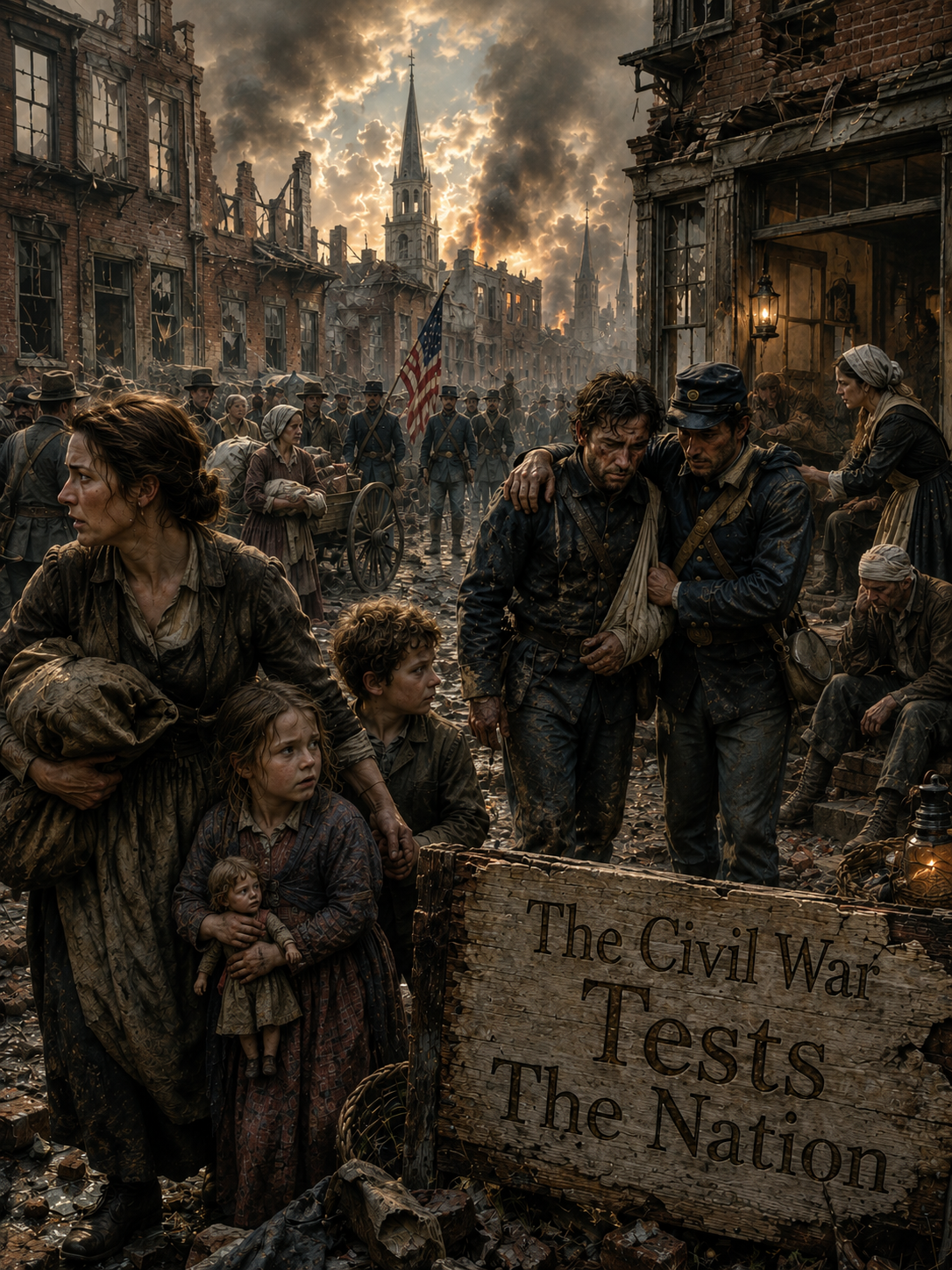
The Civil War tested the nation in ways no generation of Americans had ever experienced before. Ordinary people endured fear, grief, exhaustion, and unimaginable sacrifice while still holding onto the fragile hope that somehow the suffering might lead to a stronger, more united, and more just future.
The War Became Real
At the beginning, many Americans believed the war would end quickly.
Some young men marched away with confidence. Some families tried to believe the separation would be brief. Some communities told themselves courage, loyalty, and determination would settle the crisis before life was permanently changed.
Then the reality of war began to arrive.
Early battles shattered hopes for a quick victory. Casualty lists stunned communities. Soldiers faced fear, exhaustion, hunger, disease, mud, smoke, confusion, and brutal battlefield conditions.
War was no longer something people argued about in newspapers or cheered from sidewalks.
It became letters written from camps, names read aloud in towns, wounds carried home, and silence at tables where someone was missing.
Civil War entered the nation differently than any foreign war could have.
The enemy was not across an ocean. The enemy might be a former countryman, a distant cousin, an old neighbor, or someone raised under the same flag. That made the suffering feel even more intimate.
The nation was not only fighting a war.
It was being torn open from within.
Families Lived With The Waiting
Families endured the war through waiting.
Letters became emotional lifelines between soldiers and loved ones back home. A folded page could bring comfort, fear, relief, or devastation. Every delay in the mail could become a private torment. Every knock at the door could make a family brace for news they dreaded.
Women carried enormous burdens.
Wives, mothers, sisters, and daughters kept homes, farms, shops, children, churches, and communities moving while men were away. Many faced financial strain, loneliness, grief, and the exhausting responsibility of holding families together when the future had become uncertain.
Children learned war through absence, whispers, black clothing, worried faces, and adults trying not to show fear.
Nearly every community became touched by sacrifice.
Some towns watched groups of young men leave together and later learned how many would never return. Others received wounded soldiers, grieving families, or refugees fleeing danger.
The war did not stay on battlefields.
It entered ordinary life, and ordinary life had to keep going anyway.
The Fighting Reached Homes And Cities
As the war spread, Americans began to understand that battle did not only belong to open fields.
Towns, farms, roads, bridges, rail lines, churches, and city streets could become part of the struggle. Cannon fire and musket shots could reach places where families had lived, worked, prayed, traded, and raised children.
Windows could shatter.
Streets could fill with smoke.
Buildings could be damaged.
Civilians could find themselves listening to the sound of war from inside homes that had never been built for such fear.
Imagine a family in a city or town hearing cannon fire for the first time.
Not as a story.
Not as history.
As sound moving through the walls.
Imagine a mother gathering children away from windows, a shopkeeper watching smoke rise over familiar streets, or an elderly person realizing the world outside the door has become dangerous.
That is what war does when it leaves the map and enters human places.
The battlefield changed American history, but so did the home front.
The war tested not only soldiers, but families, neighborhoods, churches, hospitals, farms, and cities. It tested whether citizens could continue living while the nation around them seemed to be breaking.
The Cost Became Unimaginable
Battles like Shiloh and Antietam revealed the terrifying scale of the conflict.
The number of dead and wounded shocked a country that had not understood what modern war would require. Fields, roads, farms, and small communities were transformed into scenes of suffering.
Soldiers who had marched into war with confidence began to understand that courage did not make a person safe from disease, hunger, terror, or death.
Modern weapons increased destruction beyond what many Americans had imagined. Medical care struggled to keep pace with the wounds. Camps spread illness. Marches exhausted bodies. Rain turned roads into misery. Smoke and noise confused the senses.
Men endured things they could hardly describe to those at home, while those at home tried to imagine what their loved ones were surviving.
The war became a test of endurance.
It asked more than bravery in one moment. It asked people to keep going through loss after loss, letter after letter, battle after battle, season after season, without knowing when the suffering would end.
Lincoln Carried A Nation In Pain
Abraham Lincoln’s responsibility grew more difficult as the war lengthened.
Military setbacks brought frustration and criticism. The pressure upon him came from every direction: generals, politicians, grieving families, abolitionists, border states, Union supporters, and those who doubted whether the country could be preserved at all.
Lincoln carried the emotional weight of leadership during national catastrophe.
He had to make decisions while knowing that each choice could mean lives lost, battles fought, families broken, or the Union weakened. Leadership in this moment was not simply command.
It was endurance under sorrow.
It was the burden of holding a nation together when the nation itself seemed determined to come apart.
Even then, the full meaning of the war was still unfolding.
What had begun as a fight to preserve the Union was moving toward a deeper moral question. The future of slavery, freedom, and the nation’s purpose could no longer remain separate from the suffering on the battlefield.
Freedom Moved Through The War
As the conflict expanded, enslaved Americans watched for openings.
Many fled toward Union lines whenever opportunities emerged, risking everything for the possibility of freedom. Their choices changed the meaning of the war from the ground up.
They were not waiting passively for history to act upon them.
They were moving, hoping, resisting, escaping, and forcing the nation to confront what the war was truly about.
For enslaved families, the sound of war could carry terror and possibility at the same time.
Armies moving nearby could bring danger, but also a chance. Rumors traveled. Decisions had to be made quickly. A person might leave behind the only place they had known, not because the road was safe, but because bondage had made staying unbearable.
The war increasingly challenged the future of slavery itself.
Hopes for freedom expanded alongside the conflict. The moral meaning of the war slowly began changing across the country, not only through speeches and laws, but through the courage of people who moved toward freedom before the nation had fully defined what freedom would require.
The humanity of this chapter is found in the strain.
Soldiers on both sides endured fear and hardship. Families waited for news. Civilians saw war enter places that had once felt safe. Enslaved people searched for freedom in the confusion. Leaders made decisions under impossible pressure.
Communities buried the dead and kept living because there was no other choice.
The excitement and optimism that once surrounded the war had largely disappeared.
Grief spread steadily through the country.
Yet many Americans still clung to the fragile hope that the suffering might someday mean something. Some hoped the Union would survive. Some hoped freedom would come. Some hoped their loved ones would return.
Some hoped their children might inherit a country less broken than the one they were watching suffer.
War reveals both humanity’s courage and its deepest suffering.
Future generations inherit freedoms preserved through sacrifices they may never fully comprehend. The Civil War tested the nation by forcing people to endure fear, grief, hardship, and moral awakening all at once.
From here, Lincoln issues the Emancipation Proclamation, and the Civil War moves closer to becoming not only a fight for national survival, but a struggle over human freedom itself.