Chapter 40
The Emancipation Proclamation Changes the War
Twenty-one months into suffering no one had imagined, freedom entered the war — not as safety, not as victory, but as a dangerous new meaning for everything already being lost.
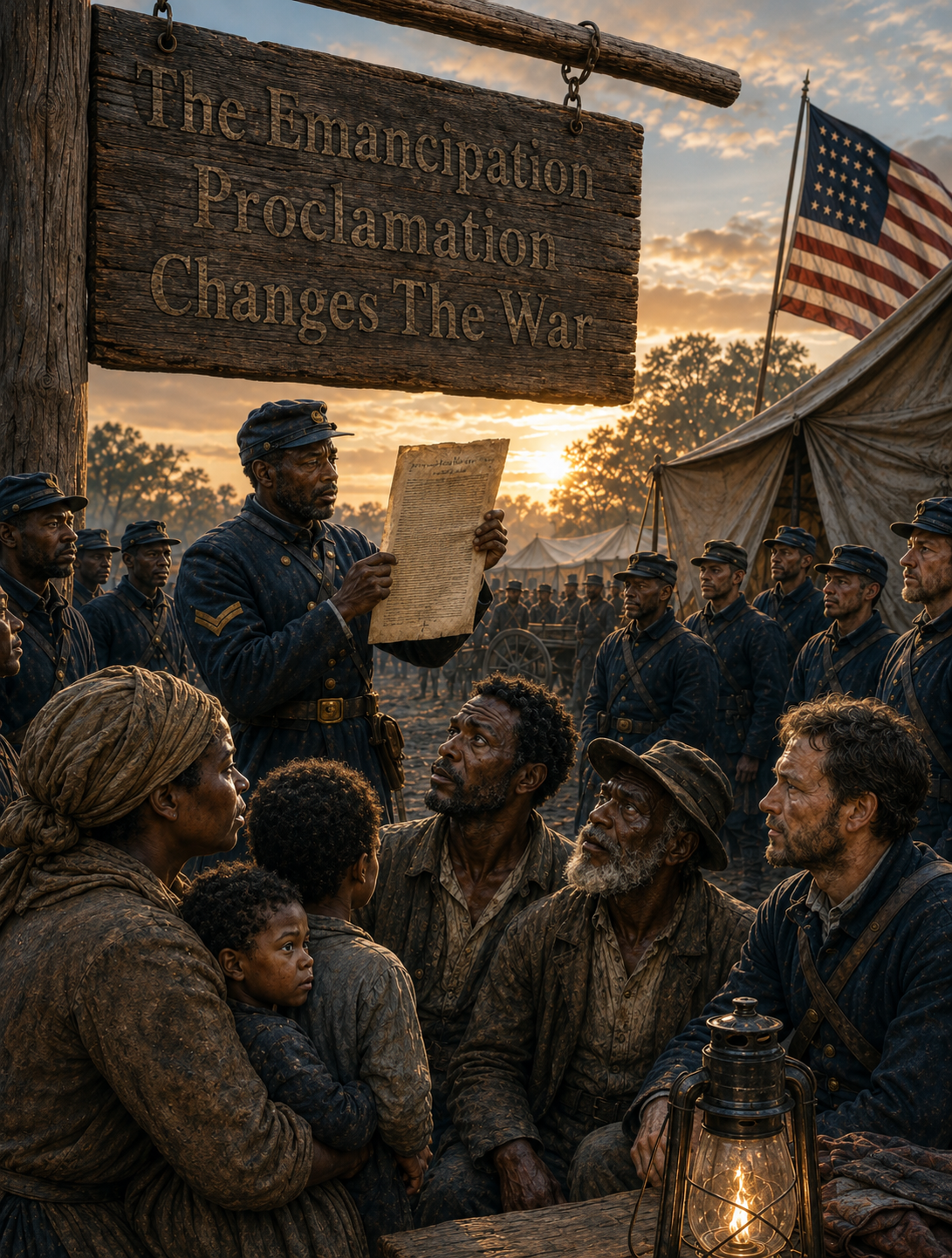
Freedom Entered A World Already Broken
By the time Abraham Lincoln issued the Emancipation Proclamation in 1863, the Civil War had already done something terrible to the American mind.
It had stripped away the early belief that courage, flags, speeches, and determination would bring a quick end. Families had already waited through sleepless nights. Soldiers had already seen what modern weapons could do to the human body. Towns had already received casualty lists. Mothers had already buried sons. Wives had already held letters as if paper could keep a man alive.
The country was not calmly debating the meaning of liberty.
It was bleeding, grieving, and trying to understand a war larger than anything most Americans had ever imagined.
Then freedom entered the war. Not as a clean answer. Not as an instant rescue.
Not as a promise everyone understood the same way.
The Emancipation Proclamation did not end the suffering. It changed what the suffering meant. What had begun as a war to preserve the Union now carried a deeper moral question:
Could a nation built on liberty survive while denying liberty to millions of human beings?
The Old World Met A Truth It Could Not Bury
Slavery was not new to human history.
Empires had conquered. Tribes had enslaved. Ancient worlds had bought, sold, owned, and destroyed human beings long before America existed. The horror was old. The darkness was ancient.
But this moment was different because America had been born speaking the language of liberty, rights, equality, Creator, and self-government. Now, in the smoke of its own battlefield, the nation was being forced to ask whether those words were only beautiful sounds, or whether they belonged to every human soul.
That is the enormity of this chapter.
The Emancipation Proclamation was not merely a document signed in Washington. It was the old inherited lie meeting a truth it could no longer keep buried.
If the enslaved person was fully human, then the old world was not merely politically threatened.
It was morally collapsing.
If Black men could fight, suffer, bleed, protect others, and help save the Union, then the country had to face what it had been refusing to see. The proclamation did not make America whole. It exposed where America was broken.
And once exposed, the wound could never again be honestly denied.
Freedom Became Possible Before It Became Safe
For enslaved Americans, the proclamation was not an abstract policy.
It was a sound of possibility moving through danger.
News did not reach everyone at once. Some heard it clearly. Some heard rumors. Some did not know what to trust. In a world where most information traveled by newspaper, soldier, preacher, neighbor, family, or whispered report, truth could arrive slowly, unevenly, and at great risk. Even today, with information everywhere, many people understand only what reaches their own circle.
In 1863, that distance between event and understanding could shape life or death.
Freedom became possible before it became safe.
Countless enslaved people moved toward Union lines whenever opportunity appeared. They did not move because the road was certain. They moved because bondage had made staying unbearable. Families made decisions without guarantees.
A person might leave behind the only place they had ever known, carrying little more than memory, courage, hunger, fear, and hope.
That hope must not be made small.
It had lived through generations of separation, forced labor, violence, silence, and prayer. When freedom entered the war, it reached people whose families had survived a world designed to break them.
Yet even then, freedom was not simple.
It had to be walked toward.
It had to be risked.
It had to be claimed inside a nation still at war with itself.
Black Soldiers Carried A Terrible Honor
As Black men joined the Union Army, the war’s moral meaning became flesh and blood.
These were not symbols placed neatly inside history.
They were men.
Many were sons, husbands, fathers, brothers, workers, believers, and family protectors. Many came from communities where faith, dignity, discipline, and moral uprightness had helped hold families together against a world that denied their full humanity.
History forced many of those upright men into war, not because they were made for violence, but because the world had left them no peaceful road to defend their own humanity.
That is one of the sorrows beneath the glory.
Freedom became so costly that men who should have been allowed to build homes, raise children, worship, work, love, and grow old were forced to take up arms. They fought courageously while facing discrimination, unequal treatment, and suspicion from people whose nation they were helping to save.
Their service asked a question the country could not escape:
If these men could fight and die for the United States, what did the United States owe them in return?
In battle, large words often become very small beside immediate human need.
Warriors may enter under banners of country, duty, freedom, or survival, but in the smoke and terror of battle, they often fight for the person beside them.
That truth matters here.
Black soldiers did not only change the war as an idea. They stood beside other men in danger. They endured the same fear, the same hunger, the same wounds, the same terrible sounds, and the same nearness of death.
A Reckoning Began Inside Men’s Souls
The Emancipation Proclamation also forced a reckoning among white Americans, North and South.
Many people had inherited their beliefs from family, church, local society, newspapers, law, and the world immediately around them. Some had rarely, if ever, known Black people except through the distorted lens of slavery.
They may have been raised to think of themselves as decent, moral, hardworking people while accepting a social order that treated other human beings as property.
To them, that world may not have felt like an opinion.
It may have felt like reality itself.
Then war placed truth in front of them.
A white soldier who had been taught that a Black man was beneath him might one day stand beside a Black soldier under fire. He might see him afraid, brave, hungry, exhausted, prayerful, wounded, protective, and willing to die.
He might owe his own life to a man his world had told him was not his equal.
That kind of truth can break through belief in a way speeches cannot.
Not everyone changed.
Some hardened.
Some denied what they saw.
Some resisted the moral meaning of the moment with everything in them.
But the truth had entered the field. Black courage forced America to begin seeing people it had refused to fully see.
For the Black man, the reckoning was also enormous: he was fighting for a nation that had denied his humanity, while proving a humanity that should never have needed proving.
The War’s Purpose Became Larger Than Survival
The proclamation changed how the world saw the conflict.
Foreign governments watched carefully. The fight against slavery weakened sympathy for the Confederacy and made the Union cause harder to dismiss as a mere political struggle between regions. America’s identity was increasingly tied not only to national survival, but to human liberty.
The war still had to be fought. Soldiers still had to march. Families still had to wait. Death still came.
But the purpose of the sacrifice had shifted. This did not make the war easier.
In some ways, it made the burden heavier.
A war for survival asks one kind of endurance. A war that begins to carry the moral weight of human freedom asks another. Ordinary Union soldiers and families had to understand that preserving the country could no longer be separated from the question of what kind of country was worth preserving.
Enslaved people had to risk everything before freedom was secure.
Black soldiers had to enter danger while carrying both hope and the painful knowledge that the nation still did not fully recognize them.
The Emancipation Proclamation opened a door, but it did not complete the journey.
It made freedom unavoidable before freedom was finished.
It made the contradiction visible before the nation knew how to heal it.
The humanity of this moment is found in its terrible mixture of suffering and hope.
Millions still lived with violence, separation, grief, and uncertainty. Freedom remained incomplete and dangerous. Families still feared the next letter, the next battle, the next loss. Black men wore uniforms for a country still learning whether it would call them citizens. Enslaved families listened for news that might mean deliverance, or might mean a more dangerous road.
And white men were forced to confront whether the people they had been taught to look down upon were, in truth, standing beside them as brothers in danger.
The Emancipation Proclamation did not end America’s pain.
It gave the pain a new moral direction.
It did not make freedom safe.
It made freedom unavoidable.
It did not heal the nation.
It exposed the wound so deeply that the country could never again honestly pretend it did not know where the wound was.
From here, the Union turns toward victory, the Civil War moves closer to its end, and Reconstruction begins the difficult work of asking what freedom, citizenship, justice, and national healing must mean after a country has nearly destroyed itself over the truth of human dignity.