Chapter 41
When the Children Inherited the War
By the time the Union turned toward victory, the children who had entered the war were no longer children in the same way. The war had reached their homes, their sleep, their beliefs, their fears, and the futures they had not yet grown old enough to understand.
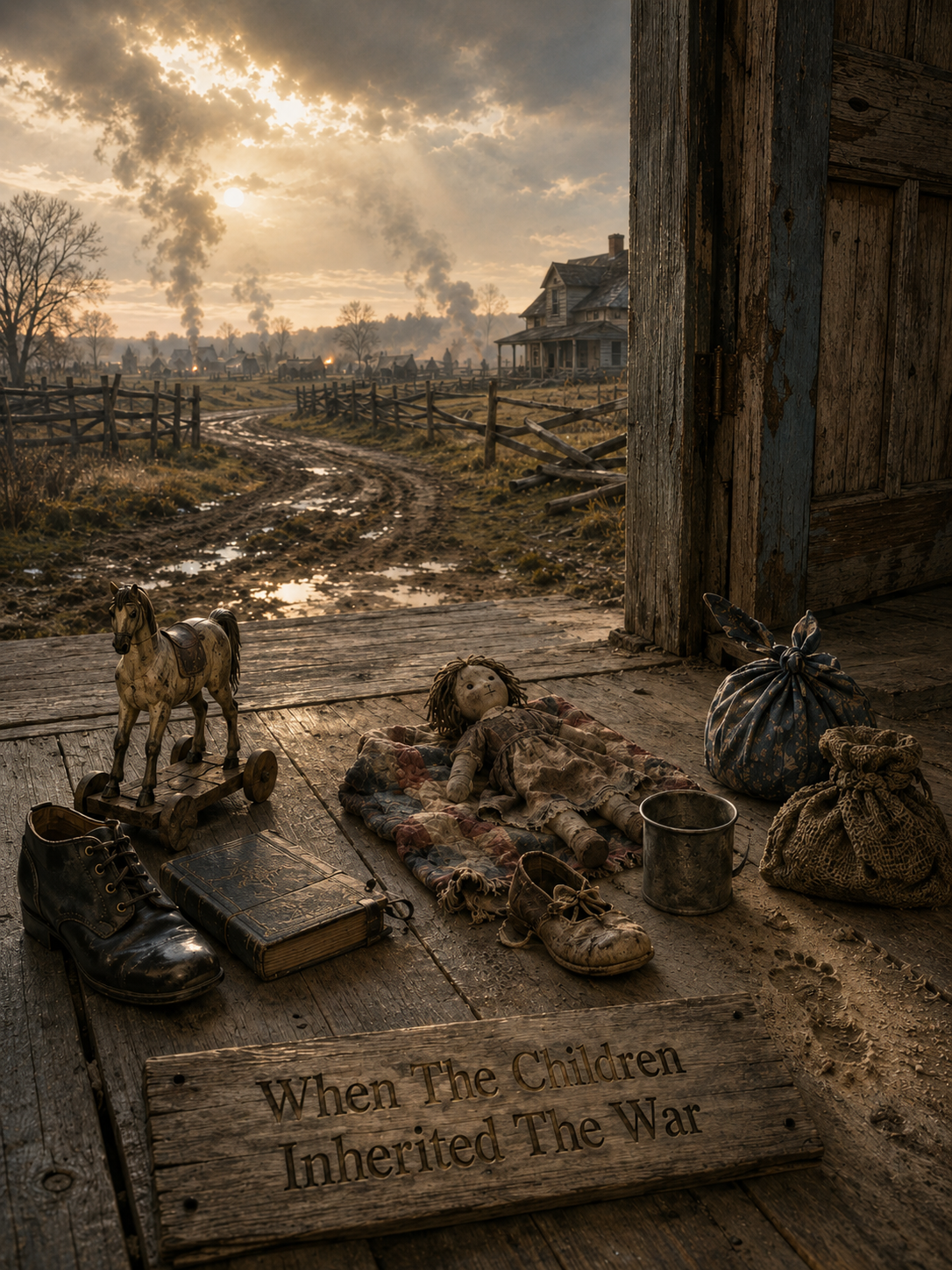
They Were Ten When The War Began
They were ten when the war began, old enough to remember the world before it broke, but too young to understand why adults could not stop it from breaking.
One child lived in a house where silver was polished, books were kept behind glass, and grown men spoke of honor as if order itself could never fail. One child lived where winter came through the boards, where meals were counted carefully, and where hardship had already taught the family not to expect much from the world. One child lived enslaved, where childhood had never fully belonged to the child at all.
None of them knew what Gettysburg would mean.
None of them knew Vicksburg would help turn the war.
None of them knew Lincoln would one day stand over the dead and try to give words to sacrifice.
At ten years old, history was not a subject. History was the tone in a parent’s voice. It was the sudden silence when adults stopped talking. It was a missing chair, a distant cannon, a letter folded too many times, or the sight of grown people trying not to be afraid.
The Worlds They Had Been Given
The wealthy child had been taught that the world had shape.
There were rules, names, rooms, manners, family expectations, and adults who seemed to know where everyone belonged. War first arrived as talk around tables, then as uniforms, then as absence.
At first, the child may have believed what the adults believed: that courage, breeding, and command would decide things quickly. But war has a way of humiliating certainty. It reaches past curtains and staircases. It enters through casualty lists, wounded visitors, sleepless mothers, and fathers whose faces change before anyone explains why.
The poor child had inherited a different world.
There had never been much cushion between ordinary life and fear. Work came early. Food mattered. Weather mattered. A sick animal, a bad harvest, or an injured parent could change everything.
When war came, it did not interrupt comfort. It piled terror onto a life already close to the edge. The child learned to listen for bad news before knowing how to name dread. The world became too loud, too uncertain, too hungry, too full of things no child could repair.
The enslaved child had been handed the cruelest inheritance.
This child already knew that adults could be powerless, that families could be separated, that the body could be commanded by someone else, and that fear could live inside ordinary daylight.
When the war began, it did not destroy a safe world.
It cracked open an unsafe one.
That did not make the crack easy to walk through. It made it dangerous. But somewhere in the movement of armies, rumors, rivers, roads, and Union lines, the child began to understand that the world which had claimed ownership over human beings might not last forever.
When Fear Became Normal
Today, people have words for the damage prolonged terror can do to the mind.
The children of the Civil War did not.
They had no language for what cannon fire did inside the body after the sound had stopped. They had no explanation for why a door closing too hard could make someone flinch, why a mother might stare at nothing, why a soldier could return home alive and still seem partly gone, or why a child might stop crying because crying no longer changed anything.
The wealthy child learned stillness.
At first, the stillness looked like manners. Then it became armor. The child discovered that if the face did not move, adults asked fewer questions. If the voice stayed calm, fear could be hidden. If grief was folded carefully and put away, the day could continue.
This was not peace.
It was numbness learning to dress itself as strength.
The poor child could not fold fear so neatly.
Hunger, noise, absence, and uncertainty pressed too hard. Sleep became thin. The child listened for hoofbeats, for weather, for news, for the wrong knock at the door. Some children survive by becoming quiet inside. Others begin to come apart.
Not because they are weak, but because no human soul, least of all a child’s, was made to carry war without shelter.
The enslaved child knew fear already, but the war changed its direction.
Fear no longer pointed only toward punishment or separation. It also pointed toward possibility. That made it sharper. To stay was dangerous. To move was dangerous. To hope was dangerous.
Yet the child began to watch adults differently, listen more closely, remember paths, notice soldiers, measure distance, and understand that courage is sometimes not a feeling at all.
Sometimes courage is the next step taken while the body is afraid.
The War Turned, But Not For Everyone The Same Way
When Gettysburg came, it did not arrive to the children as a chapter title.
It arrived as death moving through families. It arrived in newspapers, wagons, whispers, church bells, black clothing, and names spoken with hands over mouths. The battlefield was far from some and close to others, but the grief traveled.
Men who had once been boys in someone’s yard were now gone.
Families received news that divided life into before and after.
When Vicksburg fell, the meaning was different depending on where a person stood. For the Union, the river opening helped make victory imaginable. For the Confederacy, it deepened the sense that the old confidence was weakening. For enslaved people near moving armies, every Union advance could become rumor, danger, hope, and decision.
Maps were changing, but so were the inner lives of people who had never been allowed to choose their own future.
The wealthy child felt the old world losing authority.
The poor child felt the war swallowing what little steadiness remained.
The enslaved child felt something impossible beginning to breathe.
The same events moved through three lives differently. That is what history often hides when it becomes too clean. A nation may turn toward victory, but human beings receive that turn through the lives they have already been given.
Lincoln Gave Words To The Dead
After Gettysburg, Abraham Lincoln stood where the cost of division could not be ignored.
The dead had already said more than any speech could say. They had given their bodies to the question of whether the Union could survive, whether liberty could be renewed, and whether sacrifice might still lead the living toward something larger than grief.
For adults, Lincoln’s words helped frame the war’s meaning.
For children, the meaning would come more slowly.
A child does not understand national renewal all at once. A child understands a mother weeping, a father gone, a brother changed, a field avoided, a uniform hanging where a person used to stand.
Yet words matter because they tell the living what to do with pain.
Lincoln did not make grief disappear.
He gave it direction.
The wealthy child may have heard adults repeat his words with anger, reverence, confusion, or disbelief. The poor child may have heard only pieces, if any at all. The enslaved child may not have heard the speech, but lived near the meaning of it: that the dead might not have died in vain if the nation moved closer to freedom.
The words belonged to history, but the wound belonged to people.
Three Children, Three Roads
By the time the Union turned toward victory, each child had changed.
The wealthy child had learned how to stand in a room and feel very little. This child might grow into someone disciplined, useful, even powerful, but part of the heart had gone quiet to survive what the eyes had seen.
Numbness can look like courage from the outside.
Inside, it can be a locked door.
The poor child had begun to bend beneath the weight. Too much fear with too little safety can make the world feel unbearable. This child might become restless, fragile, angry, silent, or unable to trust peace when peace finally comes.
Not every soul rises under pressure.
Some are injured by it in ways no one around them knows how to heal.
The enslaved child moved.
Not without fear.
Not without loss.
Not as a simple hero from a clean story.
This child moved because staying inside bondage had never been safety, and the war had opened a crack in the wall. The child carried memory, hunger, danger, and hope together.
What others thought impossible became necessary.
What others thought weakness became strength.
What others had refused to see as fully human began walking toward freedom.
What They Carried Forward
The Union turning toward victory did not mean the children were healed.
It meant the world they would inherit had changed direction while leaving marks inside them. Gettysburg and Vicksburg helped turn the war. Lincoln gave language to sacrifice. Union momentum made survival imaginable. Slavery moved closer to destruction.
But inside homes, fields, camps, roads, and quarters, children carried the cost in ways no history book can fully measure.
This is why remembrance matters.
The freedoms later generations inherit were not preserved by ideas alone. They were carried through bodies, families, fear, hunger, grief, endurance, and children who had to grow around wounds they did not choose.
To remember them is not to worship suffering.
It is to understand the price paid before us, so we can become more grateful, more humane, and more careful with the world we hand forward.
From here, the Civil War moves closer to its end. The Union presses toward victory. Slavery nears legal destruction across the United States.
America prepares to emerge from its darkest internal conflict forever changed, carrying both the promise of freedom and the wounds that victory alone could not heal.