Chapter 42
The Civil War Finally Ends
The guns finally fell silent, but no one mistook silence for healing.
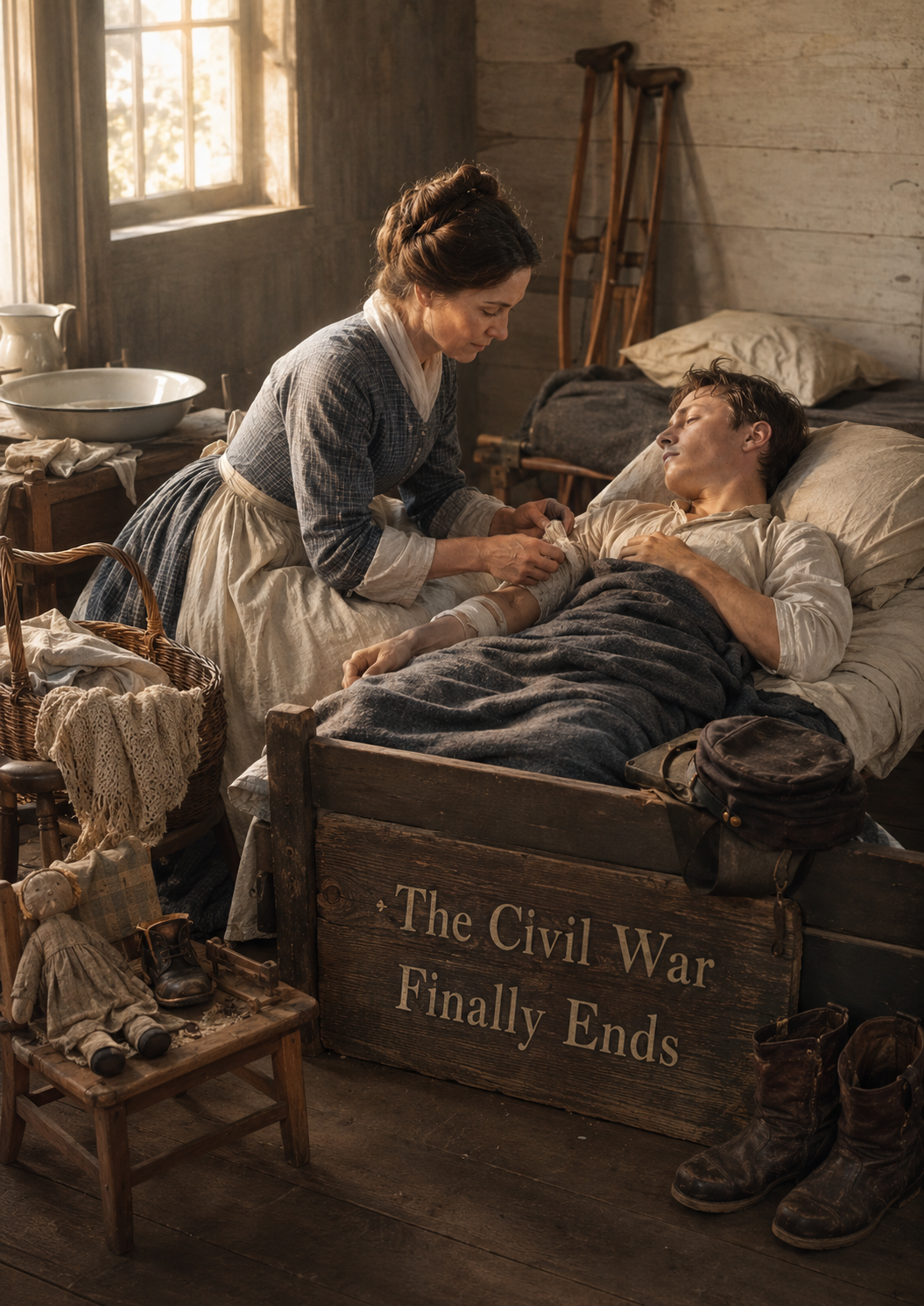
The War Was Over, But The Nation Was Not Whole
The Civil War did not end in the hearts of the people when the armies stopped firing.
It ended first on paper, in military surrender, in official language, and in the slow lowering of weapons by exhausted men who had carried too much for too long. But the human ending came differently.
It came in hospital rooms.
It came at train stations.
It came on farms where a chair remained empty.
It came in homes where a mother opened the door and saw that the son who had returned was not the same son who had left.
The war was over, but the nation was not whole.
There are moments in history that people are tempted to describe as victory. The Union had been preserved. The Confederacy had collapsed. Slavery, the wound that had poisoned the nation from its beginning, was being forced toward legal death.
Those truths mattered.
They mattered beyond measure.
But ordinary people did not stand in the spring of 1865 holding clean victory in their hands. They stood among the dead, the wounded, the missing, the freed, the defeated, the grieving, and the ruined.
They stood in the silence after years of cannon fire and asked the question every generation asks after great suffering:
What do we do now?
No One Came Out Whole
The Civil War had taken more than lives.
It had taken certainty. It had taken sleep. It had taken sons, fathers, brothers, neighbors, limbs, farms, towns, marriages, childhoods, and faith in what people thought their country was.
Hundreds of thousands were dead.
Many more came home injured, diseased, weakened, or changed in ways no one yet had language to explain. Some returned without arms or legs. Some returned with wounds that would not close. Some returned coughing from illness picked up in camp. Some returned with eyes that no longer rested easily on the world around them.
Families had waited for letters.
Some letters came.
Some stopped coming.
Some carried news no family was ready to receive.
Others gave false hope because the person named in the letter was already gone by the time it reached home.
The end of the war did not erase any of that.
A mother who had buried one son did not feel victorious because another army surrendered. A wife whose husband returned broken did not experience history as a clean ending. A child who had spent years watching adults whisper, weep, pray, and flinch did not suddenly become untouched because the guns had stopped.
The nation had survived.
But survival was not the same thing as healing.
The Wounded Came Home
For many families, the end of the war arrived not as a parade, but as a body.
Sometimes the body was alive.
Sometimes it was carried.
Sometimes it was changed beyond what the family had imagined.
A man might come home missing a limb. He might come home with fever still inside him. He might come home unable to work the land as he once had. He might come home and sit quietly while everyone around him tried to pretend that silence was peace.
The war had made old men out of young ones.
Many who had marched away as boys returned carrying memories no boy should have been asked to hold. The powers of the world have always had a way of sending the young to pay the cost of decisions made above them.
Governments speak in terms of policy.
Generals speak in terms of strategy.
History books speak in terms of campaigns and outcomes.
But in the hospital, the language became simpler.
Pain.
Water.
Breath.
Mother.
Home.
Men who had stood under fire, marched through mud, and carried weapons into battle sometimes cried out for their mothers when the body could no longer pretend to be brave. In that cry, every uniform fell away.
Union or Confederate.
Victor or defeated.
Soldier or enemy.
Beneath all of it was someone’s child.
That is one of war’s most terrible truths. It dresses boys like men, places them inside history, and then, when suffering strips away the costume, the child inside still reaches for the first safety he ever knew.
Before They Were Nurses, They Were Mothers
Into that world stepped women whose service had not begun with war.
Some were trained. Many were not, at least not in the formal way later generations would understand. But long before they were called nurses, many had already learned the oldest lessons of keeping life alive.
They had cooled fevers, cleaned wounds, fed children, sat through nights of sickness, comforted fear, washed bodies, buried loved ones, and held households together when there was no applause for doing so.
Before many of them were called nurses, they were called mother, daughter, grandmother, wife, aunt, neighbor.
War dragged the skills of home into the rooms of national suffering.
The same hands that had once held children now held soldiers. The same steadiness that had carried families through birth, sickness, hunger, and death now stood beside amputations, infection, fever, and men crying for home.
These women had been formed by generations of survival before history ever gave them a title.
And when the nation broke open, they served.
They were not there to give speeches over the meaning of the war. They were not there to declare who had won. They were there because a man was bleeding. Because another needed water. Because one could not breathe. Because one needed a letter written before it was too late.
Because one should not be left alone in the last hour of his life.
A true servant’s heart does not first ask what history will call the moment.
It says:
I AM here.
I AM here to clean this wound.
I AM here to help him breathe.
I AM here to write to his mother.
I AM here to hold his hand so he does not feel alone.
In the middle of the war’s wreckage, that presence became its own kind of answer.
The Same Human Need
The nurse saw what politics could not see clearly enough.
A wounded Union soldier and a wounded Confederate soldier could be reduced by pain to the same human need. Fever did not care which flag a man had followed. Infection did not care what arguments had filled his hometown. Thirst did not ask which side he had served. Fear did not respect the lines people had drawn across maps.
At the bedside, the great declarations of war became smaller.
A cup of water mattered.
A clean cloth mattered.
A hand on the forehead mattered.
A letter home mattered.
A name spoken gently mattered.
This does not mean the causes of the war were equal.
They were not.
Slavery was a moral wound that had denied the full humanity of millions. The preservation of the Union and the destruction of slavery’s legal power mattered deeply.
But the human cost of war fell through every political category and landed in bodies, homes, and memories.
The nurse lived inside that contrast.
War had broken the body.
Service tended the body.
War had reduced men to numbers.
Service remembered names.
War had been built through command.
Service answered through presence.
In a world where history so often records what power does, the nurse revealed what humanity still remembers.
Freedom Came With No Easy Road
For enslaved people, the end of the war carried a meaning larger than words could hold.
Freedom was not an idea floating above the earth. It was family, body, name, movement, wages, marriage, worship, protection, and the right to belong to oneself.
But freedom did not arrive as safety.
The war ended, and millions of formerly enslaved people stood before a future they had longed for, prayed for, risked everything for, and still could not fully see. Families searched for one another. Husbands and wives tried to reunite. Parents looked for children who had been sold away.
Men who had fought for the Union returned with honor, but not with equality guaranteed.
Freedom had become unavoidable, but its daily protection had not yet been secured.
This was another reason the end of the war could not be treated as a simple victory.
For some, it meant defeat and ruin.
For some, it meant grief inside preservation.
For some, it meant the first legal doorway into a life that should never have been denied.
For all, it meant uncertainty.
No one knew what came next.
That is important to remember. People living through history do not get to read ahead. They do not know how Reconstruction will unfold. They do not know what promises will be kept, what promises will be broken, what laws will be passed, what violence will follow, what courage will be required, or what future generations will inherit.
They stand only where they are.
And in 1865, America stood among wreckage and possibility at the same time.
The Servant Against The War
There is a false story often told about human beings.
It says we are only a warring species, as if war is the deepest truth of us. History can make that idea seem believable if we look only at kings, governments, armies, empires, territories, weapons, and control.
But ordinary life tells a fuller story.
When a child falls into a well, people stop.
They leave their work. They bring machines, ropes, lights, hands, prayers, and hope. They do not ask whether the child can repay them. They do not wait for history to explain the meaning.
They gather because one life is in danger.
Human beings do that again and again.
We do it for children.
We do it for strangers.
We have even done it for animals.
Somewhere beneath the noise of power, something in the common human heart still recognizes suffering and moves toward rescue.
The nurse in the Civil War hospital belongs to that same human truth.
She could not undo the war. She could not return the dead. She could not restore every limb, heal every fever, or make every family whole.
But she could serve the person placed before her.
That is not a small thing.
Sometimes history changes through declarations, battles, amendments, and surrender. But sometimes history changes because one person in a room of suffering refuses to let another person feel abandoned.
The war showed what organized human brokenness could do.
The nurse showed what ordinary human love could still do inside it.
What Was Left To Carry
When the Civil War finally ended, America did not step into peace as much as it stepped into consequence.
The dead had to be mourned. The wounded had to be cared for. The formerly enslaved had to build lives in a country that had not yet learned how to honor their freedom fully. The defeated had to face ruin, bitterness, and responsibility. The victorious had to understand that winning a war did not automatically heal a nation.
Families had to keep eating.
Farms had to be worked.
Children had to be raised.
Bodies had to be buried.
Futures had to be imagined.
There was no clean place to stand.
And yet people stood.
That may be one of the most important truths history gives us. Human beings often discover what they are capable of only after life places them somewhere they never would have chosen.
A mother becomes stronger than she believed she could be.
A wounded man learns how to live differently.
A formerly enslaved family steps toward freedom without any guarantee of safety.
A nurse walks into a room filled with suffering and becomes calm enough for others to borrow her courage.
If she can stand there, maybe I can stand where I am.
If they could carry that, maybe I can carry what is in front of me.
If service remained possible there, maybe it remains possible here.
The Civil War finally ended.
But it did not end with everyone healed, everyone safe, or everyone whole. It ended with a nation forced to look at what had been broken and decide what kind of people would rise from the wreckage.
The guns were silent.
The wounds were not.
And somewhere in that silence, beside a bed, beside a broken body, beside someone still crying for home, a servant-hearted woman remained.
The war had ended, but the work of becoming a nation had not.
America had preserved itself, but now it had to decide what preservation meant. It had destroyed slavery’s legal foundation, but now it had to decide whether freedom would be protected, honored, and allowed to live.
The battlefield was quiet.
The moral test was not over.
It had only changed places.
I AM here.