Chapter 43
Reconstruction Begins
The war had ended, but the meaning of freedom still had to survive the peace.
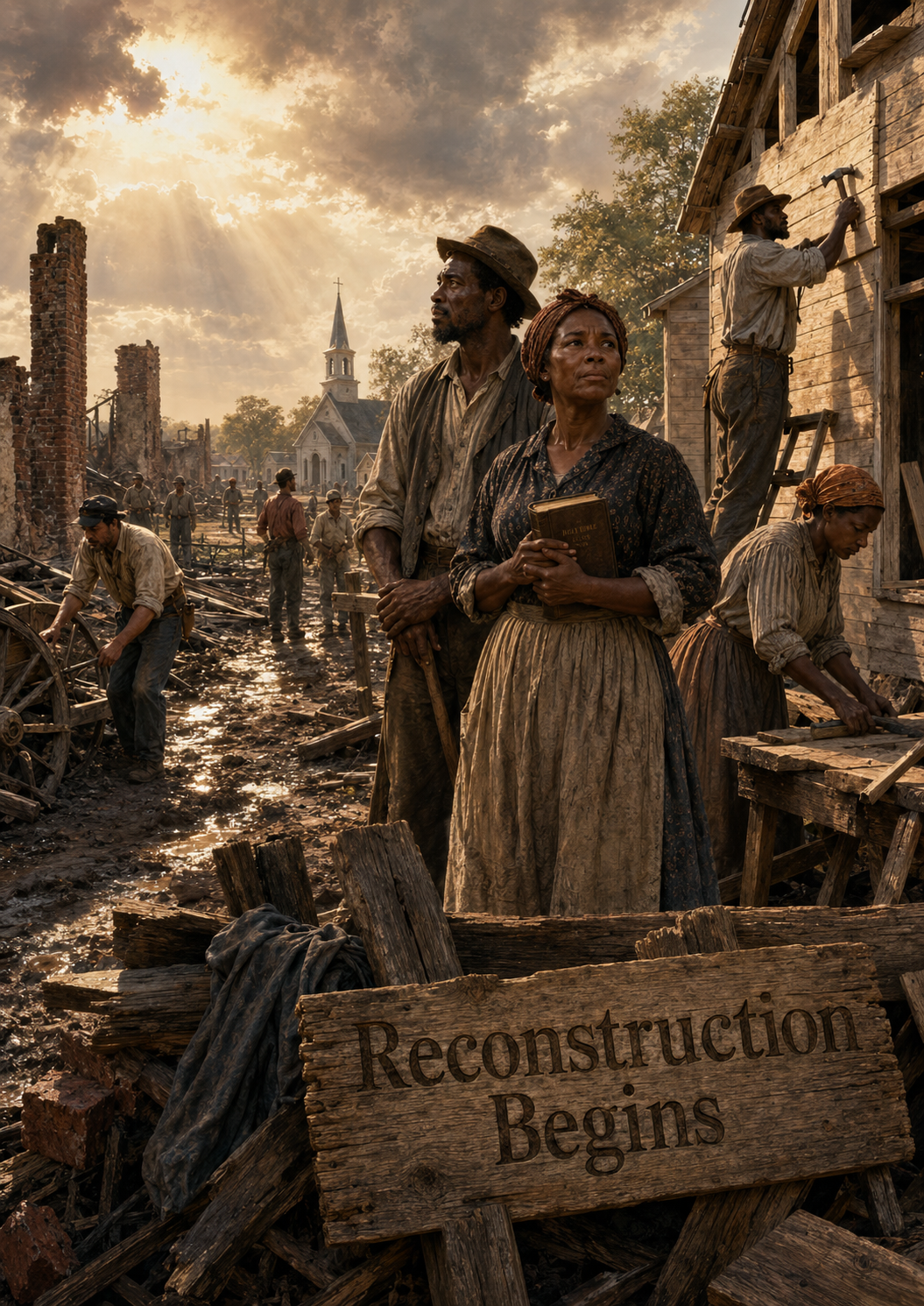
The Nation Stood In The Aftermath
When the Civil War ended, America did not step into a clean new beginning.
It stepped into wreckage.
The armies had stopped fighting, but towns, farms, railroads, families, and trust had been broken across much of the country. The Union had survived, and slavery’s legal foundation had been struck down, but survival alone did not tell Americans how to live together again.
The South faced ruined land, destroyed communities, economic collapse, and the bitterness of defeat. The North carried grief, exhaustion, and the cost of years of war. Veterans returned home wounded in body and mind.
Families tried to restore ordinary life while standing beside empty chairs, missing limbs, unpaid debts, burned fields, and memories no one knew how to heal.
Reconstruction began in that difficult space between devastation and possibility.
It was not simply a government program.
It was a national test.
America had to decide whether the freedom spoken of during war would become real enough to shape daily life after the battlefield grew quiet.
Freedom Became A Daily Work
For millions of formerly enslaved people, freedom was not an abstract word.
It meant the right to move, work, worship, marry, learn, earn wages, search for family, raise children, and belong to oneself. It meant standing upright in a world that had spent generations denying their humanity.
Across the South, newly freed Americans began building lives with courage that deserves to be remembered.
Families searched for husbands, wives, parents, children, brothers, and sisters who had been separated by slavery. Churches became centers of worship, leadership, education, protection, and community life. Schools formed quickly because learning had long been denied, and the hunger for literacy carried deep meaning.
To read, write, sign a name, open a Bible, or teach a child became part of freedom itself.
But freedom did not arrive wrapped in safety.
Hope and danger walked together. The same people stepping toward citizenship and independence also faced poverty, uncertainty, intimidation, and violent resistance.
Emancipation had opened the door, but the nation had not yet proven it would guard the doorway.
Lincoln Was Gone
Then, just as the country entered this fragile moment, Abraham Lincoln was assassinated.
His death shocked the nation and deepened wounds that were already raw. Many Americans had looked to Lincoln as the leader most able to guide the country through surrender, grief, and reunion.
He had carried the burden of war with sorrow and steadiness, and he had begun speaking of rebuilding with restraint rather than revenge.
Now he was gone.
The timing mattered.
The war had barely ended. Families were still mourning. Soldiers were still returning. Formerly enslaved people were still trying to understand what freedom would become.
Political leaders were already arguing over how the South should return, how former Confederate states should be treated, and what rights should belong to the newly freed.
Lincoln’s assassination left the country not only grieving, but uncertain.
A nation that had just survived one catastrophe suddenly felt the ground shift again.
The question of rebuilding remained, but the man many had trusted to help carry that question was no longer there.
The Country Argued Over Freedom
Reconstruction forced America to confront questions it could no longer avoid.
What did citizenship mean?
Who had the right to vote?
Would formerly enslaved people be protected by law?
Could states that had rebelled simply return, or would they have to accept a new moral and political reality?
Would freedom mean only the absence of slavery, or would it include dignity, protection, education, labor rights, and political voice?
Many Americans believed the country had a responsibility to expand civil rights and protect the people slavery had oppressed. Others resisted change with anger and fear. Some wanted quick reunion. Others knew reunion without justice could leave the deepest wound untouched.
This was the painful truth of Reconstruction:
Ending slavery was not the same as building equality.
The old system had been defeated legally and militarily, but old beliefs, old fears, old power, and old habits did not disappear because a war ended.
The nation had to decide whether it would rebuild only its roads and governments, or whether it would rebuild its conscience.
That decision would not be made in one speech, one law, or one election.
It would be fought over in homes, churches, schools, courthouses, fields, newspapers, and communities.
Reconstruction became the place where America’s promises met America’s resistance.
Ordinary People Carried The Burden
As leaders debated policy, ordinary people carried the weight of rebuilding.
Teachers entered communities where education had been denied. Ministers helped gather people into churches that became centers of strength. Families rebuilt cabins, farms, businesses, and routines. Laborers repaired railroads and roads. Veterans tried to find a place in a world that had changed while they were away.
Formerly enslaved parents worked to give their children a future they themselves had never been allowed to hold.
Widows and mothers kept households alive. Black communities built institutions with limited resources and enormous faith. White Southern families faced defeat, ruin, grief, and the need to live in a changed world. Northern families carried sorrow and wondered what the war had truly purchased.
No one experienced Reconstruction from above.
They lived it day by day, through hunger, work, prayer, fear, hope, anger, and endurance.
The country was being rebuilt by hands that were tired before the rebuilding even began.
And yet, people still tried.
In the middle of uncertainty, many ordinary Americans believed the nation could become something better than it had been before the war.
Not easily.
Not quickly.
Not without conflict.
But still possible.
The Future Was Being Built
Reconstruction was one of the most fragile beginnings in American history.
It held grief and promise in the same hand. It carried the pain of war, the hope of freedom, the shock of Lincoln’s death, the courage of newly freed people, and the resistance of those unwilling to accept a changed nation.
Its lessons did not remain in the past.
Future generations would inherit either healing or division, justice or delay, courage or avoidance. The choices made after conflict often shape a nation as deeply as the conflict itself.
Rebuilding trust after division requires honesty.
Freedom requires protection.
Equality cannot survive if it is endlessly postponed.
A society that has lived through violence must decide whether it will invest in healing or pass its bitterness forward.
After the Civil War, America stood at the uncertain beginning of rebuilding both the nation and the meaning of freedom itself.
The battlefield had gone quiet, but the moral work had only begun.
From here, railroads, factories, immigration, invention, wealth, hardship, opportunity, and inequality begin transforming America into a modern industrial power.
The country would grow stronger in many ways, but the questions left behind by Reconstruction would not disappear.
Freedom had been declared.
Now it had to be defended in daily life.