Chapter 44
America Rapidly Industrializes
The nation began moving faster, and millions of ordinary people had to learn how to live inside a world being remade by iron, steam, machinery, invention, and hope.
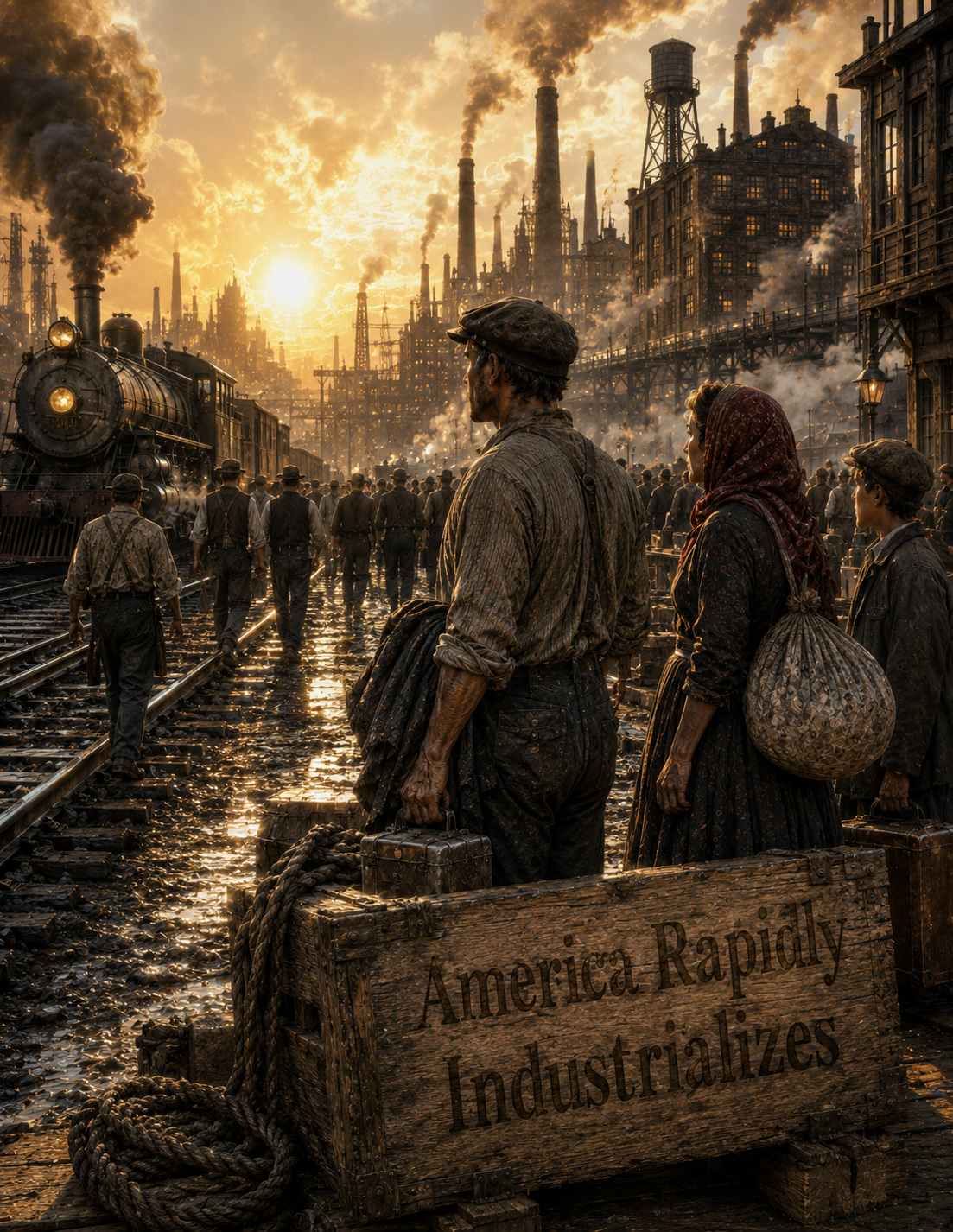
The Nation Began Moving Faster
After the Civil War and Reconstruction, America did not simply return to what it had been before.
The country began changing in ways that reached into work, travel, communication, family life, cities, farms, and daily expectation. The pace of life quickened. Distance seemed to shrink. News moved faster. Goods traveled farther. People began to imagine futures that earlier generations could barely have pictured.
This was not one single change.
It was a great turning of many wheels at once.
Railroads stretched across enormous distances. Factories multiplied. Machines changed how goods were made. Immigrants arrived by the millions, carrying languages, traditions, griefs, skills, faith, and hope. New technologies made the nation feel larger and smaller at the same time.
To some Americans, this new industrial age looked like promise.
To others, it felt like being pulled into a world they had not chosen and could not slow down.
Progress was real, but it was not gentle.
It opened doors while also creating new forms of hardship.
Railroads Connected Distance
Railroads became one of the great symbols of the new America.
Tracks crossed rivers, plains, mountains, forests, farms, and towns, tying distant places into one expanding national economy. A journey that once took weeks could be shortened dramatically. Goods that once remained local could now move across states and regions.
Towns grew where rail lines passed.
Markets expanded.
Farmers, merchants, workers, and families began living with a new awareness that the nation was becoming more connected than ever before.
But railroads were not built by imagination alone.
They were built by labor.
Men worked through heat, cold, danger, exhaustion, and isolation. Immigrant workers, freedmen, poor laborers, and countless ordinary hands carried the weight of the tracks that later generations would simply inherit as progress.
The railroad changed America’s sense of distance, but it also revealed something important about industrial growth.
The future often arrives looking like invention, but underneath it are human bodies doing difficult work.
Factories Changed Work
Factories changed how Americans understood labor.
More people moved toward cities where industrial jobs promised wages, opportunity, and a place in the growing economy. Machines made production faster and goods more available. Clothing, tools, household items, building materials, newspapers, and countless products began moving through systems larger than any one worker could see.
For some families, factory work offered survival and possibility.
A steady wage could mean food, rent, clothing, or the hope of advancement.
For others, it meant long hours, dangerous machines, poor ventilation, low pay, and little control over time. The workday could swallow strength.
A machine did not care if a person was tired, injured, hungry, or grieving.
Industry measured output more easily than humanity.
This was part of the deep tension of the age.
America was growing more powerful, more productive, and more modern. But ordinary workers often carried the heaviest cost of that growth.
The same factory that helped build the future could also wear down the people building it.
Immigrants Carried Hope Into Hardship
Millions of immigrants arrived during this period searching for work, safety, land, wages, freedom, or a future their old homes could not offer.
They came with different languages, customs, foods, songs, prayers, trades, and memories. American cities changed as neighborhoods filled with new accents, new churches, new synagogues, new businesses, and new forms of community life.
For many, America offered possibility, but not ease.
Immigrant families often faced poverty, overcrowded housing, discrimination, dangerous jobs, and the loneliness of beginning again in an unfamiliar world. Parents worked long hours while children learned new streets, new schools, and sometimes a new language faster than the adults around them.
Old-world identity and new-world survival often lived inside the same household.
Yet countless ordinary people continued forward.
They crossed oceans because they believed something better might be possible. They entered factories, shops, rail yards, kitchens, mines, and markets. They endured what they had to endure because they were carrying more than themselves.
They were carrying the hope of children, grandchildren, and generations they would never meet.
Progress Created Wealth And Strain
Industrialization created enormous wealth.
Some business leaders built companies and fortunes on a scale America had never seen before. Steel, oil, railroads, banking, manufacturing, and new technologies helped turn the United States into a rising industrial power.
Invention changed communication, transportation, production, and daily life.
The nation began to feel energetic, ambitious, and almost limitless.
But wealth did not spread evenly.
While some rose quickly, many workers remained poor. Cities expanded faster than housing, sanitation, and public systems could manage. Laborers faced unsafe conditions. Families crowded into small rooms. Injuries could destroy a household’s stability. Children sometimes worked because families needed every possible wage.
The promise of the industrial age was real, but so was its pressure.
This is one of history’s repeating lessons.
Rapid progress often brings both opportunity and inequality. Innovation can improve lives while also disrupting communities and traditions.
Societies are strongest when they remember that growth is not only measured by wealth, production, speed, or invention.
It is also measured by what happens to ordinary people inside the systems being built.
The Modern Nation Began To Form
By the end of this transformation, America no longer felt like only a recovering postwar nation.
It was becoming a modern industrial power. Railroads connected markets. Cities expanded. Factories reshaped work. Immigrants reshaped culture. Inventions changed what people expected from the future.
The country began moving with a force that future generations would inherit in roads, buildings, machines, jobs, cities, systems, and opportunities.
But the emotional truth of the age was not simple excitement.
It was excitement mixed with uncertainty. Millions of ordinary Americans adapted to dramatic change while wondering who would truly benefit from the nation’s growth.
Some saw doors opening.
Others felt trapped inside machines they did not control.
Some found opportunity.
Others found exhaustion.
America rapidly industrialized, and in doing so, it began building the modern world.
But the question remained:
Would that world serve ordinary people, or would ordinary people be asked to serve it without measure?
From here, wealth, industry, invention, and urban growth reshape the nation on an even larger scale.
The Gilded Age will reveal both the shine of prosperity and the shadows beneath it.