Chapter 45
The Gilded Age Transforms America
America glittered with progress, but beneath the shine millions of ordinary people were still asking whether the future had room for them.
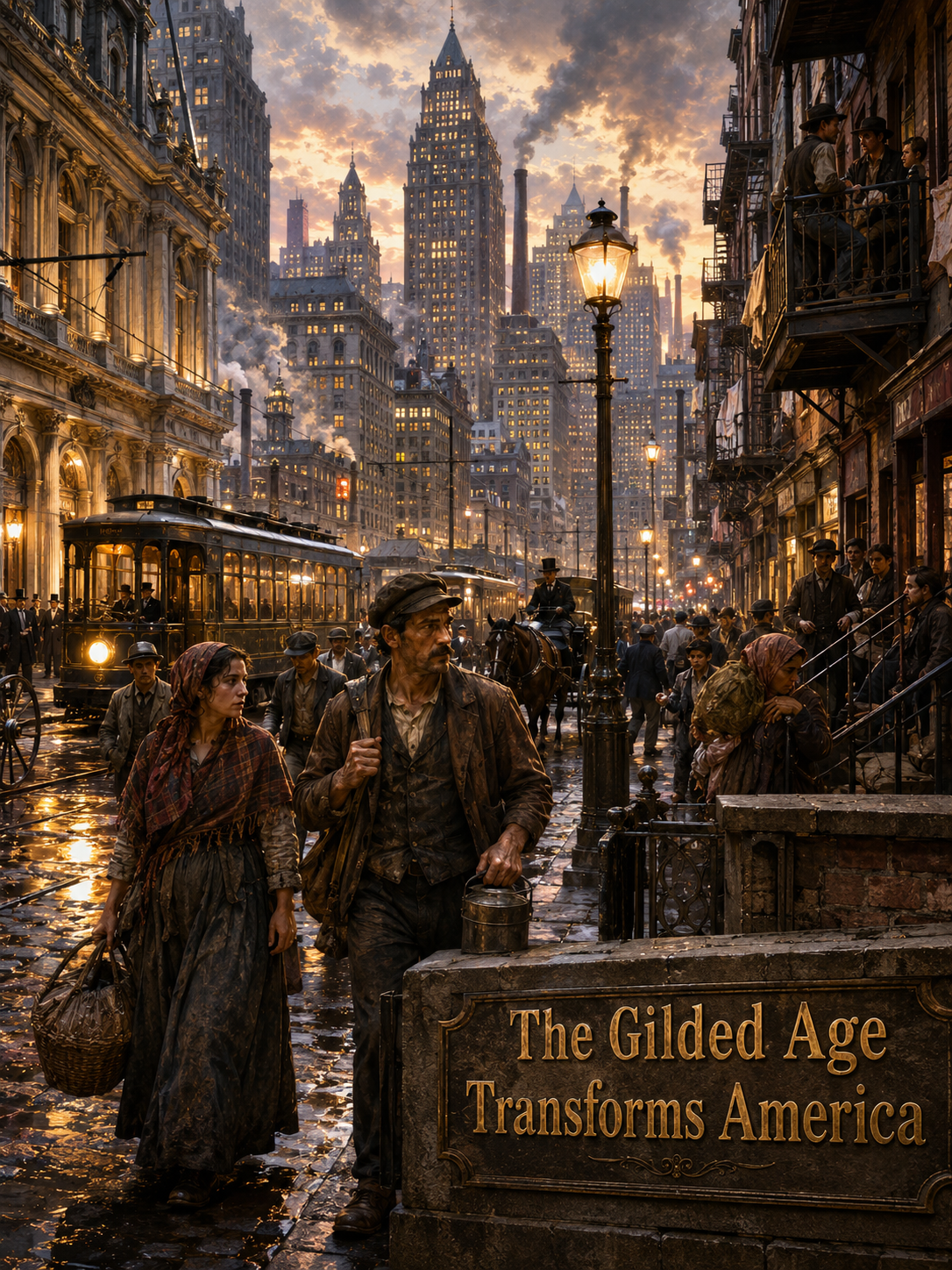
The Shine And The Shadow
The Gilded Age was a time of astonishing movement.
Cities expanded. Factories multiplied. Railroads tied distant regions together. Immigrants arrived by the millions. Inventions changed communication, transportation, work, entertainment, and daily life. America began to see itself as a rising industrial giant, full of energy, ambition, confidence, and possibility.
But the word gilded carries a warning.
It means something covered in gold on the surface. It shines, but the shine does not always tell the whole truth beneath it.
That was the emotional reality of the age.
America was becoming wealthier, faster, more inventive, and more powerful, but millions of ordinary people were still living with poverty, exhaustion, discrimination, overcrowding, and uncertainty.
This was not a simple story of progress or suffering.
It was both.
The nation was building the modern world, but it had not yet decided whether that world would honor the people whose hands were building it.
Cities Rose Into The Future
American cities grew with breathtaking speed.
Streets filled with workers, wagons, streetcars, factories, shops, boardinghouses, churches, markets, and crowded neighborhoods. Taller buildings began changing skylines. Electric lights slowly altered the feeling of night.
The city became a symbol of modern possibility, drawing people from farms, small towns, and other nations toward wages, opportunity, and a new kind of life.
For many, the city felt alive with promise.
Work might be found. A business might begin. A child might be educated. A family might rise.
But city life could also be harsh.
Housing was often crowded. Sanitation struggled to keep up with growth. Noise, smoke, disease, hunger, and long hours became part of daily survival for many families.
The nation was increasingly becoming urban instead of rural.
That change altered more than where people lived.
It changed how they understood time, work, community, money, family, and the future itself.
Wealth Reached A New Scale
During the Gilded Age, some Americans built fortunes beyond anything earlier generations could have imagined.
Steel, oil, railroads, finance, manufacturing, and national markets created business empires that stretched across the country. Industrial leaders gained enormous influence over work, prices, transportation, politics, and public life.
To some people, these fortunes represented vision, risk, invention, and bold ambition.
To others, they revealed how much power could gather in the hands of a few while millions struggled beneath the systems those fortunes controlled.
Luxury and poverty increasingly stood within sight of each other.
A city could contain mansions, clubs, fine clothing, electric lights, and grand buildings while workers crowded into cramped rooms not far away.
That contrast became one of the defining realities of the era.
America was proving it could generate wealth on a massive scale. The harder question was whether prosperity would remain concentrated at the top or expand widely enough to strengthen ordinary life.
Immigrant Families Built New Lives
Millions of immigrants arrived carrying hope, fear, memory, and determination.
They came from different nations, spoke different languages, practiced different traditions, and entered a country that needed their labor even when it did not always welcome their presence. In neighborhoods across growing cities, immigrant families built churches, synagogues, businesses, schools, mutual-aid societies, and cultural communities that reshaped America from the inside.
Their lives were rarely easy.
Many entered factory work, construction, domestic service, rail yards, sweatshops, mines, and street trades. Families faced poverty, overcrowded housing, discrimination, unfamiliar laws, and the loneliness of beginning again.
Parents often carried the old world in their language and memories while children adapted more quickly to the new one.
Yet they kept going.
That courage matters.
They were not statistics in a migration chart. They were mothers, fathers, sons, daughters, neighbors, workers, and dreamers carrying the hope that America might give their children a future unavailable somewhere else.
Workers Demanded Dignity
The industrial age depended on labor, and labor often came at a heavy cost.
Factory workers faced dangerous machines, long hours, low wages, poor ventilation, and little protection when injury or sickness came. Miners worked underground. Railroad workers faced accident and exhaustion.
Women and children often labored because families needed every possible income to survive.
As inequality became harder to ignore, workers increasingly began organizing.
Labor unions, strikes, and protests grew as ordinary Americans demanded better wages, safer conditions, shorter hours, and recognition of their dignity.
They were not only asking for money.
They were asking whether the nation’s prosperity would include the people whose bodies made prosperity possible.
This was one of the great human questions of the Gilded Age.
Economic growth can build cities, fortunes, inventions, and power, but a society is not judged by growth alone.
It is also judged by whether ordinary people can live with safety, dignity, and hope inside the systems growth creates.
The Modern World Took Shape
Innovation continued reshaping daily life.
Electricity spread through businesses, streets, and eventually homes. Telephones and faster communication connected people in ways earlier generations could not have imagined. New machines changed production. New forms of transportation altered movement.
Newspapers carried information quickly across growing urban populations. Entertainment, commerce, politics, and culture all began moving with modern speed.
America’s future seemed almost limitless, but limitless possibility can become dangerous when humanity is pushed to the margins.
The Gilded Age revealed both the power of ambition and the cost of forgetting the ordinary person.
It showed what a nation could build, but also what could happen when wealth and influence moved faster than fairness, protection, and shared responsibility.
Future generations would inherit the inventions, cities, industries, and opportunities of this era.
They would also inherit the tensions it created.
The Gilded Age transformed America by revealing a truth that still matters:
progress shines brightest when the people building it are not left standing in its shadow.
From here, America steps onto the world stage, and the nation’s growing power begins reaching beyond its own borders.