Chapter 46
America Steps Onto the World Stage
America was no longer only building itself; it was beginning to decide what kind of power it would become in the world.
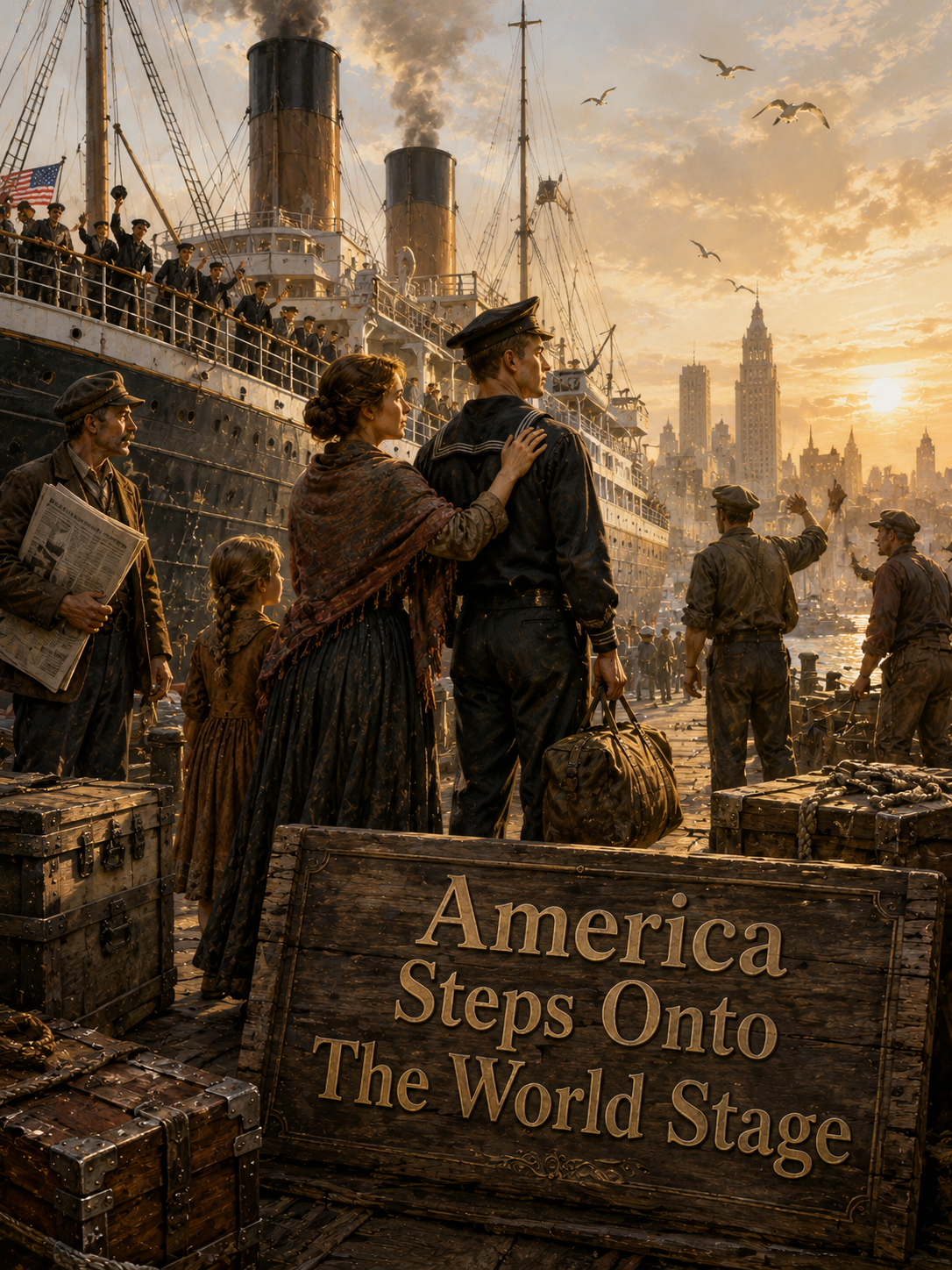
A Nation Looked Beyond Itself
As the nineteenth century came to an end, America no longer felt like the same country earlier generations had struggled to build.
The nation had survived revolution, expansion, civil war, emancipation, Reconstruction, industrialization, immigration, and enormous social change. Railroads crossed great distances. Factories filled cities with smoke and light. Newspapers moved information quickly. Businesses reached farther.
The country was becoming larger in wealth, population, confidence, and ambition.
For many ordinary Americans, this new strength stirred pride.
They saw a nation rising rapidly and believed America was entering a powerful new chapter. The United States was no longer only focused on survival or settlement. It was beginning to look outward, toward trade, military influence, overseas conflict, and a place among the world’s powerful nations.
But rising power changes the questions a nation must answer.
It is one thing to build a country.
It is another to decide how that country should use its strength beyond its own borders.
Newspapers Brought The World Home
Technology helped make distant events feel closer than ever before.
Newspapers expanded rapidly, carrying reports, images, rumors, opinions, and emotional stories into homes, shops, factories, streets, and cafés. Americans who had never traveled far from their own towns could now follow events happening across oceans and imagine themselves connected to places they had never seen.
This changed how ordinary citizens experienced national life.
The world no longer felt entirely far away. War, trade, disaster, conflict, and political debate could enter daily conversation through printed pages. A family at breakfast, a worker on a street corner, or an immigrant reading in a crowded neighborhood might all be drawn into the same national excitement or anxiety.
Information moved faster, and with speed came emotion.
Pride could spread quickly.
Fear could spread quickly.
Anger could spread quickly.
The modern world was teaching Americans that distance no longer protected the imagination from events beyond the horizon.
The Spanish-American War Changed Direction
In 1898, conflict with Spain pushed America more directly into overseas affairs.
Many Americans followed the war closely through newspapers and public discussion. Military victories increased national confidence, and the United States emerged with a larger international presence than it had held before.
For some citizens, this seemed like proof that America had become strong, modern, and important.
They saw the country standing taller among nations and believed it had entered a new era of influence. The war also connected military service with national identity in new ways. Young men left home for places many families had barely understood before headlines made them familiar.
But war is never only a national event.
It enters homes through absence, worry, letters, pride, fear, and waiting. A flag may wave in public, but a mother still watches the door. A father still wonders whether his son will return.
A young man may carry the nation’s confidence outward, but his family carries the emotional cost at home.
Families Felt The Cost Of Distance
America’s expanding role touched ordinary families in quiet ways.
Young men left familiar streets and farms for distant service. Immigrant families sometimes saw military service as part of becoming American, a public sign that they belonged to the nation they were helping build. Cities continued growing as factories, railroads, commerce, and communication tied daily life to a larger national and global system.
The country felt energetic and modern.
Telephones, electricity, railroads, newspapers, and industrial production changed how Americans understood time and distance. Older generations had watched life move at one speed. Their children and grandchildren were entering another.
The world seemed to be getting smaller, faster, and more connected.
Yet many families still lived with poverty, exhausting labor, overcrowded housing, and uncertainty. National power did not erase ordinary struggle. A country could grow stronger while many of its citizens still worked long hours for survival.
That tension mattered.
The nation was rising, but ordinary people were still asking what that rise would mean for their own children.
Power Raised Moral Questions
As America’s influence expanded, difficult questions emerged.
Some Americans celebrated the nation’s growing power and believed it had a responsibility to spread its influence. Others worried that overseas expansion could conflict with the democratic ideals America claimed to honor.
Could a nation built on liberty hold power over others without losing something of itself?
Could ambition remain connected to humility?
Could strength be guided by wisdom?
These questions did not have easy answers. They were debated in newspapers, churches, political speeches, homes, and public life. The country was learning that power is never only about ability.
It is also about responsibility.
Human nature has not changed.
When individuals gain strength, they must decide how to use it.
Nations face the same test.
Rising power can create opportunity, confidence, protection, and influence. It can also create overreach, pride, blindness, and consequences future generations must carry.
America was stepping into that test.
A Larger Future Began
By the turn of the century, America was no longer only a nation shaped by its own continent.
It was becoming an industrial, military, economic, and cultural force with growing influence beyond its borders. The modern American century had not fully arrived, but its outline was beginning to appear.
For ordinary families, this future felt both exciting and unfamiliar.
Their nation was stronger than before. Its newspapers spoke of distant conflicts. Its businesses reached outward. Its young men served in places previous generations could scarcely have imagined. Its technology made the world feel closer.
Its confidence grew.
But beneath that confidence was a question the country would face again and again:
Would America’s power remain connected to its highest ideals, or would ambition outrun humility?
America stepped onto the world stage, and with that step came more than influence.
It came responsibility.
From here, the story moves through Ellis Island, where millions of immigrants arrive carrying hardship, labor, culture, courage, and generational hope into the American story.