Chapter 47
Ellis Island and the American Dream
Millions crossed oceans carrying little more than memory, fear, and the hope that their children might someday stand on safer ground.
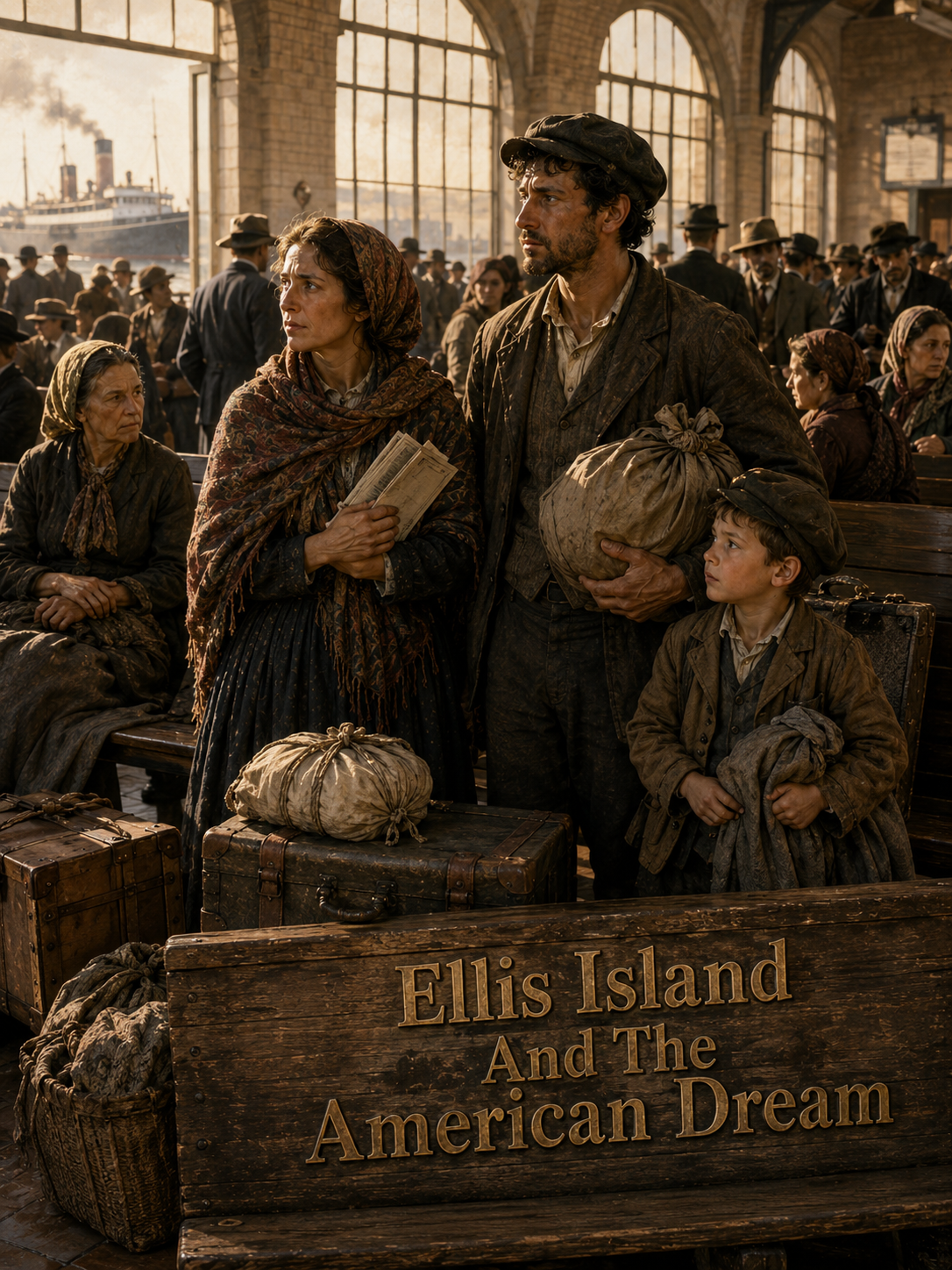
They Crossed With Hope
For millions of immigrants, America began before they ever saw its shoreline.
It began as a story, a rumor, a letter, a possibility, a promise spoken across kitchen tables and crowded rooms far from the United States. Some came seeking work. Some came seeking safety. Some came fleeing poverty, persecution, hunger, violence, or closed futures.
Many came because they believed their children might inherit opportunities they themselves had never been allowed to hold.
The journey was not easy.
Families left behind homes, languages, graves, neighbors, customs, and familiar streets. They carried trunks, bundles, documents, religious objects, family keepsakes, and memories too heavy to pack.
Some arrived with confidence.
Others arrived with fear.
Most carried both.
Immigration is often described as movement, but for the people living it, it was sacrifice.
To cross an ocean was to step away from the world that had shaped them and trust that an unknown future might become worth the cost.
Ellis Island Became A Doorway
Ellis Island became one of the most powerful symbols of new beginnings in American history because so many lives passed through it with trembling hope.
For countless families, it was not merely a place of inspection.
It was the threshold between what had been and what might become.
The first sight of America could stir awe, relief, anxiety, and confusion all at once. People stood in lines, answered questions, waited for decisions, and tried to understand instructions in unfamiliar languages.
A family might be only one official judgment away from entering the country or facing separation, delay, or return.
Yet beyond the fear was possibility.
To pass through Ellis Island meant stepping into a nation already changing rapidly through industry, cities, labor, and diversity. America was not simple, and it was not always welcoming. But to millions, it still represented a chance history had not given them elsewhere.
The doorway did not promise ease.
It promised a beginning.
New Communities Took Root
Immigrant families reshaped American cities from the inside.
Neighborhoods filled with new languages, foods, songs, prayers, trades, customs, and ways of seeing the world. Churches, synagogues, schools, markets, bakeries, workshops, mutual-aid societies, and family businesses formed around people trying to survive together in unfamiliar streets.
These communities became anchors.
They helped new arrivals find work, translate the city, preserve faith, protect traditions, and endure loneliness. Older generations often held tightly to the world they had left, while younger generations learned American streets, schools, slang, and customs more quickly.
Inside many homes, two worlds lived at the same table.
Immigrant labor helped build railroads, factories, bridges, mines, shops, homes, clothing industries, and expanding cities. Their work became part of the country’s foundation, even when their names were not remembered.
America was becoming a nation shaped not by one background alone, but by many ordinary families carrying culture, labor, memory, and hope into the same future.
Hardship And Opportunity Walked Together
The American Dream did not arrive evenly.
Many immigrant families faced overcrowded housing, exhausting factory labor, dangerous work, low wages, discrimination, and suspicion from people who feared the changes immigration brought. Children sometimes worked because families needed every possible income.
Parents labored long hours in places where language barriers made them vulnerable and poverty left little room for mistake.
Hope did not remove hardship.
It often had to live inside hardship.
That is what makes the immigrant story so powerful. Many families continued forward not because America was easy, but because they believed difficulty here might still lead somewhere.
A cramped room, a dangerous job, or a long day could be endured if it helped a child stay in school, learn English, earn a trade, open a shop, or live freer than the generation before.
People throughout history have carried suffering for the sake of future generations.
At Ellis Island and beyond, that ancient human pattern entered the American story by the millions.
Families Carried The Dream Forward
The American Dream was often carried by parents who might never fully receive it for themselves.
They worked, saved, translated, endured, adapted, and sacrificed so that their children might stand differently in the world. A mother might clean homes or sew garments late into the night. A father might work in a factory, rail yard, dock, mine, street market, or shop.
Grandparents might preserve memory while children learned the new country’s ways.
Family became the emotional anchor.
In a strange land, family held identity together. Around tables, in crowded rooms, through worship, meals, stories, discipline, and work, immigrant families carried both old-world inheritance and new-world possibility.
This was not always peaceful.
Generations sometimes misunderstood one another. Children adapted faster than parents. Traditions changed. Names changed. Languages faded.
But beneath the strain was a deep human desire:
to give the next generation a life with more room in it.
The dream survived because ordinary people kept feeding it with sacrifice.
America Became More Than One Story
As millions arrived, America’s identity continued changing.
The nation became more culturally diverse, more crowded, more energetic, more conflicted, and more complex. Debates grew over what it truly meant to become American.
Some welcomed new arrivals as part of the country’s strength.
Others feared difference, resisted change, or treated immigrants as outsiders even while depending on their labor.
That tension did not disappear.
It became part of the American story.
But the deeper truth remains: ordinary families helped build the nation quietly. They did it through work, faith, endurance, neighborhood, food, language, culture, courage, and children.
They brought memories from other lands and planted them in American soil.
They changed the country, and the country changed them.
Ellis Island and the American Dream remind us that hope often arrives tired, poor, uncertain, and carrying a bundle.
It does not always look powerful at first.
Sometimes it looks like a family stepping off a ship, afraid and exhausted, believing that somewhere ahead, a child they love may finally live freer.
From here, labor movements, economic inequality, and social reform challenge the harsh realities of industrial America.
Ordinary workers will demand dignity within a rapidly changing economy, and America will be forced to ask whether opportunity can remain meaningful when so many of the people building the nation are still struggling to stand securely inside it.